
In Memoriam
Cowasjee's credo
Died: Noshirwan Cowasjee, 88, businessman and philanthropist, in London on May 22, 2002.
"This unique Zarathushti had a particular soft spot for those who suffered ill-health, (requiring) expensive specialist medical or surgical treatment available only in western countries. He made it his life goal to raise a substantial corpus for the WZO (World ZoroastrianOrganisation) Medical Benevolent Fund... to enable (innumerable needy) Zarathushtis to receive such treatment and have a fighting chance to live,” noted Shahpur Captain, founder president and currently a member of the board of the WZO, in its quarterly journal Hamazor (2002 # 3). In his single-minded drive to achieve the constantly increasing targets he set himself he printed and sold a book on the life of Dadabhai Naoroji at his own expense and added his own munificent amounts — always anonymously — to donations from other like-minded people. By his "sole and singular efforts” Cowasjee had created a corpus of £ 223,230 ere he passed away.
"A very shy and private man”, as his daughter Toxy Cowasjee, social worker and Hamazor editor, described him, Cowasjee stubbornly opposed any recognition for his services. So when the WZO’s International Board decided to honor him at the Organisation’s 20th anniversary celebrations at St. James Court Hotel on September 13, 2000 along with 12 other Zoroastrians from around the world, they had to go to "extraordinary lengths” to keep the information confidential as "the slightest whiff of it would have resulted in his not attending the function,” wrote Captain.
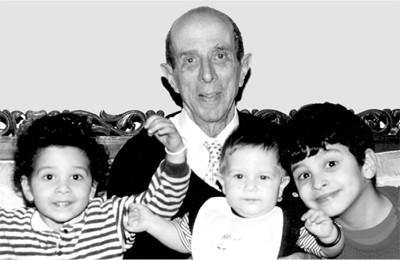
Cowasji with great grandchildren (from left): Nina Anklesaria, Sohrab Anklesaria and Cyrus Cowasjee
Though small and frail of body, the then septuagenarian’s tenacity and determination were deployed to telling effect when he opposed the Zoroastrian Trust Funds of Europe’s decision in 1985 to exclude non-Zoroastrian spouses from the muktad prayers and Fravardigan jashan. Ever since these prayers were initiated at the ZTFE under the benign stewardship of the late Dastur (Dr) Sohrab Kutar 30 years earlier non-Zoroastrian spouses had been welcome to attend. When the ZTFE committee refused Cowasjee’s repeated and reasoned requests, he instituted a separate ceremony at Brookwood Cemetery in 1986 to ensure these individuals’ "right of worship” for their deceased family members. The annual event continued over the years with Cowasjee not only organizing the prayers at his own cost, but providing and serving refreshments to over 200 Zarathushtis and their spouses who attended, related Captain.
The youngest of Karachi based Fakirjee and Aimai Cowasjee’s two daughters and three sons, he schooled at the B.V.S. Parsi High School and St. Patrick’s. For the major part of his life Cowasjee’s day started with a bath at 5 a.m. Then he would be fully dressed with a tie — except in summer — until he was ready for bed. He loved his work and he "worked relentlessly,” remembers Toxy.
Well known on the Indian subcontinent for his exploits in the field of marine salvage, Cowasjee had featured until recently in the Guinness Book of Records and had won a high award for saving the m. v. Toledo which had grounded on Karachi’s Clifton Beach, noted Captain. Noshirwan and his elder brother Russi had inherited their father’s stevedoring business in 1939. They supported the British Navy during World War II, converting merchant ships into troop carriers, wrote WZO chairman Rumi Sethna in Hamazor (2002 # 2). After the war they branched into selling and servicing American cars. Their showroom sported the first car turntable on the Indian subcontinent, related Captain.
Migrating to the UK in 1957, Cowasjee set up salvaging ships and a few years later took over the management of two passenger ferries in Jersey — The Duchess of Normandy and The Duchess of Bretagne that plied between the Channel Islands, Southampton and France. He started the first passenger car drive-on drive-off ferry service between the Channel Islands and France with The Duchess of Normandy in 1964. Whilst docked in Jersey harbor, the ship was used for dancing sessions, recalled Captain. Two years later he expanded the service by buying The Duchess of Bretagne, getting her refurbished to his specifications in Antwerp and deploying her between the Channel Islands, St Malo and Cherbourg in France, Weymouth and Torquay — the first time Torquay had ever been used as a ferry port. The Duchess of Bretagne boasted a casino, a bureau de change and a duty-free shop, Captain described the entrepreneurs’s initiative and vision.
When competition became too severe the workaholic started a small business in 1969 and retired voluntarily in 1975, "dedicating his life wholly” to his beloved wife Villie whose illness required him by her side. "A man who only knew how to make tea and toast, taught himself to cook when my mother no longer could. Let alone cook for two, he used to invite 30 to 40 people at least four times a year for dinner, making everything himself and washing up after everyone left,” noted Toxy. "His two daughters, four grandchildren and four great-grandchildren were his other loves. To him the family came first, and that meant the full family, his siblings, their children, cousins, etc. Nothing gave him more pleasure than to do something for all of us.”
"Loving and generous beyond bounds,” as Toxy remembers him, he was "a real sucker for any sop-story.” His love for children in general led him to carry around and offer chocolates to all the little passers-by. In later years his friends and family tried to stop him for fear of this gentle soul being implicated for child abuse in an increasingly paranoid world.
Excursions to Holland to enjoy oysters, to Paris for bouillabaisse, to Monte Carlo for a bash at the casino, ("If he lost, that was it; if he won, he gave all the money away including what he started off with”) football in the park with his great-grandchildren... created archives of happy memories for his family.
When Villie died and was buried in Brookwood beside his father and grandfather, it became a ritual and an anchor for him to visit her and "talk to her” every month. "(He went) by train, irrespective of the weather. The walk from the station to the Zoroastrian cemetery is quite a distance even for a young person let alone an octogenarian, but this never deterred him,” noted Toxy. And he wrote Villie’s name along with his own in all his personal mail.
The man who had "thrived in adverse conditions” all his life, transmuted his great personal loss into an opportunity to work for others with major medical problems and the WZO Medical Benevolent Fund, now renamed the Noshirwan F. Cowasjee Medical Benevolent Fund, became the focus of his time, energy and determination. As did other non-sectarian charities that he also served, with gracious humility and self deprecating humor.
Cowasjee is survived by his daughters Toxy Cowasjee and Khurshid Bamboat.
Arnavaz S. Mama
◆ ◆ ◆
From the archive