
Cover Story
“Blood on our hands”
Having witnessed atrocities on the Gaza Strip, two US surgeons urge Americans to protest against the government funding of the genocide
"As humanitarian surgeons we thought we had seen all manner of cruelty in the world, but neither one of us has ever experienced anything like what we found when we arrived in Gaza,” noted a joint statement by trauma surgeon Dr Feroze Sidhwa and orthopedic surgeon Dr Mark Perlmutter dated April 11, 2024. Their experience was carried by Common Dreams, an independent, online news outlet. While Sidhwa is a trauma, critical care and acute care surgeon at San Joaquin General Hospital in Stockton, California, Perlmutter, who specializes in hand surgery, is president of the World Surgical Foundation and past president of the US Section of the International College of Surgeons.
"As humanitarian trauma surgeons we have both seen incredible suffering. Collectively, we were present at Ground Zero (the New York Twin Towers collapse) on 9/11, Hurricane Katrina, the Boston Marathon bombing, and the 2010 earthquake in Haiti on the first day of these disasters. We have worked in the deprivation of southern Zimbabwe and the horrors of the war in Ukraine. Together we have worked on more than 40 surgical missions in developing countries on three continents in our combined 57 years of volunteering. This long experience taught us that there was no greater pain as a humanitarian surgeon than being unable to provide needed care to a patient,” they wrote.
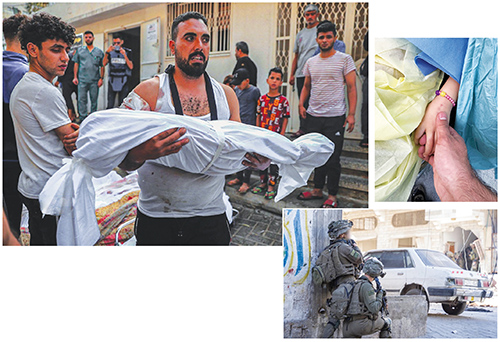
Clockwise from top l: death of a Palestinian child Photo: Wikipedia, Fars Media Corporation;
giving succor to a victim; at an alley in Khan Younis Photo: Wikipedia;
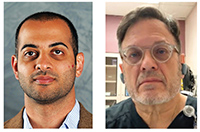
Drs Feroze Sidhwa (far l) and Mark Perlmutter
Witnessing massacre on the Gaza Strip during the fortnight that they worked at the Gaza European Hospital in Khan Younis, they were distraught that "the blood on the floor of the trauma bay and the operating room is dripping from our own hands. We Americans provide the crucial funding, weapons, and diplomatic support for a genocidal assault on a helpless population.” They described the "horrifying violence deliberately directed at civilians and even children: a three-year-old boy shot in the head, a 12-year-old girl shot through the chest, an ICU (Intensive Care Unit) nurse shot through the abdomen, all by some of the best-trained marksmen in the world…”
They pointed out that the timing of the horrific cluster bombs "always coincided with iftar, when families in this overwhelmingly Muslim country broke the daily fast of Ramadan and were most vulnerable… Incredibly powerful explosives ripped apart rock, floors and walls, and threw them through human bodies, penetrating skin with waves of dirt and debris” making infection control impossible for the medicos.
At the Gaza European Hospital, one of the last remaining semi-functional hospitals for the 2.5 million human beings in the Gaza Strip, "every square inch of the Hospital’s floor is taken up with makeshift tents where displaced families live, desperate to find some semblance of safety. They are the lucky several hundred who get to live indoors, unlike the tens of thousands sheltering outside on the hospital’s grounds.” The duo admitted that amidst bombings every 30 seconds or so they and their team feared for their own safety and appealed to the US embassy and Congressmen for protection but their plea fell on deaf ears.
In a podcast on Democracy Now!, one of the leading US-based independent daily news broadcasts in the world, a day after they returned to the US, Sidhwa expressed his admiration for the dedicated staff at the Hospital who were functioning despite limited infrastructure, sans sanitation and hygiene, and no salaries being paid to them for the last six months. He commented on the Palestinians attempting "to maintain their dignity and humanity even in such horrifying circumstances; staying in family units, observing their Ramadan fasts when they were so hungry, maintaining their belief that the future can be better.”
Knowing that "the media is being sterilized… that the tax payers are paying for these bombs,” the surgeons want to create an awakening. Urged Sidhwa, "Go to your houses of worship, go to your community centers… demand a meeting with a Congressman… Do anything you can to embarrass these people and to make it obvious to the world that they are not acting with normal human decency. They are acting with purely cold, almost Mafia -like political calculations.”
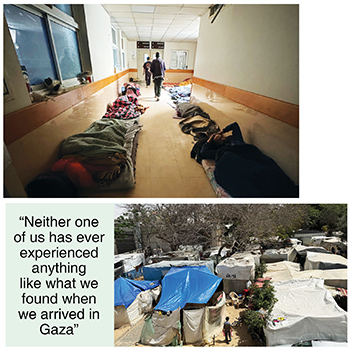
Refugees inside the Gaza European Hospital and in the compound
Photos: Dr Feroze Sidhwa
While Sidhwa spends approximately 80 hours per week on his duties as a surgeon and as general surgery residency program director at San Joaquin General Hospital, he devotes his "free time working abroad in Ukraine and Gaza.” The 42-year-old doctor regrets that he does not have time to be involved with Zoroastrian community associations in his area. Living in Lathrop in central California, "the closest Parsi communities to me are in Sacramento and the San Francisco Bay Area which are 60 to 90 minutes away,” stated the surgeon when responding to queries from Parsiana. We were able to reach Feroze thanks to the intervention of Houstonians Ervad Kayomarz Sidhwa, Arnavaz Sethna and Feroze’s parents Shahnaz and Dr Yazdi.
Feroze believes that "Zoroastrians in the US can contribute to the resolution of the Israel-Palestine conflict the same way every other American can: by calling on their government to stop funding and arming Israel until it stops the genocidal assault on Gaza and negotiates an end to the conflict.” He further reminds his co-religionists, "We are very blessed.” With many in the community being wealthy he recommends, "We can and should use our wallets to try to help the victims. Donating money to UNRWA (United Nations Relief and Works Agency), the organization that feeds and cares for 80% of Palestinians in Gaza, is a good way. And it’s tax deductible, which is always nice.”
Born and educated in the US, Sidhwa graduated from the University of Texas Health Sciences Center at San Antonio Long School of Medicine in 2011. "I went to medical school thinking I would be an anesthesiologist or a pediatrician, but when I did my surgery rotation I fell in love with it,” he recalled. The medico then decided he would become a pediatric surgeon but during his residency the Boston Marathon bombing occurred which made him realize he found trauma and surgical critical care more fulfilling. He thus earned his board certification in general surgery, surgical critical care and neurocritical care.
Feroze acknowledges that his parents (originally from Pakistan), "shaped my values. They rarely talked about a duty to help others; instead they taught by example. My dad was a physician in a very poor town in the US named Flint in the state of Michigan. He provided services to anyone who needed them regardless of whether or not they could pay him or had insurance. My mom was a school teacher and went out of her way to help children however she could.” He also acquired from them "a love for books and learning, and a love for truth, regardless of where it leads you.”
◆ ◆ ◆
From the archive