
Zoroastrians Abroad
Bounty for bullae
To preserve and document a database of 824 Sasanian clay bullae (lumps of clay used for sealing documents and packages), Prof Almut Hintze received a grant of £ 999,998 (Rs 9,93,80,558) from the UK Arts and Humanities Research Council (AHRC), noted an email from Malcolm Deboo, president of the Zoroastrian Trust Funds of Europe. The project is titled "Beyond Discovery: Religion, economics and administration in Sasanian Iran through new clay bullae from Taxt-e Solayman (Throne of Solomon).”
Hintze is the Zartoshty Brothers Professor of Zoroastrianism in the Department of Religions and Philosophies at the School of Oriental and African Studies (SOAS), London University. She will be assisted in this project by Dr Yousef Moradi, researcher in the Department of Religions and Philosophies, who was responsible for excavating these bullae in 2002-2008 at the world heritage site of Taxt-e Solayman located in the province of western Azerbaijan.
Hintze is the Zartoshty Brothers Professor of Zoroastrianism in the Department of Religions and Philosophies at the School of Oriental and African Studies (SOAS), London University. She will be assisted in this project by Dr Yousef Moradi, researcher in the Department of Religions and Philosophies, who was responsible for excavating these bullae in 2002-2008 at the world heritage site of Taxt-e Solayman located in the province of western Azerbaijan.
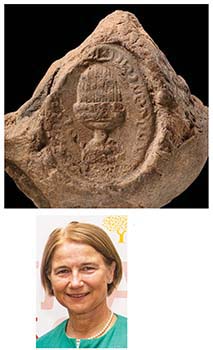
Top: bulla depicting fire and urn; above: Prof Almut Hintze
Nearly 2,000 seals were pressed into the soft clay "to prove the authenticity of the document or package. Widely used in Sasanian Iran (224-651 CE), the imagery and inscriptions provide valuable insights into the economy and religion of the time,” noted the press release.
To understand the origin, diffusion and meaning of the imagery, Hintze and Moradi will categorize and interpret the sealings via technologies of 3D imaging, computer vision and artificial intelligence. Further, analysis of the bullae’s chemical composition will determine if the clay of a bulla comes from a sole source or from various locations. They will also investigate and reconstruct the process which created bullae by transforming a lump of clay into a culturally meaningful and functional object bearing legal force.
"This work would not be possible without the support of the AHRC, SOAS, and the Iranian Center for Archaeological Research. We are most grateful to these institutions and we will do our best to honor the trust they have put in us to present this collection of seal impressions to the public,” declared Hintze.
The project will draw to a close with two exhibitions, one in the Museum of Urmia in Azerbaijan where the bullae are kept, and one at the Brunei Gallery at SOAS in 2028. Results will be disseminated in print as articles and as a two-volume book to be published in the series Corpus Inscriptionum Iranicarum covering sealing practices, inscriptions, iconography and providing a full descriptive catalog with plates. An electronic data set published online with metadata will provide photographs and line drawings of all 824 bullae and 3D models.
◆ ◆ ◆
From the archive