
Books
Exploring relationships
After a two-year hiatus The K. R. Cama Oriental Institute (KRCOI) on November 30, 2022 held its first in-person event, the launch of Farrokh Suntook’s novel The People We Know (see "Fate and family dynamics,” Books, Parsiana, September 21-October 6, 2022).
London-based Suntook who has been in marketing research and consultancy read passages from his book having a conventional narrative, evoking the atmosphere as with a paint brush. The plot emerged in Suntook’s mind after reading an article delineating a bizarre occurrence. He shared that he had a clear picture of the ending from this article and worked backwards. He didn’t have a game plan, he admitted; the characters and the plot emerged organically. He was picky about selecting the mot juste (right word). Aided by the vast vocabulary of wife Maneck, Farrokh wrote three drafts. He was also helped by friends; Dr Firdaus Gandevia had vetted a draft.
London-based Suntook who has been in marketing research and consultancy read passages from his book having a conventional narrative, evoking the atmosphere as with a paint brush. The plot emerged in Suntook’s mind after reading an article delineating a bizarre occurrence. He shared that he had a clear picture of the ending from this article and worked backwards. He didn’t have a game plan, he admitted; the characters and the plot emerged organically. He was picky about selecting the mot juste (right word). Aided by the vast vocabulary of wife Maneck, Farrokh wrote three drafts. He was also helped by friends; Dr Firdaus Gandevia had vetted a draft.
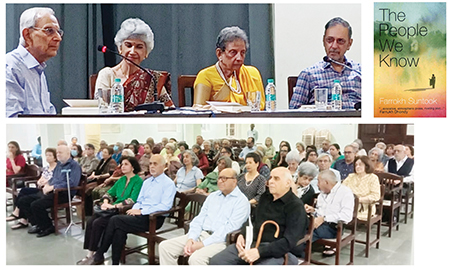
Top, from l: Farrokh Suntook, Drs Shireen Vakil, Nawaz Mody
and Firdaus Gandavia; above: audience at the launch
The evening’s moderator Dr Shireen Vakil brought the audience up-to-date by giving a brief summary of the plot. Gandevia, closely associated with KRCOI and Suntook, provided the closing remarks and vote of thanks. A welcome address was given by senior KRCOI trustee Dr Nawaz Mody.
The main themes of the book are "relationships, especially love and chance or otherworldliness.” The writer condoned people who withhold personal happenings for fear of social non acceptance and prejudice. He asked the audience a rhetorical question: "Do we become judgmental when we find out the foibles in close relationships?” The author came out strongly against misogyny, racial and religious intolerance as well as the partial treatment extended to male siblings as versus female.
The main protagonist, Sheela, was not in control of what she finds out about her husband Cyrus, or the Australian couple who intrude on her plan to commit suicide. There is also reference to a mystical happening between Sheela and her deceased husband.
On being asked about the autobiographical element in the book, Farrokh denied this, explaining that though there are incidents or attributes of character from some whom he knew, he has replicated no one from his life. He vividly shared the incident of how as a young boy he heard the strains of Frederick Chopin’s C minor waltz his sister was playing and how he replicated the visceral response when a character hears this Chopin piece.
Writing the book took him longer than he had envisaged, Farrokh said, as he is in the habit of substituting words as he re-reads his writing. A self-proclaimed worshipper of British author Jane Austen, Farrokh referred to the "westernization” of most people in the audience and how his plot is based on his life and tolerance of behavior. He was urged to write more novels, judging from how popular the reading of this one has become.
MEHROO KOTVAL
◆ ◆ ◆
From the archive