
Books
The Gimi who gave
Though Rusi Gimi was a pioneer in outdoor advertising, his heart lay in philanthropic endeavors
Edited excerpts from Rusi B. Gimi by Prochy Noomi Mehta, edited by Tehnaz Bahadurji and published by Selvel One, reprinted here with permission from the author.
In 1945 my father Rusi Gimi, Soli Nicholson, and two other partners started Selvel Syndicate. The other two dropped out early and Rusi and Soli were left to carry on the endeavor. When Soli passed away in 1967 at a young age of a sudden heart attack, the business was amicably divided territory-wise with Soli’s wife Gul. She was given the first pick, and Rusi accepted whatever was left, which comprised North and East India.
Rusi was a pioneer in outdoor advertising (OA). The classic 20x10 ft hoarding board was his innovation, as was the two-iron pillar format. OA was not looked upon favorably as a profession in the early 1950s. His father-in-law was not very impressed with his chosen profession, nor was his stationery printer Kanai Lal Dey Niyogi. In fact, the printer insisted on a personal guarantee from Rusi’s father-in-law before taking the first print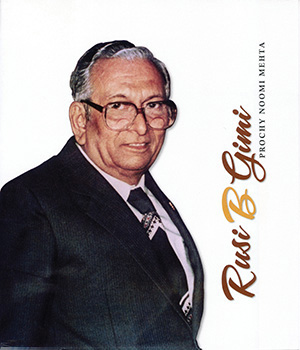 ing order. A time would come when this same man would be so convinced of the solidity of Rusi’s business that he insisted on two of his sons being given employment there.
That Rusi was a novice in this field was very apparent to all. Luckily, he had godfathers who showed him the way. When he went to make his first sale the client quietly listened to his sale pitch, then asked the cost. Rusi had not really thought about this and mentioned a sum, thinking that should be okay for a year. The client, evidently a kindhearted man, realized that he was dealing with a rookie and instead of taking advantage asked nonchalantly, "Oh, for a month?” Realizing his mistake Rusi quickly nodded his head. Then, generously, the client added, "and painting and construction cost will be extra.” That is when Rusi realized he had not done his homework and how lucky he had been to have found a savior.
After Rusi married my mom Zarin and settled in Calcutta, they conducted their office affairs out of a rented flat in Park Circus. Zarin was his primary pillar of support. Rusi was the public face of Selvel. He met the clients, the site landlords and did all the outdoor work. But Zarin was the backbone of the fledgling company. She did the paperwork, administration, correspondence and filing. She answered the phone and, learning from the bucket factory days, managed the finances. She dealt with the painters and construction workers, assigned tasks, ensured on time delivery and scrutinized the petty cash accounts. And she still had time to cook, clean, make jams and pickles, supervise our studies, and stay in close touch with family and friends, always checking to ascertain who needed a helping hand.
Rusi was a pioneer in outdoor advertising (OA). The classic 20x10 ft hoarding board was his innovation, as was the two-iron pillar format. OA was not looked upon favorably as a profession in the early 1950s. His father-in-law was not very impressed with his chosen profession, nor was his stationery printer Kanai Lal Dey Niyogi. In fact, the printer insisted on a personal guarantee from Rusi’s father-in-law before taking the first print
ing order. A time would come when this same man would be so convinced of the solidity of Rusi’s business that he insisted on two of his sons being given employment there. That Rusi was a novice in this field was very apparent to all. Luckily, he had godfathers who showed him the way. When he went to make his first sale the client quietly listened to his sale pitch, then asked the cost. Rusi had not really thought about this and mentioned a sum, thinking that should be okay for a year. The client, evidently a kindhearted man, realized that he was dealing with a rookie and instead of taking advantage asked nonchalantly, "Oh, for a month?” Realizing his mistake Rusi quickly nodded his head. Then, generously, the client added, "and painting and construction cost will be extra.” That is when Rusi realized he had not done his homework and how lucky he had been to have found a savior.
After Rusi married my mom Zarin and settled in Calcutta, they conducted their office affairs out of a rented flat in Park Circus. Zarin was his primary pillar of support. Rusi was the public face of Selvel. He met the clients, the site landlords and did all the outdoor work. But Zarin was the backbone of the fledgling company. She did the paperwork, administration, correspondence and filing. She answered the phone and, learning from the bucket factory days, managed the finances. She dealt with the painters and construction workers, assigned tasks, ensured on time delivery and scrutinized the petty cash accounts. And she still had time to cook, clean, make jams and pickles, supervise our studies, and stay in close touch with family and friends, always checking to ascertain who needed a helping hand.
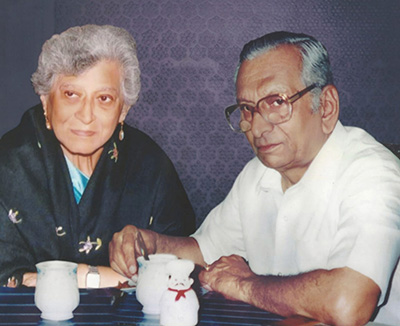
Zarin and Rusi
At first the office comprised only three people — Rusi, his partner and office assistant Zarin, and a peon who would deliver letters on a cycle which was the official office vehicle. Rusi wanted OA to be respected and given its rightful place in the advertising world. He would put on his suit and travel by tram to his client’s office, since that was the only transport he could afford. The suit helped him project OA as a high-class business, one that clients should definitely include in their advertising plans. Since no one saw how he commuted, the suit sent out a forceful message of prosperity and style.
As the business grew, the office, which had started in the living room of the flat, swallowed up the dining room and even the children’s room during the day. I recall coming back from school and sitting at the dining table to do my homework, together with the office staff. One of them would double as my Bengali teacher, and dad was always there to explain anything else. Like dad, I had a wicked streak in me, and I am always reminded of how I removed all the gem clips from the office papers to make a chain which I used as a skipping rope. The office staff spent hours reorganizing and settling the mess I left behind.
Selvel is now a legendary name in OA. Its success lured others into the profession, and Rusi organized these new entrants into a well-knit body, the Outdoor Advertising Association (OAA), which he guided for seven years as its president.
The demands of the office finally outgrew the home and Zarin convinced Rusi to buy a property, somewhat out of town, which was all they could afford. That was in Alipur, today a highly developed part of the city. They built a grand three-storey building there in 1967, Selvel House, with the office on the ground floor and the residence on the first floor. We no longer had to share our study space with the office staff, but they were still close enough for us to raid pencils, rulers, erasers from their desks throughout our school lives.
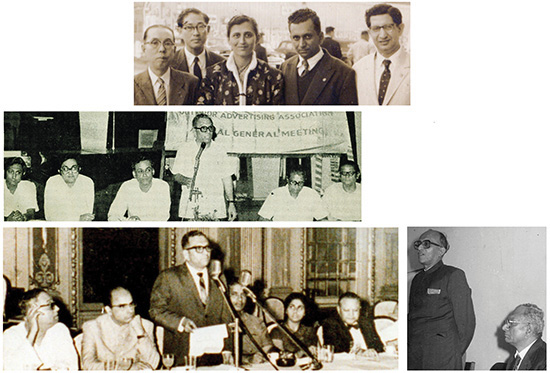
Top row: Zarin and Rusi Gimi, and Soli Nicholson (3rd, 4th, 5th from l) with Japanese peers;
2nd row: Rusi addressing Outdoor Advertising Association;
3rd row: Inder Gujral and Rusi (2nd and 3rd from l) at Advertising Club meeting; Calcutta mayor Kamal Basu with Rusi
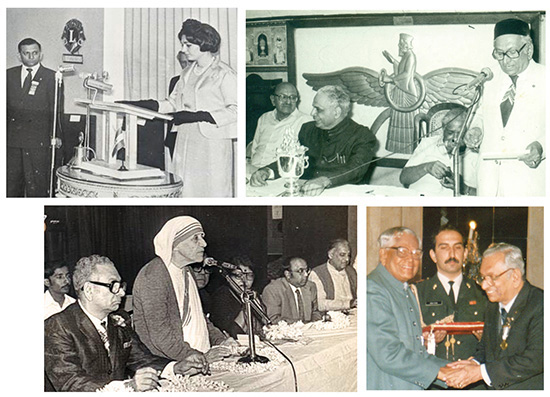
Clockwise, from top l: Gimi felicitated by Shahbanou Farah Pahlavi;
addressing Sikkim governor Homi Taleyarkhan (in dark coat);
Gimi with then President of India R. Venkataraman; with Mother Teresa
Till the 1980s, all hoardings were hand painted. The client would give a design which would be drawn onto paper the size of the board. Then a stencil would be cut. This would be taken to the site and the basic outline of the design marked out. Now the actual painting work began. We have all struggled through art classes, learning perspective. But imagine balancing on a bamboo structure 20 ft above the ground and painting a hoarding. Using the stencil and the picture, they had to paint a huge hoarding, sometimes 20x10 ft, sometimes larger, and do it with perfect proportion. They could not step back to get a clear view, as they would fall off the scaffolding. There was no such thing as a safety harness. It was a difficult task indeed, but hundreds of billboards were hand painted exactly like this all over India. Some of the more skilled artists painted free hand, without a stencil. The mind just boggles at how they managed the proportions with the board hardly a foot away from their nose. Junior artists filled in the outlines and learnt this unique skill on the job. Maqbool Fida (M. F.) Hussain, the globally acclaimed artist, started his life as a billboard painter and yes, he had painted many of Rusi’s billboards.
Selvel soon became synonymous with OA. If the advertising message was outdoors, it had to be Selvel. Rusi once ran a teaser campaign at the zoo where he put up some billboards. The first board asked, "What did the monkey say to the lion?” And a little ahead the second one said "Selvel, of course.” Every day the office would receive hundreds of phone calls from people. They would say, "What did the monkey say to the lion? Selvel, of course,” and quickly put the phone down.
At the start of his advertising career, Rusi had to face immense discrimination. He was a member of the Advertising Club Calcutta which would hold its meetings at Firpo’s, the most stylish restaurant in Calcutta. No colored people were allowed into Firpo’s and he was automatically sidelined at Advertising Club events. In a reversal of fortune, in 1973 he was unanimously elected president of the very same body. Overcoming obstacles slowly but surely became second nature to him. A humble boy from a small town in rural India who could not even speak English properly became the president of an association which had once looked down on Indians. He helped to change that ethos so that Indians were treated with respect in their own country. He was inducted into the Hall of Fame of the Advertising Club. He was also founder member of the Public Relations Society of India. Highly respected and revered, his was the quintessential story of going from being a nobody to a somebody. He traversed that journey with effort, innovativeness, and a never-say-die attitude.
In 1980, at the annual general meeting of the OAA, he spoke about the changes that had come about in OA: "During the seven years since the founding of the OAA, many changes have taken place in the outdoor medium. The authorities have begun to take note of our work. Advertisers have come to appreciate the medium’s effectiveness and potential. Several leading advertisers have used it ingeniously on many occasions.
"Many local charitable causes have sought, and received from OAA, effective publicity and support for their fundraising efforts. I dare say, the outdoor medium can promote anything from packaged goods to political candidates and from Ashoka’s Edicts to matrimonial alliances. I do hope OA will also establish an intra-medium code of conduct and camaraderie as successfully as it has established its raison d’etre and effectiveness in the world of modern advertising.”
Though Rusi had risen to relevance in the world of OA, built a reputed company providing excellent service to clients, and earned good money, he was still unfulfilled. He became actively involved in Lionism, a worldwide philanthropic network. In fact, Rusi gave credit to this organization for teaching him many skills. He found more personal satisfaction in serving the needy, spending his time, money and energies there, rather than in earning money for himself.
So, in the last 20 years of his life, he handed over his business altogether to his three sons-in-law — Rustom Daroga, Noomi Mehta and Darius Bahadurji. He devoted himself entirely to social work. He was a prolific writer and wrote newsletters and monthly bulletins for various organizations: the Blind School, the Bhoruka Blood Bank, St Johns Ambulance Association and the Lions Club, among many others. He would start the day doing a few minutes of yoga sitting on the carpet in the early morning rays of the sun. Then he would be at work.
◆ ◆ ◆
From the archive