
Sports
Busting cricket myths
Did Charlie chuck? Unraveling the facts about Test cricketer Nari Contractor’s near fatal head injury in the West Indies
Extract from the book Myth-Busting: Indian Cricket Behind the Headlines by Gulu Ezekiel is reproduced with permission from Rupa Publications.
March 17, 1962 was one of the darkest days in the history of Indian sport. On this day India’s cricket captain, Nariman ‘Nari’ Jamshedji Contractor was struck on the head by the infamous fast bowler Charlie Griffith in the match against Barbados at Kensington Oval, Bridgetown and the world held its breath in collective agony as he hovered between life and death for five excruciating days.
Contractor was 28 at the time and was halfway through the tour of West Indies which a demoralized and devastated Indian team would eventually lose 5-0. That Contractor is still with us well into his 80s means the cricket gods must have smiled on him for as he told me in an interview for bbc.com on the 40th anniversary of the incident in 2002 ("40 Years After Bridgetown,” March 17, 2002) the "concussion of the brain” that he suffered was back then considered 99% fatal.
It is no wonder the first thought that struck Datta Gaekwad when he was hit by Michael Holding at Sabina Park 14 years later was the Contractor incident. It took years for the trauma to heal even though Contractor made a full and miraculous recovery. This was largely due to the round-the-clock care by manager and former captain Ghulam Ahmed, one of the finest gentlemen Indian cricket has produced.
So what are the myths surrounding this near-tragedy? Quite simply it is the kind of delivery that Griffith delivered that fateful day and how Contractor dealt with it.
March 17, 1962 was one of the darkest days in the history of Indian sport. On this day India’s cricket captain, Nariman ‘Nari’ Jamshedji Contractor was struck on the head by the infamous fast bowler Charlie Griffith in the match against Barbados at Kensington Oval, Bridgetown and the world held its breath in collective agony as he hovered between life and death for five excruciating days.
Contractor was 28 at the time and was halfway through the tour of West Indies which a demoralized and devastated Indian team would eventually lose 5-0. That Contractor is still with us well into his 80s means the cricket gods must have smiled on him for as he told me in an interview for bbc.com on the 40th anniversary of the incident in 2002 ("40 Years After Bridgetown,” March 17, 2002) the "concussion of the brain” that he suffered was back then considered 99% fatal.
It is no wonder the first thought that struck Datta Gaekwad when he was hit by Michael Holding at Sabina Park 14 years later was the Contractor incident. It took years for the trauma to heal even though Contractor made a full and miraculous recovery. This was largely due to the round-the-clock care by manager and former captain Ghulam Ahmed, one of the finest gentlemen Indian cricket has produced.
So what are the myths surrounding this near-tragedy? Quite simply it is the kind of delivery that Griffith delivered that fateful day and how Contractor dealt with it.
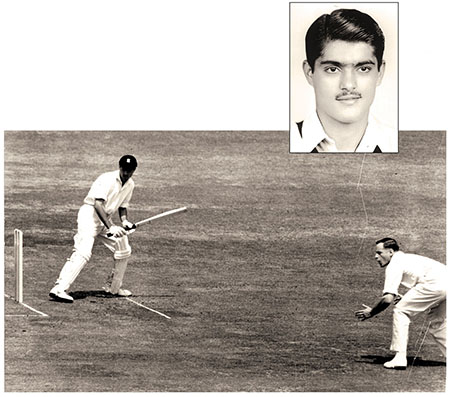
Above: Nari Contractor batting and inset
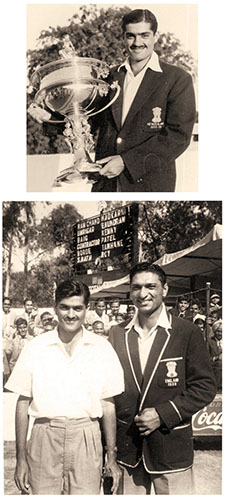
Top: Contractor holding the Rohinton Baria Trophy, 1953;
above: with Polly Umrigar (r)
Most West Indians have over the years tried to explain it away as the batsman ducking under what he thought was a bouncer but which was not. The only available photo of the incident indeed shows Contractor squatting, almost on his haunches, supported by his bat with wicket keeper David Allan, bowler Griffith and the two slips looking on concerned.
In My Autobiography, Garry Sobers states: "Nari Contractor was hit while playing for India against Barbados when he ducked into a ball that didn’t get up from Charlie Griffith. Charlie was going to appeal for leg before wicket but I stopped him as I could see that Contractor was in serious trouble and, in fact, nearly died.”
However in the book Fire in Babylon it is written: "He (wicket keeper David Murray) …had seen Nari Contractor hit by that infamous Charlie Griffith bouncer in 1962. ‘Just a schoolboy but still I hear the conk of the ball on his head.’”
Murray, born in 1950, played 19 Tests and 10 ODIs (One Day International) for West Indies from 1973 to 1982.
It appears that the Barbados players decided to stick to the line that the Griffith delivery was harmless and that Contractor ducked into and thus the bowler was not to blame. This is strongly refuted by Mansur Ali Khan Pataudi who was vice captain to Contractor on the tour till he was thrust into the captaincy following the incident. In his 1969 autobiography Tiger’s Tale he wrote: "Nari Contractor received a ball from Griffith which was short of a length, and it rose very abruptly. Nari had no time to play any sort of shot, but at the last moment hunched his shoulders. Even from the distance of the dressing room we could hear the sickening thud as the ball struck his head.
"It was a delivery which has since been the subject of much discussion. One suggestion is that the ball did not, in fact, rise above stump height. As an eye-witness from reasonably close range I can dismiss this as completely inaccurate.
"Contractor is about five feet nine in height, and when hit was clearly standing upright without having attempted any stroke. In fact, he did not move a muscle until the very last second when he appeared to pick up the ball for the first time, then he hunched into his right shoulder in a protective gesture.
"It should also be remembered that Contractor was an already extremely competent and experienced Test batsman, not easily deceived, and still less likely to be scared, by the very best fast bowling.”
Pataudi also refers to umpire Hugh B. de Cortez Jordan at square leg sensationally calling Griffith for throwing in the second innings as "(displaying) his own brand of courage…It confirmed our opinion that at times during this match Charlie’s action did not accord with the definition of a fair delivery stated in the book of laws.”
It was courageous indeed on the part of Jordan who was a local and he enraged the large crowd that was baying for Indian blood with his call.
This is what Contractor told me in the 2002 interview: "In those days there was no sightscreen at the pavilion end from where he was bowling and the wicket was in line with the dressing rooms. As he started to run in for the fourth ball, somebody suddenly opened a window in the pavilion. The thought flashed in my mind that I would play this delivery and then tell them to close it. In retrospect I now realize I was not concentrating 100% and that was the reason I was hit. I turned my head a fraction but it hit me at a 90-degree angle and I fell on my knees. Photos show me sitting down and it was said at the time that I had ducked into the ball. That is not correct. The photo was taken after I had sunk to my knees, still clutching the bat. It was a short-pitched delivery, or a bouncer.”
Dicky Rutnagur, the Indian born journalist who would later emigrate to England and who was editor of the short-lived The Indian Cricket Field Annual covered the tour for Wisden Cricketers’ Almanack and wrote this in the 1963 edition: "What most of the outside world heard about the incident was that Contractor was struck through ducking to a ball delivered by Charlie Griffith which never rose beyond the height of the stumps.
"Contractor did not duck into the ball. He got behind it to play at it — he probably wanted to fend it away towards short-leg — but could not judge the height to which it would fly, bent back from the waist in a desperate, split-second attempt to avoid it and was hit just above the right ear.”
Rutnagur wrote much the same about the fateful delivery in his report for the 1962-63 edition of The Indian Cricket Field Annual. In the editorial section he made it amply clear that he considered Griffith a chucker, something Contractor himself all these years has refused to say.
But in an interview with Clayton Murzello in Backspin magazine ("On the Spot with Nari Contractor,” Autumn 2014) he said in reply to the question: Was Charlie Griffith a chucker?
"I have never said he was a chucker, never have, never will. But when he came to India in 1966-67 and when I saw him bowl, he was not the Charlie Griffith who bowled to me in 1962. In 1962, he ran in differently to what he did in 1966-67. His action had changed completely. It is for people to decide. Sports reporter K. N. Prabhu was there covering the series and he felt Griffith chucked. Our boys felt he chucked — Vijay Manjrekar, Polly Umrigar — everybody felt the same.”
When I asked him the same question in my 2002 interview Contractor replied:
"I can’t say for sure, as when I was batting, I never had a side view of his action.”
Writing in Sportsweek’s Flashback series ("When Contractor Hovered Between Life and Death,” July 8, 1973) journalist Berry Sarbhadhikary who was reporting the match described the "bouncer” and the manner in which Contractor attempted to evade it in much the same manner as Rutnagur did for Wisden.
Rutnagur in his editorial made an ominous prediction about Griffith being included in the team to England in 1963. "West Indies captain Frank Worrell on the eve of the 1962 match had warned the Indians at a party about Griffith’s action and after the incident swore he would never choose him in any side he led. At that stage he had played just one Test in 1960. So his selection came as a shock.
"I have now grave misgivings about the tour (England 1963) being a happy one…I wonder whether the world is in store for what could be a most entertaining series or another of those bitter cricketing feuds.”
In fact Griffith had an outstanding series with 32 wickets in five Tests and being chosen as one of Wisden’s Five Cricketers of the Year. But it was not long before respected cricketers such as Richie Benaud, Ted Dexter, Ken Barrington and Bobby Simpson publicly called out his action. Apart from the 1962 match, he was also called for throwing in a tour match in England in 1966.
It was a stigma he carried with him throughout his career and which he strenuously denied in his 1970 autobiography Chucked Around.
In it he makes the false claim that Contractor must have been wary about facing his bouncer after he had hit Manjrekar on the nose. In fact Manjrekar was hit after Contractor — who was stuck in the third over of the Indian innings — and followed his captain to hospital for an X-ray. Griffith also states that Manjrekar was out soon after when in fact he retired hurt on two immediately after being hit — and scored a gallant unbeaten 100 in the second innings following treatment.
"I bowled him a ball just short of a good length and rising about bail height. He seemed to have seen it and was shaping to play it. Then, suddenly, he ducked. Poor fellow, he was struck on the ball of the head. The blow resounded all around the ground,” Griffith wrote.
The controversy over Contractor’s injury and then being called for chucking in the same match obviously left Griffith a shattered man and he claims in his book that he felt like quitting the game. He attacks both Worrell and umpire Jordan asking why the no-ball chucking call was not made before he struck Contractor — which is odd since it happened on just the fifth ball of the third over and his second of the innings. There are many such contradictions in the book in which he spends five pages taunting the Indians’ fear of pace, attacking some individuals and largely feeling sorry for himself.
Rutnagur in the editorial in his annual stated: "When a pace bowler delivers with a crooked elbow and its corollary, a jerk, the bouncer is not related to the length of the ball and trajectory. Except the readers of two or three Indian newspapers who had their correspondents on the spot (including Prabhu of The Times of India), the rest of the world read the description of biased and unknowledgeable agency reporters, who wrote that Contractor ‘ducked’ into a short ball that did not rise. Nothing could be further from the truth.”
So just how quick was Griffith? These are the words of Trinidad and West Indies batsman Charlie Davis: "He was the most lethal man who ever bowled a cricket ball” (Sportsworld, June 21-27, 1989).
Postscript: Courage was in Contractor’s DNA. In 1959 in the second Test at Lord’s he had two ribs broken by Brian Statham, an injury that made it difficult for him to even breathe. Yet he battled on to 81 and 11 not out in the second innings.
After a series of life-saving brain operations in Bridgetown and another in Vellore, Tamil Nadu where he had a metal plate inserted in his skull, it was courage of the highest order that by October 1963 — 18 months after the near-fatal incident — he was back doing what he loved best, playing cricket, though never again Test cricket.
This when a year earlier he was half blind and barely able to walk a few steps! And in the semifinal of the Duleep Trophy at Bombay in December came the first century on his comeback, 144 for West Zone v East Zone.
Contractor kept up his consistent batting and was in contention for a place in the Indian team for the twin tours to Australia and New Zealand in 1967-68.
This is where the BCCI (Board of Control for Cricket in India) stepped in out of concern for Contractor’s welfare. They dispatched Ahmed to speak to Contractor and his wife Dolly. This was a man whom Contractor had always maintained was his savior and when Ahmed requested them to drop plans for a Test comeback, both husband and wife agreed, albeit reluctantly. The retirement from all cricket came in 1970-71.
The man who marked his first-class debut for Gujarat with a century in each innings (152 and 102 not out) against Baroda in November 1952 at Baroda, thereby emulating Australia’s Arthur Morris, ended it with scores of 20 and 53 not out again for Gujarat vs Baroda at Ahmedabad on December 12-14, 1970.
His first-class record till the injury and after makes interesting reading:
Till injury: Matches: 94; Innings: 159; Not Out: 9; Runs: 6,076; Average: 40.50; 100s: 17; 50s: 27.
After injury: Matches: 44; Innings: 75; Not Out: 9; Runs: 2,535; Average: 38.40; 100s: 5; 50s: 13.
Like Frank Sinatra’s iconic song My Way, with its lyrics "Regrets I have a few, but then again, too few to mention,” Contractor has lived with just one regret these last nearly 60 years — "not getting to play for my country again after my head injury in Barbados” as he told Murzello for Backspin in 2014.
But a grateful nation never forgot.
◆ ◆ ◆
From the archive