
Observation
Relay by railway
Obliging guards, engine drivers and managers of dining cars took turns ferrying community members and materials to select destinations
If the Parsis of Delhi enjoyed crisp OK wafers from Bombay and fresh chhamnas (pomfret) or surmai (king fish) at the Anjuman’s Fasli and Shahenshahi Navroz dinners during the 1930s and ’40s, it was thanks to the kindness of the Parsi engine drivers, guards or dining car managers. If the parcel was not small, it would be booked as freight into the brake-van, with the guard made aware of its importance. He in turn would convey its importance to the next guard on duty on that journey. If there happened to be a Parsi engine driver, the importance of the cargo would be known to both him and the guard. This would ensure that the valuable package remained safely in the brake-van until it reached Delhi where it would be handed over to the Parcel Office for delivery.
For the chhamnas in ice boxes, additional pre-paid ice was added at Baroda and Mathura or at stations where the overhead ice troughs of air conditioned compartments were replenished. This is how the Parsi railway staff unknowingly started an efficient and reliable amenity that decades later came to be known as courier service. What initially started as a convenience facility between stations like Bombay and Delhi gradually got extended to faraway places like Simla, Rawalpindi, Karachi and even Quetta.
When uncle Jiji Irani of Empress Mills, Nagpur, first sent a kandio (large basket) of fresh, large Nagpur oranges to his brother in Delhi, they arrived a week or so later, half of them covered in fungus or rotten as they had remained at Itarsi station for some days before they could be put on a Delhi bound train. Itarsi and Jhansi were — and still are — two major loco-hubs on the Great India Peninsula (GIP) Railway, now known as Central Railway. On the BB&CI (Bombay, Baroda and Central India, now known as Western Railway) line, the main stations were Ratlam and Baroda. The next time Jiji uncle sent oranges they reached the following day for he had used the contacts of many known jaatwallas (community members), both engine drivers and guards.
During those days important mail trains had dining cars managed by European catering companies. Brandon and Company were the caterers on the GIP Railways’ Punjab Mail to and from Victoria Terminus, Bombay, and Spencer and Company on the BB&CI’s Frontier Mail to Bombay Central. On Wednesdays only the Frontier Mail steamed into Ballard Pier where it met the important "Mail liners” to or from Europe. Many of these dining cars had obliging Parsi managers.
For the chhamnas in ice boxes, additional pre-paid ice was added at Baroda and Mathura or at stations where the overhead ice troughs of air conditioned compartments were replenished. This is how the Parsi railway staff unknowingly started an efficient and reliable amenity that decades later came to be known as courier service. What initially started as a convenience facility between stations like Bombay and Delhi gradually got extended to faraway places like Simla, Rawalpindi, Karachi and even Quetta.
When uncle Jiji Irani of Empress Mills, Nagpur, first sent a kandio (large basket) of fresh, large Nagpur oranges to his brother in Delhi, they arrived a week or so later, half of them covered in fungus or rotten as they had remained at Itarsi station for some days before they could be put on a Delhi bound train. Itarsi and Jhansi were — and still are — two major loco-hubs on the Great India Peninsula (GIP) Railway, now known as Central Railway. On the BB&CI (Bombay, Baroda and Central India, now known as Western Railway) line, the main stations were Ratlam and Baroda. The next time Jiji uncle sent oranges they reached the following day for he had used the contacts of many known jaatwallas (community members), both engine drivers and guards.
During those days important mail trains had dining cars managed by European catering companies. Brandon and Company were the caterers on the GIP Railways’ Punjab Mail to and from Victoria Terminus, Bombay, and Spencer and Company on the BB&CI’s Frontier Mail to Bombay Central. On Wednesdays only the Frontier Mail steamed into Ballard Pier where it met the important "Mail liners” to or from Europe. Many of these dining cars had obliging Parsi managers.
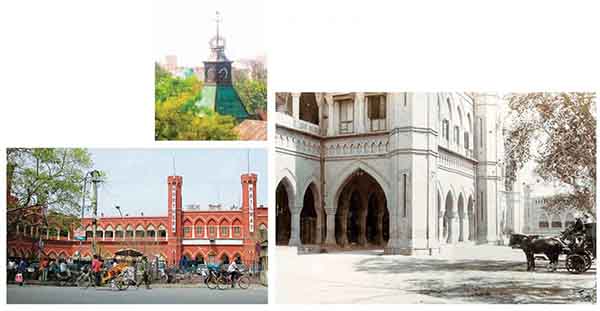
Clockwise, from top: View of rooftop of Roshanara Mansions with
weather cock and Queen’s crown; Delhi Station, 1920 Photo: Harsh Vardhan, Indian Railways Fan Club;
Delhi Main Station, 2002 Photo: Rusi R. Sorabji
.jpg)
Punjab Mail, circa 1930 Photo: Dr Ardeshir B. Damania
At times when reserved seats were not available in the over-crowded third or inter-class compartments, some stranded Parsis were accommodated by the kind managers of the dining car, with the knowledge of the Travelling Ticket Collector (TTC) and the guard as also their colleagues who replaced them at the end of their scheduled duties.
In all likelihood it was the popularity of the dining car’s English breakfast that drew Delhi Parsis to walk to the railway station so early on winter or summer mornings when one or the other of the Parsi dining car managers was Bombay bound. Or was the purchase of a one anna platform ticket meant to facilitate the exchange of the latest news or gossip with the manager or to send personal letters or small urgent packages to their sagawallas (relatives) en route? On trains arriving from Bombay, and that was in the evening, the local jaatwallas met the dining car managers to collect their copies of Kaiser-e-Hind or kustis, loban, sukhar, sudrehs, soovapak, sutterfeni, sukkha boomla (dried Bombay Duck) and the like that some family member had sent them. I remember old ladies remarking that it was good the prayer items were not handled by non-Parsis: "Naapak thai jaté (it would have become impure).”
Religious minded Parsis who believed that auspicious items on the sagan ni ses should not land in inappropriate hands would approach Parsi drivers or guards requesting them to throw their withered flowers, coconuts and coins into the water when the train crossed the Bassein Bridge or some major river along the way. When we travelled to Bombay as kids, we threw coins into the big rivers or inland creek crossings although we never quite understood the logic of this traditional offering. The "pings” from the rebounding coins hitting the steel bridges and the tracks continue to ring in my ears. My mother used to tell us tales of coconuts thrown from the Bassein Bridge sometimes landing on the bathers or boatmen below. In those bygone times the trains traversed this long open Bridge at a very slow speed.
My father Ruttonshaw, who was the station master in Delhi (see "Lineup of legends,” Parsiana, October 21-November 6, 2020), derived great pleasure meeting or assisting other Zarathushtis. Many a time Parsi travelers were stranded in Delhi for one reason or the other, sometimes without enough money for a return ticket. They were invited to stay at one of the several Parsi houses close by or at the station master’s bungalow where a Goanese khansama, a bearer and a host of other domestic help were always present to attend to the visitor’s needs. This is how the idea of a Parsi guesthouse took root and around two decades later materialized as the Delhi’s Parsi dharamshala when Ruttonshaw was the secretary of the Delhi Parsi Anjuman and his good friend Dr S. P. Shroff was its president.
Sometimes these stranded individuals were lucky enough to receive gift baskets of fresh North Indian fruits, vegetables and even eggs with the compliments of the Parsi station master and friends. (Incidentally, according to a note made in my father’s diary on April 29, 1929, it cost one rupee to send an express telegram to Bombay or important connections.) Eggs from Tarori were 100 for a rupee. Four-inch diameter balls of wholesome fresh paneer from Gwalior in a black matlu (earthen pot) about 16” diameter cost four annas a seer (approximately one kilo, while a Bombay rattal weighed about one pound) and a heap of assorted seasonal vegetables cost less than half a rupee. Six-and-a-half large bottles of Solan beer came for a rupee; the best of Scotch was priced at eight rupees a bottle. Ruttonshaw’s salary then was Rs 600 p.m.
Across the street from where Ruttonshaw lived was the Empress Aerated Soda Water (ASW) Factory owned by a Parsi lady named Dinbai Jal Irani. Ruttonshaw (who later became her son-in-law) helped Dinbai to expand sales of the drinks to the railway platform stalls, retiring rooms and the dining cars. It is believed that thanks to the dining car managers on the Frontier Mail, the Empress ASW products eventually found their way abroad on the P&O and BISN liners to UK. The year when there was a strike in Bombay and soda and other drinks were not available, large consignments of Empress ASW bottles were ordered by the shipping lines sailing to Europe and England to quench the thirst of passengers on the high seas.
We lived near the railway lines for 40 years, first in the Railway bungalow west of the Dufferin Bridge, then till 1970 at Roshanara Mansions due west and less than two miles from the main station. The present Roshanara Road /Pull Bangesh Metro station is structured atop the South wing of the Mansions. Living there one did not need a clock in the house. We were informed of a train arriving or departing not only by its whistle at set times but also from the vibrations it set off, at first very mildly like a murmur, increasing in frequency and rattle as the train approached closer and passed by the house. We were awakened at 6.30 a.m. by the approaching Simla-Kalka Mail. At 10.40 p.m. it was the train to Kalka/Simla. There were trains, meter and broad gauge, passing at short intervals throughout the day. If a known Parsi or friendly Anglo-Indian was manning the engine, he’d pull his signature whistle when passing by.
South of Roshanara Mansions was the fork between the lines going west and north. At the middle of the Y caused by the lines was a large signaling cabin. Some summer evenings while going for a walk along the lines that edged two of Delhi’s famous gardens, dad would take my brother and me to the Signal Cabin, named Brewery Cabin, to show and explain the intricate workings of the signal arms, lights and track changing systems, how fox caps would be strapped on top of the rail to make a big blast as the engine wheels crushed them, thereby immediately warning the engine driver of danger ahead (fox caps looked like thick two-inch diameter wrist watches with approximately six-inch long pliable tin or steel bands; the watch side was placed atop the rail and the extension securely wrapped under its sides). It was on such outings that we learnt of the use of flares and detonators and some secrets of the railway operations.
◆ ◆ ◆
One reader wrote
Your memory never ceases to amaze me, Rusi../ Yezad
From the archive