
Zoroastrians Abroad
PhD on neo Zoroastrians
For his doctoral study on the historical origins and development of the neo Zoroastrian movement, Ruzbeh Hodiwala is hoping to garner candid feedback from neo Zoroastrians and Zoroastrians through two questionnaires that he has posted on his website www.neozoroastrianproject.com. A PhD student at the School of Oriental and African Studies (SOAS), University of London, Hodiwala clarifies at the outset that the term neo Zoroastrians — to describe Zoroastrians "born into a family where both mother and father are non-Zoroastrians — is solely used for academic purposes and to ease the collection of research data, without any prejudice towards individuals, groups and the Zoroastrian community.”
He will supplement his anonymous online surveys with additional tools of research: online audiovisual/audio interview or informal interaction; documentation of experiences; adopting participant-observation methods to study the socio-cultural and religious activities of neo Zoroastrians. The student is working under the supervision of Dr Almut Hintze, Zartoshty Brothers Professor of Zoroastrianism.
"The Neo Zoroastrian Project (NZP) was conceived in 2015 when the student had travelled to Europe out of curiosity and stayed with a group of neo Zoroastrians and interviewed them for an independent article. NZP aims to undertake an ethnographic study of neo Zoroastrian settlements globally and analyze their interaction with Zoroastrians (those born to Zoroastrian parent/s). The project will generate data on the demographic composition, socio-religious and cultural practices, migratory patterns and organizational structures of neo Zoroastrians,” notes his website.
He will supplement his anonymous online surveys with additional tools of research: online audiovisual/audio interview or informal interaction; documentation of experiences; adopting participant-observation methods to study the socio-cultural and religious activities of neo Zoroastrians. The student is working under the supervision of Dr Almut Hintze, Zartoshty Brothers Professor of Zoroastrianism.
"The Neo Zoroastrian Project (NZP) was conceived in 2015 when the student had travelled to Europe out of curiosity and stayed with a group of neo Zoroastrians and interviewed them for an independent article. NZP aims to undertake an ethnographic study of neo Zoroastrian settlements globally and analyze their interaction with Zoroastrians (those born to Zoroastrian parent/s). The project will generate data on the demographic composition, socio-religious and cultural practices, migratory patterns and organizational structures of neo Zoroastrians,” notes his website.
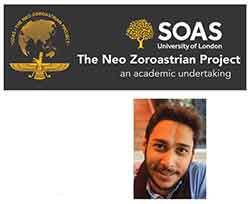
Ruzbeh Hodiwala: doctoral data drive
Besides the UK, Hodiwala toured the Netherlands, Italy, Germany, Norway, Belgium, France, USA, Azerbaijan, and Georgia to attend soodreh-pooshi ceremonies and to meet and interact with neo Zoroastrians. He conveyed to Parsiana that "each facilitator has a different technique for conducting ceremonies, different ideas and perspectives on the Zoroastrian identity. I will attempt to observe, record and analyze these variations and their resultant impact on Zoroastrianism as practiced by neo Zoroastrians.” Although planning to visit most of these countries again, as also Canada and Sweden, the field work that was to start in September 2020 has been postponed due to the pandemic. It will now be undertaken in his third year of studies.
While he has not set a target for the number of respondents to Survey I to be filled by neo Zoroastrians (https://forms.gle/hmwjhQ1aEykqw2GX7), for Survey II to be filled by Zoroastrians (https://forms.gle/XRckvge2QRnVrBU7A), he hopes to get 3,750 responses from North America (NA), and 1,000 from Europe, mainly from the UK. For ‘rest of the world,’ there is no set sample size. "The idea is not to categorically press for responses to the survey in other regions, like I will attempt for NA and Europe by regularly sending reminders and encouraging community members to participate. Instead, I will let the respondents from other regions complete the questionnaire until it is in the public domain (for the next five to seven months). The data will be separated, analyzed and used as appendices or to write an independent article. For example, although there is no significant interaction between the two groups in India, country data may provide useful insights into attitudinal trends and examine the interaction of Indian Zoroastrians with neo Zoroastrians on virtual platforms,” he responded to Parsiana’s queries.
According to Hodiwala’s estimate, on an average it would take 20-25 minutes to answer each questionnaire. If the respondent chooses not to respond to the last section, which consists of optional questions, it can be completed within 15-18 minutes. If the respondent wishes to answer subjective questions in depth, it may take longer to complete. "The questionnaire takes less time on a big screen as compared to mobile phones,” he notes. To progress to the next question, a respondent perforce has to answer "mandatory” queries that may appear "a seemingly pointless and tiring exercise” in light of the previous answer indicated. Hodiwala concedes, "The right approach would have been to lay down a questionnaire that would be able to recognize the option entered by the respondent and not to show those questions whose answers become obvious due to the entered choice. But I have limited access to these features when using google forms – the only platform that I could use giving the financial factor.”
To reach a vast spread of neo Zoroastrians, the freely circulating online questionnaire in English will also be available in a few foreign languages like Persian, French and Russian.
◆ ◆ ◆
One reader wrote
No mention is made of the Neo Zoroastrians of Iraqi Kurdistan who number in the thousands in the article. There are also a lot of Neo Zs in Sweden all of whom should be studied by Mr Hodiwala.
From the archive