
Navsari Tales
Growing up in the moholla
While they were all regarded as the children of the moholla, poor or orphan or differently abled, they were to be seen and not heard. Barring an outlier like the 12-year-old Pheroze (see "Gilli and Dando,” Parsiana, September 7-20, 2020) who asked Uncle Keki whether the latter was a ghelsappo or a ghelchodio in consideration of receiving several scoops of Kolah’s pink ice cream, Navsari children were disciplined, obedient and respectful. They spoke to the elders with their gaze downwards (aankh nichhi raakhi né vaat karo!) and in hushed tones. For minor indiscretions, fathers routinely slapped or kicked their sons while mothers were accomplished in chumtaoing errant daughters (pinching and cruelly twisting a substantial portion of flesh on the cheeks or other delicate body parts). The children seldom protested. However, these angels turned into devils at school.
An old and meek teacher named Pavri complained to the principal that "chhokraao mara kharaab kharaab bhago dabaavéch (boys are squeezing sensitive parts of my anatomy).” It was commonplace to loudly burp or break wind, upon which the Gujarati teacher would exclaim, "Arré, koné havaa bagadi (who has spoilt the air)?” — followed by allegations and counter allegations about the probable culprit. The legendary Pheroze, who must have been an ace knife thrower in a previous incarnation, routinely aimed dividers at the toes of terrified teachers. The revenge of the teachers was equally brutal. Outstretched fingers were required to be placed on the edge of an open drawer, which was then, like the guillotine of the French Revolution, forcefully pushed inward. Bloodied and bruised fingers resulted in further parental slaps rather than sympathy. Mass caning of the involuntarily offered posteriors of the entire class by an enraged principal was commonplace. Students were made to kneel on newspapers sprinkled with unrefined salt from the nearby Dandi seashore (where the Mahatma had created history); dusters were used not only for cleaning the blackboard but as missiles to target a talkative pupil. Despite such violence, grateful students remembered their erstwhile teachers wistfully.
An old and meek teacher named Pavri complained to the principal that "chhokraao mara kharaab kharaab bhago dabaavéch (boys are squeezing sensitive parts of my anatomy).” It was commonplace to loudly burp or break wind, upon which the Gujarati teacher would exclaim, "Arré, koné havaa bagadi (who has spoilt the air)?” — followed by allegations and counter allegations about the probable culprit. The legendary Pheroze, who must have been an ace knife thrower in a previous incarnation, routinely aimed dividers at the toes of terrified teachers. The revenge of the teachers was equally brutal. Outstretched fingers were required to be placed on the edge of an open drawer, which was then, like the guillotine of the French Revolution, forcefully pushed inward. Bloodied and bruised fingers resulted in further parental slaps rather than sympathy. Mass caning of the involuntarily offered posteriors of the entire class by an enraged principal was commonplace. Students were made to kneel on newspapers sprinkled with unrefined salt from the nearby Dandi seashore (where the Mahatma had created history); dusters were used not only for cleaning the blackboard but as missiles to target a talkative pupil. Despite such violence, grateful students remembered their erstwhile teachers wistfully.
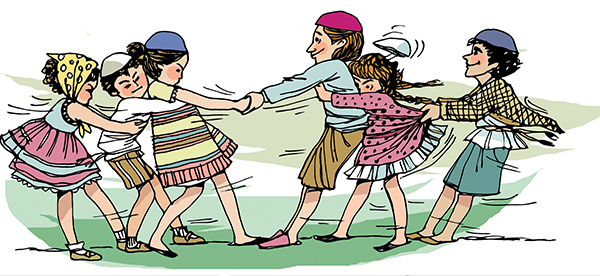
Illustration by Farzana Cooper
In the absence of the internet, telephones, televisions or even transistors, the children regaled themselves by playing Ring-a-ring-a-roses (Husha! Busha! being replaced by Hormuzsha, Bomansha!) and Oranges and Lemons (the game ending in a tug of war, with the winners demanding a player from the losing side — "We want Baba Soli Soli; We want Baby Nergish Nergish” — often resulting in matrimony between Soli and Nergish who would remember this as the first moment of hormonal attraction). The moment the lights came on, play would stop. This ensured discipline and also helped to preserve virginity. The children did their farajyaat (mandatory) prayers, were fed a spartan meal, made to walk the length of the house to aid digestion (chaalo! féra maro!), and then tucked into bed, with not a whimper tolerated.
Boys were physically trained by an ustaad (a sort of gym master); there was one called Maneckji Ustaad who claimed to have killed tigers and other lesser animals with his bare hands or by hurling hardened stale kababs at the wretched creature’s medulla oblongata. Children of both sexes attended dharam gyaan (religious knowledge) classes including reciting tales from the Shahnameh in Gujarati (called ‘bet-baaji’). The flippant ones trivialized the tragedy of the legendary Rustom mistakenly killing his son, Sohrab. According to their improvised version, Rustom aé aapyo Sohrab né jolaab; Né Sohrab aé kidho, légho kharaab (Rustom gave a beating to Sohrab who soiled his underpants). Children had to serve food at the gahanbars (communal feasts comprising delicious vegetarian food) which taught them dignity of labor and humility. Many teenage eyes met over sooran na kabab and onion rings dripping with vinegar smelling to the high heavens.
Eating three meals a day for five consecutive days at a wedding feast in the moholla was a treat much anticipated, despite the inevitable indigestion brought about by the gluttony. All were deemed to be invited (no juddins, of course). Caterers served half cutlets and small helpings to the children, and slapped the ones who asked for more. Misappropriating one anna coins meant for placing as ashodaad in the fire temples and diverting the funds for buying ice gola or "Mama na pattice,” was a frequently resorted to practice. The more daring ones flicked coins from the ashodaad chamach itself, pooh-poohing parental warnings that their fingers would get stuck to the chamach; thereby displaying their early inclination towards serving as trustees of charities.
When the ruler of Baroda, Sayajirao Gaikwad, who had a soft corner for Navsari, presided at a state function, Parsi girls were dressed as Japanese dolls in kimonos, fanning themselves with intricately carved hand held Japanese fans, and shuffling their feet covered in white socks and rubber chappals. This authentic Japanese fan was a part of the heirlooms of our grandmother who was amongst the first batch of girls from Tata School to be taken to Bombay for an excursion in 1909 when the children were told that the telephone was an instrument for communicating with the dead and were quite surprised to learn that people in Bombay had a third meal in the morning which they called breakfast.
Berjis Desai, author of Oh! Those Parsis and The Bawaji, occasionally practices law.
◆ ◆ ◆
From the archive