
Readers' Forum
Climate and cricket
Classical ecology comprises three factors: climatic, edaphic (pertaining to the soil) and biotic (mainly anthropogenic). Among the climate parameters, the pride of place goes to precipitation in its various avatars — liquid (rain water), solid (hail), vapor (fog), powdery (snowflakes), semi-visible (dew) and invisible (humidity) — which in one way or the other affect the game of cricket.
The rain factor hangs like the sword of Damocles over the heads of organizers, managers, curators of pitches, captains, players, umpires and fans. Whereas a torrential downpour comes as a blessing to the losing side as the match is abandoned and a draw declared, the winning side heads to the pavilion grumbling all the way.
One cannot imagine a match in Bombay in July when the south-west monsoon is in vigor or in Madras in November when the north-east monsoon and cyclones flood the city.
The rain factor hangs like the sword of Damocles over the heads of organizers, managers, curators of pitches, captains, players, umpires and fans. Whereas a torrential downpour comes as a blessing to the losing side as the match is abandoned and a draw declared, the winning side heads to the pavilion grumbling all the way.
One cannot imagine a match in Bombay in July when the south-west monsoon is in vigor or in Madras in November when the north-east monsoon and cyclones flood the city.
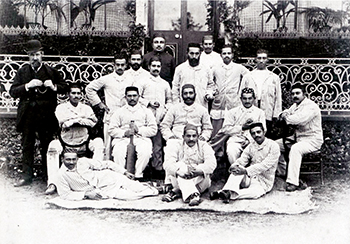
First Parsi cricket team to tour England in 1886
Linked to the rains is the cloudiness factor: dim light would play spoilsport. Length of day (short in winter, long in summer) decides the hours of play. Wind velocity is also to be factored in. Only a statistician could clarify if there is an incidence of a strong breeze dislodging the bails and thus breaking the record of the past fast bowler Dattu Phadkar sending the bails 18 ft away!
A cause of concern for the cricketers is the temperature. Tropical teams visiting England may have to face severe cold and icy blasts from the Arctic, resulting in total collapse and a fiasco. Similarly, teams from temperate climes have to deal with the oppressive summer heat in India.
The soil factor intervenes in the composition of the pitch. Sometime earlier, on the alluvial soul of the Gangetic Plain, the game was played on carpet pitch. Grass cover on the outer field also matters.
Finally, we come to the anthropogenic factor. This mainly involves frayed human tempers. Commentators have to be extremely careful in the words they use. In one of the Test matches in Bombay, the junior commentator announced that the umpire’s decision had favored a batsman of the visiting team. This statement agitated the crowd and led to a riot-like situation. It was left to senior commentator A. F. S. Talyarkhan to pacify the mob so that the match could continue. Spats among the players are becoming an increasingly common phenomenon these days.
Dr V. M. MEHER-HOMJI
◆ ◆ ◆
From the archive