
Events & Personalities
Parsis at Sotheby’s
A teakwood sculpture by Adi Davierwalla, a set of two sketches by cartoonist R. K. Laxman including one of a Parsi girl, and two posters created by advertising doyenne Nargis Wadia for Air India were part of the 60 lots of art auctioned by Sotheby’s at its inaugural auction in India at Bombay’s Taj Ballroom on November 29, 2018. Titled "Boundless: India” the sale featured paintings, sculpture, design and photography both "created in and inspired by the Indian subcontinent,” as mentioned in the Foreword to the sale catalog.
Expected to fetch between Rs 15,00,000 and 20,00,000, Davierwalla’s Entwined Figures executed in 1949 measures 33”x5 ½”x5 ½”. It was previously exhibited in a retrospective of his works at Jehangir Art Gallery in 1979. "(With) its emphasis on line and gesture, Entwined Figures with its delicately flowing lines, its two floating figures... within the tubular limits of a single block of wood, is a powerful depiction that fully evokes the tenderness and devotion that Davierwalla is able to imbue the work with,” notes the write-up accompanying his artwork. The sculpture was sold for Rs 70,00,000.
Expected to fetch between Rs 15,00,000 and 20,00,000, Davierwalla’s Entwined Figures executed in 1949 measures 33”x5 ½”x5 ½”. It was previously exhibited in a retrospective of his works at Jehangir Art Gallery in 1979. "(With) its emphasis on line and gesture, Entwined Figures with its delicately flowing lines, its two floating figures... within the tubular limits of a single block of wood, is a powerful depiction that fully evokes the tenderness and devotion that Davierwalla is able to imbue the work with,” notes the write-up accompanying his artwork. The sculpture was sold for Rs 70,00,000.
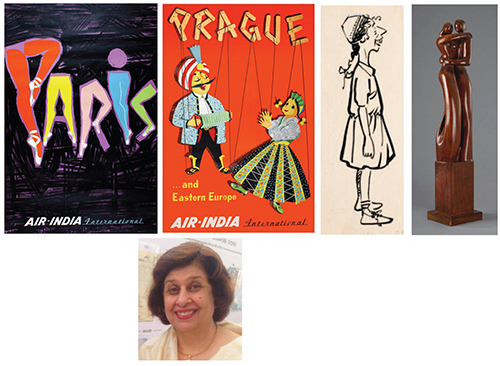
Top, from left: Nargis Wadia’s posters for Air India; R. K. Laxman’s Parsi Girl;
Adi Davierwalla’s Entwined Figures; Above: Wadia
R. K. Laxman’s image of a toothy, slightly dishevelled Parsi girl with a cap, one of a pair of images in ink on paper, sold for Rs 6,87,500 against a reserve price of Rs 1,75,000 to Rs 2,00,000. "Drawn in his typical playful style... The Parsi Girl capture(s) the same ‘mood of mischievous abandon’ which Laxman ascribed to his famous cartoons,” noted the sale catalog.
Air India, which was seen primarily as an Indian carrier in the 1950s, wanted to make a mark internationally, Wadia told The Times of India on November 24. Besides posters promoting the European and other capitals and countries, Wadia also worked on posters highlighting the carrier’s reclining seats and other services. "I had created these posters, (including the two on sale), when I was a visualizer/artist with them and had preserved them all these years for sentimental reasons,” Wadia wrote to Parsiana. One shows the iconic mascot of the airline, the podgy Maharaja with a Czechoslavakian girl, as puppets dangling from the letters P-R-A-G-U-E. The other poster spells out Paris with women’s legs. The reserve price stated in the catalog for the pair of posters was Rs 60,000 to 90,000. They fetched Rs 10,00,000.
To many, the 1950s were the heydays of Air India with its legendary advertisements, developed under the eye of commercial director Bobby Kooka who created the Maharaja, and head of publicity, Jal Cowasji. Wadia left Air India in 1957 and later set up her advertising company Interpub.
"We’re an oversensitive lot today. We can’t even say ‘Eskimos’ anymore. A lot of the creative work that Air India produced then may not be possible today,” Wadia told Conde Nast Traveller in May this year.
◆ ◆ ◆
From the archive