
Baug bearings
Community baugs and halls endeavor to provide amenities despite dwindling resources
Allbless Baug shows 80 days (22%) usage in a year and Jeejeebhoy Dadabhoy Agiary, around 70-75 days of bookings in a year (21%). This is primarily in the months of November to February when weddings and navjotes are celebrated. Cama Baug is booked for 136 days (37%) in a year but that is because it gives patrons a choice of booking the entire premises, or either the big otla (courtyard) or small otla and upper hall, at very reasonable rates. Thus besides the 15 marriages and 49 navjotes held there annually, their premises are booked for an equal number of jashans. The oldest of all, Dadysett Atash Behram, has its two otlas and hall booked on an average for 30 days (eight percent) in a year, for weddings, navjotes and gahanbars.
The maximum utility of 41% was reported by the cosmopolitan Sohrab Palamkote Hall in Dadar that on an average sees 150 bookings in a year. Of the two other venues in the same vicinity, also for use by all communities, the Mancherji Joshi Memorial Hall is booked for 40 days (11% utility) whilst the open grounds of the Dadar Parsee Colony Gymkhana, see 25 paid events (seven percent) in a year.
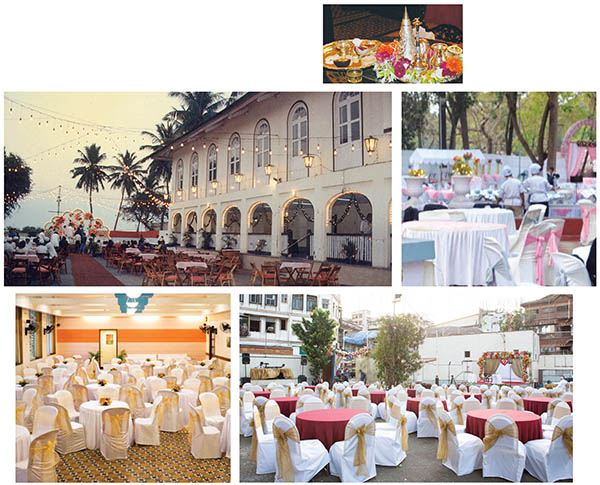
Clockwise from top: auspicious ses, Malcolm Hall, Cama Baug, Palamkote Hall, Jeejeebhoy Dadabhoy Agiary
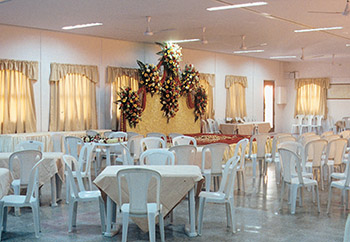
Banaji Atash Behram Hall
The indoor facilities of the Mancherji Bahmanji Seth (Sethna) Agiary Hall are booked on an average for 50 days (14%) while the Banaji Atash Behram Hall sees approximately 45 (12%) bookings in a year. The Salsette Community Hall has one or two bookings a month for private celebrations. This would work out to barely five percent of usage during the year on income generating activities. The rest of the year it is used for indoor sports events by the residents of its colony, 18 days of muktad and by community associations like XYZ that are permitted free use of the premises.
Although the trustees of Saher Agiary declined to answer our questionnaire, our sources reveal that on an average 30-35 functions (eight percent) are held on its grounds each year. Usually it is navjotes and wedding anniversaries that are celebrated at Saher Agiary, very rarely is it booked for a marriage. For the Malcolm Hall and compound we were not able to ascertain the usage as the president and committee members of The Malcolm Baug Zoroastrian Association (MBZA) refused to comment unless they had discussed the questionnaire at their forthcoming meeting in November.
Baugs beckon
Allbless Baug specifies that it can be hired only "for religious and joyous occasions” and the performance of a religious ceremony is mandatory. They charge Rs 61,000 inclusive of taxes for booking. All other facilities are available on extra payment. If the venue is to be booked by welfare organizations, for gahanbars or scouting activities, they charge a rate of Rs 10,000. Renovations is a continuous process for the Baug that believes in painting and polishing every year before the season begins. Recently they spent Rs 12 lakhs on repairs to their roof.
With each passing year it is getting more difficult to maintain their property due to a decline in bookings. To mark their 150th anniversary this October, they inaugurated the airconditioned Allbless Hall (see "Blessed to have Allbless,” pg 22) that will be made available to the community "for any joyous occasion” if there is no function in the main Baug, stated the trustees Roshan Lentin, Tosher Govadia, Navaz Lentin and Gool Kalyaniwalla. The rates and other details have yet to be worked out.
On an average there are 25-30 navjotes, 20-25 wedding ceremonies and 25-30 marriage/ navjote receptions in a year at the Jeejeebhoy Dadabhoy Agiary. If their grounds are to be used for the reception of an interfaith marriage or the celebration of a navjote of a child of a Parsi mother, or for Parsi corporate functions, the performance of a jashan on any day prior to the event is mandatory. They charge Rs 1,25,400 plus a separate payment towards full basic baug lights which works out to Rs 36,785, inclusive of taxes. "Right from the time a client books our venue, till their function comes to an end, personal attention is given to each one of them, taking care of all their requirements. Ours is the only Baug that gives a fair chance to all the contractors; even the clients get a wider choice of contractors,” states trustee Byram Jeejeebhoy.
Before the season starts, the Baug that was established in 1836 is painted each year and also plumbing, masonry, electrical and other major repairs are undertaken. With the advice and guidance of the trustees, they are able to ensure their annual income is sufficient to maintain their property. In fact they channel three-fourth of the booking charges towards donations to poor and needy families (education, medical and general help), bhojan fund, milk fund and anaaj coupons.
At Cama Baug, the big otla is available for Rs 8,080 that includes rent for Rs 6,000, refundable deposit of Rs 1,000 and 18% GST of Rs 1,080. The rates for the small otla are Rs 3,450 that includes rent for Rs 2,500, deposit of Rs 500, 18% GST of Rs 450. The upper hall can be booked for Rs 1,385. Established in 1869, the Baug was last restored around 20 years ago with funds from Naryman Dubash’s family. "The annual income only covers staff salaries, government taxes, electricity charges, minor repairs,” noted trustee Burjor Antia. The interest from investments helps with minor maintenance but they realize they need to upgrade their facilities to be on par with other baugs.
The Dadysett Atash Behram venue is mainly used for navjotes, weddings and gahanbars. They charge Rs 14,000 for Otla A, Rs 5,000 for Otla B, Rs 3,000 for the Hall and Rs 3,500 for the kitchen. They have no separate charges for lights. A nahan room with attached toilet and bath for the groom and bride as also a dressing room are the facilities they offer. They also note they have adequate parking facilities. The oldest of the baugs, the Dadysett Atash Behram celebrated its 236th anniversary this year. The annual income being insufficient to maintain the property, they are dependent on "donations and internal accruals” for regular maintenance, states Trust secretary Darayesh Katrak. While the hall was renovated a few years ago, the roof and walls of the hall and otlas are well maintained with regular replacement of broken tiles, and plastering and painting undertaken every year. They are in the process of finalizing their future plans.
The Sethna Agiary Hall is used mainly for jashans and birthday parties. During the year there are on an average 20 jashans, 20 birthdays, five weddings and five navjotes celebrated. Their hall can be booked for Rs 4,000 plus extra payment for lights. Their facilities include the lower hall used as a dining area and the upper hall with a dressing room and chairs. "Established in 1927, painting is done every year and they (manage to) break even,” according to manager Firoze Jagirdar who was responding on behalf of the trustees.
The Banaji Atash Behram Hall is on an average used for eight navjotes, three weddings and 17 other events. The Hall can be booked for Rs 22,000 plus Rs 5,000 interest free refundable security deposit. These charges are inclusive of chairs, tables and tablecloths; there are no hidden charges. "Established in 1843, the Hall was last renovated in 2018,” according to trustee Antia. Since the income from the Hall is not sufficient to maintain the entire Atash Behram premises, they plan to further popularize the venue. Like all charitable trusts, they are also dependent on donations.
The Salsette Hall is mainly hired for birthdays and engagement parties, and occasionally for navjotes. Their rates are Rs 20,000 plus Rs 2,000 for electricity. Built around 2000, maintenance work was last undertaken two years ago, noted manager Ardaviraf Elavia. It is the Salsette Trust that subsidizes the annual upkeep of the facility.
At the Palamkote Hall, there are approximately 150 weddings, and around 20 other functions; navjotes are few. They charge Rs 40,000 for the ground floor hall and Rs 30,000 for maximum usage of six hours of the air-conditioned hall on the first floor. This does not include GST and other taxes as applicable. The Palamkote Hall was established in 1928, and the first floor was last renovated in 2004. Their annual income is sufficient to maintain their property and they use "the surplus for charity, mostly for educational and medical purposes,” clarified managing trustee Zarir Sethna. Plans are underway to air-condition the ground floor hall.
Around 25 weddings are celebrated at the Dadar Parsee Colony Gymkhana grounds. Whilst the Gymkhana was established in 1931, functions have been held on their grounds in the last 25 years, responded manager Mehernosh Bamji on behalf of the trustees. For more details on the Gymkhana, the office is to be contacted, and they would put the prospective customer in touch with the decorator who would provide a list of facilities and its charges.
The Mancherji Joshi Hall is generally used for educational purposes, school programs and conferences. Whilst it is not booked for weddings or navjotes, about 10 engagements and birthday parties are celebrated each year. The Hall was built in 1990 and last painted in 2015. Those who book the Hall are provided with 150 chairs, stage and hall lights. "The Trust (Athornan Mandal) subsidizes it,” stated Ervad (Dr) Ramiyar Karanjia, principal of the Dadar Athornan Institute.
At the Malcolm Hall, though the current rates are not known, in the year ending August 16, 2018, for use of the full compound and hall, Rs 11,236 had to be paid to N. M. Wadia Charities (from November to April), or Rs 6,742 (from May to October). Another component had to be paid as donation to MBZA, Rs 51,000 if a member of MBZA or Rs 55,000 for a non-member. For use of Hall and half the compound, Rs 2,809 went to N. M. Wadia Charities, and Rs 13,500 to MBZA. For only the Hall, the rates were Rs 2,809 to N. M. Wadia Charities and Rs 8,000 to MBZA. For use of verandah, for children’s parties, Rs 562 to N. M. Wadia Charities and Rs 1,000 to MBZA.
All those who responded stated that in "unforeseen” or "extenuating” circumstances like a death in the family they would permit transfer of baug/hall usage to another date, subject to availability and at the discretion of the trustees. Rules and regulations governing usage are stipulated at the time of making payment.