
Professions
“A passion for India”
US Col Cainaz Vakharia is serving as an Army attaché in New Delhi
"I am Cainaz Vakharia,” says the quiet, diminutive lady dressed in an exquisite Parsi gara sari, standing before me. A lady so modest, she belies the many titles of friend, sister, daughter, wife, mother and, above all, a colonel in the United States Army!
Colonel is a rank attained by very few being just one rank below general in the US Army hierarchy. Vakharia is currently the Army attaché in the US Embassy in New Delhi.
Colonel is a rank attained by very few being just one rank below general in the US Army hierarchy. Vakharia is currently the Army attaché in the US Embassy in New Delhi.
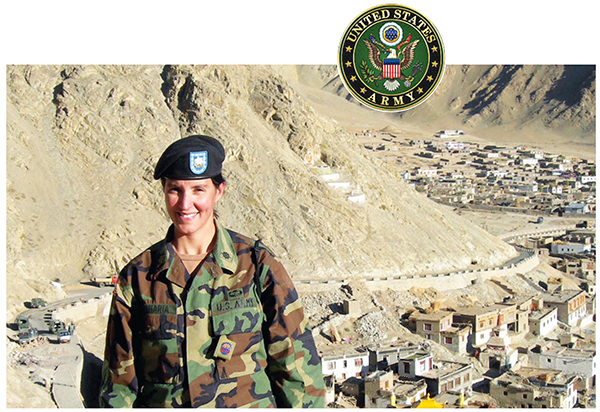
Col Cainaz Vakharia at one of her postings; inset: US Army logo
Returning to the familiar environment of the country of her birth in 2017 was exciting for Vakharia. "With US-India relations on a positive trajectory, now is a crucial time to be a part of this mission,” she explains. "The US is making tangible progress on the sale of defence equipment to India in an atmosphere of mutual cooperation and trust… While the US extends cooperation to India in trade, commerce, agriculture, education, etc, defence sales have risen to US $ 15 billion over the past decade.” Sales to India of transport aircraft, artillery weapons, attack helicopters, etc, are increasing as the two countries consider sharing technology.
"Both the US and Indian governments have democratic and bureaucratic challenges,” states Vakharia with differences in the parliamentary system in India and the US presidential government. Vakharia has been appointed by the US Army which in turn is under the department of defence, run by the Secretary of Defence. "The military is not politicized and has the right to free vote.”
On bringing new perspectives to her position as Army attaché in her country of birth, Vakharia elucidates, "I am in a field of work with South Asia as my specialization. The US Army trains its personnel on ‘focus regions.’ Hence, I was able to get language training, complete a master’s degree on South Asia and participate in the Defence Services Staff College in Wellington, Tamil Nadu to immerse myself in Indian conditions. This is the way the US Army selects staff to develop training and cultural understanding of each region and engage with partners who are well equipped to focus on the same area.”
Vakharia’s current job profile is to foster interaction and cooperation with the Indian Army for which three US-India exercises are identified every year. US Army personnel are brought for courses and training with the Indian army in training academies in India and vice versa. "This exchange of staff enables army personnel of both countries to understand each others’ combat methodology, inter-operability and foster a respect for each others’ systems such as counter-insurgency and training in law enforcement.”
Vakharia is also instrumental in promoting military to military cooperation and advises the US ambassador in India on military related matters, defence and promotion of defence equipment sales. Since her specialization is the South Asia region, she is privileged to serve as advisor to ambassadors in her embassy postings in the area. Her first diplomatic posting was in Islamabad in 2012-13, followed by a stint in Dhaka in 2016-17.
"I feel a passion for India and enjoy my presence here,” she beams. "I can contribute so much more here than doing any other army job,” she adds with pride.
After her India posting, she may be transferred to another embassy in the South Asia region or to the department of defence headquarters in the Pentagon, or serve in the State department as a military advisor to understand other aspects of the government. Her stateside assignments include the Pentagon and the State Department. In her career of 24 years, Vakharia has received several commendations and awards.
Recently, she served in Dhaka as senior defence official and direct military advisor to the US ambassador in Bangladesh. "I led a team of more than 25 in a challenging environment in the aftermath of the terrorist attack in Dhaka,” she reveals. "I provided the ambassador with insights on the Bangladesh military’s counter-terrorism strategy. This helped US foreign policy makers to better understand the imminent terrorist threats in South Asia,” she adds.
For her first assignment Vakharia was stationed in Germany and then in Turkey where she participated in the daily briefings to generals from the US, France, Turkey and UK. This was her first exposure to working in a multinational environment.
Her most fulfilling leadership role was as company commander in charge of over 50 troops in South Korea. She was responsible for training and combat readiness of all assigned personnel and patrolled the Demilitarized Zone between North and South Korea.
Making a career in "military service did not occur to me until I joined Tulane University on an army scholarship. In the course of four years I gained physical fitness, mental toughness, leadership and a personal growth,” shares Vakharia. "When I attended the Airborne School, I was exposed to the real army. I did five jumps and never looked back,” she adds with pride.
Born in Bombay in 1972, Vakharia lived her early years in Tehran, Iran. "I grew up in Iran until the age of seven. I remember a happy childhood with my twin sister Keshvar and parents, Adi and Arnavaz Vakharia. My younger sister, Mazarin was born in Tehran.” Father Adi, from Surat, was a captain in the Indian merchant navy while mother Arnavaz from Bombay had previously worked with the State Bank of India. They enjoyed the "best of the East and West” in Tehran, until the 1979 revolution after which they moved to the USA in 1980. Vakharia graduated from Tulane University in 1994 as a Distinguished Military Graduate with a Bachelor’s degree in biology and was commissioned as second lieutenant in the US Army. She also holds a Master’s degree in South Asian Studies from the Johns Hopkins University.
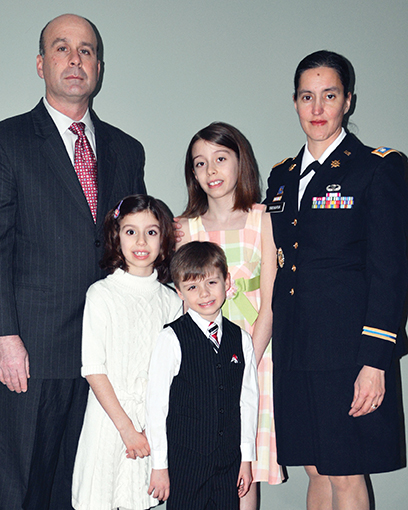
From l: Col Michael Heaton, Aryana, Zubin, Kashmira and Cainaz
"Our parents taught us to work hard, help others and practice our Zoroastrian heritage.” They encouraged their daughters to list their physical, spiritual and mental goals every year to understand the importance of sacrifice and achievement. Vakharia’s parents currently lead a retired life in Dallas, Texas, and enjoy spending time with their grandchildren.
"I am extremely proud to be a Parsi Zarathushti from birth and practice my religion as a part of my day-to-day living. My religion is my source of inner strength and I have a strong faith in Zoroastrianism as central to who we are as humans. I thrive on my strong belief which supports me in tackling personal challenges,” she adds with conviction.
Married to American Col Michael Heaton of the US Army, Cainaz has raised her three children as Zoroastrians with a strong influence of Parsi traditions and culture. Kashmira, aged 13 years, Aryana, aged 10 years and Zubin, aged eight, have been brought up to understand commitment, sacrifice, loyalty and being separated from the family to serve. "One must show them how to do their fair share of difficult tasks and contribute to the overall goodness of accomplishment. My daughters must see and pursue goals, face challenges and not quit.”
For almost eight years, Vakharia served as teacher for the youngest Avesta class in the Zoroastrian Association of Metropolitan Washington. She revamped the curriculum and incorporated it into an overall youth learning program.
"My most important roles outside the military are being a good wife and mother,” she notes. "I have an extremely supportive family who enabled me to follow my passion. I hope my example will light the way for my children just as my parents did with their three daughters.”
Col Michael Heaton
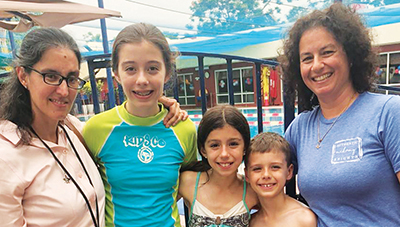
From l: Cainaz, Kashmira, Aryana, Zubin and Keshvar Buhariwala
Acknowledging the community’s dwindling numbers, Vakharia suggests that religion has to move with the times or become irrelevant. "If we don’t accept the views of our next generation, we will lose them,” she feels. She is open to diverse views but favors joint action to preserve our ancestry. "Being engaged and taking different forms requires an active role by our entire community. Let us assess all views and take a middle path,” she explains while applauding the Delhi Parsi Anjuman for moving with the times, accepting the new reality and welcoming intermarried Parsis to the fold.
Keshvar Buhariwalla, Cainaz’s twin who lives in Dallas, Texas, is actively involved in the Zoroastrian community there. As president of the Zoroastrian Association of North Texas, she was instrumental in establishing the Dallas Darbe Meher. Younger sister Mazarin Vakharia, is a lawyer based in California and is also actively involved in community service.
Cainaz has demonstrated leadership through her actions, conviction and determination. "My success is not mine alone — it is the success of my family, friends and all those I have served with over the past 24 years. My husband served in the Army for 25 years. Throughout our successful careers, we supported each other — remotely when not posted together,” she reveals. "The most important ingredient for success is to enjoy what you do. I feel a deep passion for my work and am motivated to achieve the next milestone.”
◆ ◆ ◆
From the archive