
Iftar impropriety?
P. N. Tavaria writes in A Manual of Khshnoom: "At a very early age were the children taught the Zoroastrian way of life, and the habit of purity and cleanliness was inculcated in them. For drinking water a goblet (with a curved top) was used instead of a glass, because the former permitted drinking without that vessel touching the mouth and getting polluted with germs… Similarly, at a very early age they were made to give up the habit of putting their fingers in the mouth and making them unclean. While sewing, the Parsi girls in those days invariably used a pair of scissors for cutting the thread, but never used their teeth for the purpose. Whilst eating at home or at a visit, articles of pastry like cakes, biscuits, etc. were never bitten, but broken with the fingers or cut into pieces suitable for putting them in the mouth so as to avoid contamination by germs. Eating things by biting, except in rare circumstances, was considered the way of the most filthy and lowest classes of aboriginals… In our ignorant and foolish craze for becoming what is being believed to be ‘reformed’ (?) and smart by taking to smoking, biting eatables, etc we retrograded, and assumed the filthy ways and habits of foreigners discarding our superior habits in eating, drinking etc, and thus died out our time-worn high Zoroastrian principle of purity and scientific cleanliness.”
A few sagely parhezgar (practicing all rituals) mobeds of Udvada as also a few boiwalas of other atash behrams to this day follow the long-standing traditions of purity in order to preserve their Bareshnum:
eat only chokkhu bhonu (ritually pure food) that is prepared by their wives (gorani) or by themselves or by another priestly member in their family;
never eat food cooked by a non-Parsi; eating outside food or ordering food from a restaurant was a taboo;
perform the necessary ablutions and baaj rites whilst partaking food;
ensure that they ate only in their plates and their vessels so as to avoid ajithvatar (contamination by the touch of others).
Among some saintly high priests of the past, Dastur Kukadaru lived a simple life. He used to wash his own clothes and ate one meal a day which consisted of rice and ghee (clarified butter). He used to cook it by keeping a vessel of rice in the rays of the sun and reciting the sacred Avestan verses. He did not eat meat and only consumed milk and fruits.
There is an event that took place in 1969 as recorded in Parsi Avaz. Eminent Parsis had arranged for a lavish banquet in honor of the Shah of Iran, Mohamed Reza Shah Pahlavi. Dastur Meherji Meherjirana, dressed in priestly attire, addressed the august gathering by reciting certain verses in Avesta and also read a note in English expressing his good wishes for the Shah and Shahbanoo of Iran. At dinner time, Meherjirana sat respectfully at the table next to the Shah but followed the ancestral tradition of the priestly class and did not partake of any food at the public dinner.
Dastoor owes his allegiance to his Dasturi gaadi first and to his secular responsibilities thereafter. He should look upon Kukadaru and Meherjirana as his source of inspiration and conduct himself in a manner that would preserve the respect of the Dasturi shawl he wears.
PERVIN MISTRY
Ontario, Canada
pervinmistry@yahoo.co.uk
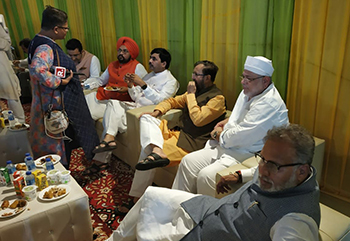
Dastur Khurshed Dastoor (2nd from r) at the Iftar party
Dastur Khurshed Dastoor responds
The members of the National Commission for Minorities (NCM) were invited by Mukhtar Abbas Naqvi for the Iftar. However Pervin Mistry’s imagination, as it generally does, has run riot and is based on fantasy, assumptions and presumptions. There was no sharing of morsels of food at the Iftar party. All invitees were served dry fruits and snacks in individual plates, nothing more, nothing less. If Mistry has any visuals different from these, she is welcome to share them with the Press.
I am very well aware of my position and responsibilities as the High Priest of Iranshah and the dignity of that august office. Mistry and those of her ilk can continue to look at all that I do with their jaundiced eyes, dip their poisonous pens in vitriol. But it matters not to me. I know fully well how to conduct myself whilst holding the two prestigious positions — as a High Priest and the Parsi (Zoroastrian) representative on the NCM — that Shreeji Pak Iranshah has blessed me with.
Mistry is by now known to wear many different caps, all of which border on the inane and ridiculous. She considers herself to be the last and final word on matters pertaining to our faith and revels in the adulation of her een-meen saré teen (handful) followers. Deluding herself to be the self appointed conscience keeper of the faith, she has, it seems, vowed to endeavor to chastise me for not following her brand of our faith. She sees red because I do things in the manner I was taught and in keeping with the times we live in. She sees exactly what she wants to see, that is negativity in all my actions.