
Politics and Policy
Looking at a logo
With a volunteer secretarial team and the creation of a logo, the Global Working Group is hoping to progress into an effective structure to synchronize its activities
A five-member team representing "300,000 Zoroastrians in Kurdistan” was in attendance at the Global Working Group (GWG) meeting hosted at the Crown complex in Perth, Australia on June 1, 2018. The popularity of Zoroastrianism is rising with "more coming back from other religions thanks to the activities of Awat Darya,” mentioned Faraydon Karim of the University of Texas. Besides Darya — the spitfire who was in the news in May for daring to describe a Muslim cleric as "a terrorist,” — others who had come to Perth from Iraq were her husband Jamal Mohammed, her mentor Karim, Mariwan Kakashikh, Kurdistan minister of religions in Congress, and Dr Shorsh Ali Ahmed, president of Kurdish Yasna organization in Victoria for development of Zoroastrian philosophy.
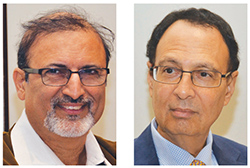
Firoz Pestonji (l) and Neville Shroff
"This is the only worldwide body of Zoroastrians that congregates for global issues…affecting all of us. At some stage we will need to invest the GWG with executive powers and authority. Let us have meaningful and productive ideas and dialog for betterment. Stay focused on discussions at hand and not dwell on technicalities. Keep self interest at bay and target on the larger issues… If organizations are tarnishing the reputation of the community, guide them in the right direction,” recommended Neville Shroff, non-executive chairman of GWG, in his opening remarks at the half day meeting.
Hopeful that the GWG would "formalize its structure and functions over one or two years and evolve along the way,” Rohinton Rivetna of Chicago, former president of the Federation of Zoroastrian Associations of North America (FEZANA) who has been endeavoring to bring the community on a common platform reiterated the need for "one global community without borders, sharing resources and enriching each other. We are here to stay. We are standing on the shoulders of stalwarts like Keki Gandhi, Minoo Shroff, Ruby Sethna, Khojeste Mistree and several others who have interacted. (Mistree and other like-minded trustees of the Bombay Parsi Punchayet owing allegiance to the World Alliance of Parsi Irani Zarthoshtis have been consistently resisting efforts to formalize a global body.) Let us follow the principle of Asha — the natural law of order and harmony.” As per his practice, he urged the representatives to exchange the hamazori hand clasp with the person seated on either side.
Since the GWG needs a coordinator to respond to enquiries worldwide, maintain records and guidelines, prepare agenda and write minutes, follow up on action plans, assist in organizing international events, publish a GWG gazette, Katayun Kapadia, former FEZANA president offered her services as did Firoz Pestonji, chair of the 11th World Zoroastrian Congress who hosted the GWG meet. Alongwith the services being currently extended by Yazdi Tantra, vice president of the World Zarathushti Chamber of Commerce, it was decided to avail of their offer to have a more effective secretariat.
Whilst the GWG has yet to set up a formal structure defining its authority and influence over regional Zarathushti federations and organizations, Sam Balsara, chairman of Madison World, who has been inducted on the global group’s advisory committee, presented a logo conceived by him saying, "the least we can do is have a logo.” Since the logo incorporated names of countries that participate in the GWG, discussions continued on whether names of regions should substitute countries. Erstwhile FEZANA president Dr Dolly Dastoor of Canada felt the word Zarathushti should be incorporated in the logo since the visual of the farohar is not exclusive to Zoroastrians.
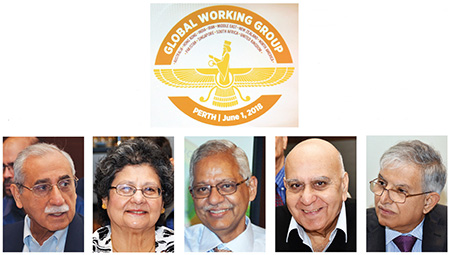
(From l): Rohinton Rivetna, Katayun Kapadia, Yazdi Tantra, Dinshaw Tamboly and Sam Balsara
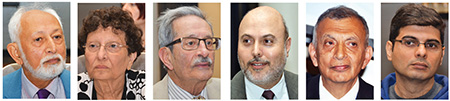
(From l): Homi Gandhi, Dr Dolly Dastoor, Rusi Dalal, Malcolm Deboo,
Dr Behram Pastakia, Maher Dhamodiwalla
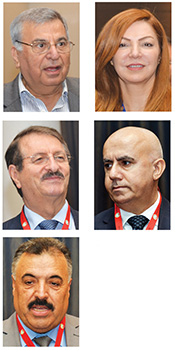
Clockwise from above left: Faraydon Karim, Awat Darya, Mariwan Kakashikh,
Dr Shorsh Ali Ahmed, Jamal Mohammed
Rivetna recorded the "wonderful effort of Firoz and Mahrukh Pestonji that brought Australia into the forefront of the world community.” Shroff too appreciated their shouldering of this "phenomenal responsibility,” knowing it is "no mean task… It is good for the community to explore different regions… Different regions should be given an opportunity to host otherwise we’ll never know the potential of these countries. Any new country that wants to host can always draw from the wealth of experience and be assured of support from countries like USA and UK… There will be challenges, we may make mistakes but as long as we learn…”
Out of 50 fire temples in Bombay and 98 in the rest of India, only nine institutions were willing to share information with the core committee of Dastur Khurshed Dastoor, Dinshaw Tamboly and Balsara tasked with the responsibility of gathering data for mobed uplift and adopt an agiary program of the GWG. Their intentions were misconstrued by a section of the community who actually instigated the trustees and management of fire temples not to share information by circulating frivolous WhatsApp messages.
"Based on information and assumptions, we tried to arrive at a plan,” said Balsara. As per their figures, the average annual cost of running an agiary works out to Rs 10.5 lakhs on the premise that two mobeds would be paid Rs 2.4 lakhs, the chasniwala and domestic staff would be paid Rs 2.4 lakhs, Rs 3.6 lakhs would be expended on kathi, one lakh on regular maintenance of the fire temple building and one lakh on electricity.
Whilst about 74 agiaries are self sufficient, nearly 50% need an annual subsidy of Rs 5.4 lakhs. Within Bombay, 78% of the agiaries have enough worshipers, and in the rest of India, 36% have enough worshipers. [In a subsequent clarification sought from Tamboly, he mentioned that the status of agiaries in Bombay was determined after discussing the issues with a "group of young, dynamic, interested and knowledgeable full-time mobeds who are at the core of the Empowering Mobeds program under the aegis of the Athornan Mandal and the WZO Trust Funds Mobed Welfare Scheme that had its workshop on May 13 (see "The medium is the message,” pg 38 ).]
As per their practical solutions, they need to make a list of agiaries which are beyond help; decide which agiaries should be helped based on the number of regular worshipers and where the sacred fire can be relocated to another agiary so that the original property can be put to alternate use or locked.
The data base of 427 full-time practising mobeds showed that 167 were aged over 65, with 129 aged between 41-60 and 131 between 20 to 40 years. Among these mobeds, 170 were unmarried, 230 were married and 27 were married with children. Estimating the variable subsidy required by the mobeds depending on their age and family circumstances, it was calculated that an annual subsidy of Rs 8.34 crores would be required on the premise that they are given a starting salary of Rs 25,000 per month with a five to 10% increment every year. Thus Rs 12.74 crores would be required annually for agiaries and mobeds or Rs 255 crores, if the amount is capitalized.
"Let us be candid with ourselves. Can we raise these funds? If we cannot, we need to pick and choose. Mobed project would get priority over agiaries for as Dr Richard Frye had said over five decades earlier, ‘Without mobeds, the religion is at stake.’ Zoroastrian Trust Funds of Europe (ZTFE) can help in funding of religious studies in Zoroastrianism” thanks to the munificent donation made by the Zartoshty Brothers to the School of Oriental and African Studies, noted ZTFE president Malcolm Deboo.
Whilst assuring the support of FEZANA and the North American Mobeds Council, FEZANA president Homi Gandhi suggested help should be sought from the National Minorities Commission. Tamboly alerted that under the Foreign Contributions Regulation Act, fire temples cannot receive funds from abroad. Even the two percent mandatory spend in India under corporate social responsibility could be extended for educational causes but not for communal causes, pointed out Deboo. When it was suggested that Balsara could use his marketing skills, he responded that "we need a larger group for fund-raising.” Reminded Tantra, "We don’t have an organization.” Since the GWG has yet to be formally constituted, "Where will the funds go?”
Financial planner Maher Dhamodiwalla of Bombay felt that instead of providing the money "can we create opportunities” for mobeds to supplement their income? This suggestion of a mobed earning money from his vocational career whilst performing his mobedi duties is as per "the Achemenian model when the religion was at its pinnacle,” informed Dr Behram Pastakia of Washington. It is the Sassanian model that sought to give alms to the priests.
Darya has obtained land from the government to start a fire temple, mentioned Karim.
The Zoroastrian Information Centre in Udvada will be refurbished with the financial assistance of Nadir Godrej and one of his companies, stated Tamboly.
ZTFE trustee Rusi Dalal stated that there are but a handful of Zoroastrians left in South Africa and none in East Africa. Whilst he is still "fighting for one last valuable property in Uganda,” he regretted that most properties had "almost gone.”
The second instalment of the GWG report will appear in a forthcoming issue of Parsiana.
◆ ◆ ◆
From the archive