
Events & Personalities
No cocktails, we’re Parsi
"Our ancestors did not come here (to India) to make a cocktail,” said Bombay Parsi Punchayet chairman Yazdi Desai. He was chief guest at the 171st salgirah of Cusrow Baug’s Nusserwanji Hirji Karani Agiary on February 2, 2018. "These people who say that ours is a universal religion are wrong…Our forefathers had sacrificed material wealth only to preserve their religious identity…There is this woman from Delhi who was asking for scriptural evidence that intermarriage is not allowed…I say to her, we have our great traditions, we do not need scriptural evidence,” he said. The reference was to veteran journalist Bachi Karkaria (based in Bombay, not Delhi) who was pitted against Desai in a television debate on the rights of Parsi women to marry persons of their choice while continuing to practice their faith (see "The highs and lows,” Editorial Viewpoint, Parsiana, November 21, 2017).
"Even the government of India wants the Parsis to increase their numbers,” Desai said, alluding to the Ministry of Minority Affairs funded Jiyo Parsi program. Follow the tenets of our religion devotedly, and marry within the community was Desai’s message. His speech was met with polite applause from the largely elderly audience, who had waited for over 20 minutes for the chief guest to arrive. Desai’s message was reiterated by Agiary trustee and tax consultant Homi Ranina. Parsiana’s statistics show that intermarriages accounted for 37% of Parsi weddings in Bombay in 2016. For 2017, the figure is 44%.
"Even the government of India wants the Parsis to increase their numbers,” Desai said, alluding to the Ministry of Minority Affairs funded Jiyo Parsi program. Follow the tenets of our religion devotedly, and marry within the community was Desai’s message. His speech was met with polite applause from the largely elderly audience, who had waited for over 20 minutes for the chief guest to arrive. Desai’s message was reiterated by Agiary trustee and tax consultant Homi Ranina. Parsiana’s statistics show that intermarriages accounted for 37% of Parsi weddings in Bombay in 2016. For 2017, the figure is 44%.
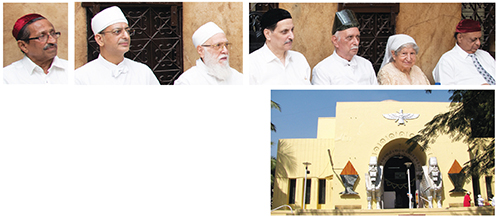
Top row, from l: Noshir Bulsara, Ervads Yazdi Aibara and Asphandiar Dadachanji,
Yazdi Desai, Bomi Hansotia, Mani Vajifdar and Homi Ranina at the Nusserwanji Hirji Karani Agiary (above)
Earlier, while welcoming the audience, Ranina had lamented that while there were many youngsters hanging outside the fire temple, the audience within did not have many young people. "We have to do something to get them in,” he said.
The morning began with a Havan gah machi on behalf of the Agiary trust and a jashan ceremony conducted by Agiary panthaky Ervad Yazdi Aibara. Vatchha Gandhi Agiary’s Ervad Asphandiar Dadachanji and other mobeds of the fire temple. In the evening, a hama anjuman jashan was conducted by Ervad Farhad Aibara and other mobeds of the Agiary, followed by a humbandagi led by Ervad Yazdi. A minute’s silent prayer for the founders of the Agiary and the Wadia family who "gave us this wonderful (Cusrow) Baug,” was requested by managing trustee Bomi Hansotia.
Dadachanji, speaking on "Atash ni bandagi (prayers to the fire),” traced the arrival of the first Zoroastrians to India. "The (Iranshah) fire was not brought from Iran, but it was the alat (religious items required for the consecration of a holy fire) that was brought from there,” he informed the audience. Yazdi Aibara’s vote of thanks included Cusrow Baug resident Mani Vajifdar for continuously hosting the annual salgirah function for several years and Rusi Davar for his photography of salgirah functions. He also thanked Khurshed and Nazneen Vajifdar for that evening’s photographs.
◆ ◆ ◆
From the archive