
Readers' Forum
“The lessons to be learned”
I thank Parsiana for opining on the Supreme Court Batliwalla Agiary judgment in "The lessons to be learned” (Editorial Viewoint, Parsiana, January 21, 2018). I cannot agree with some of the views expressed. As an involved party, I wish to clarify some relevant issues.
The order of the apex court mentions that the procedures to be followed for selling trust property involves advertisement, tender and auction. The deal was cancelled by the Supreme Court for the benefit of the Trust precisely because these procedures were not followed. The Court directed that Rs 2.95 crores be returned without interest to the builder and the restoration of the land to the Trust. The learned judges opined, "The value was many a time more at the time of entering into the agreement.”
If funds were required to meet the Trust’s expenses, tenders and an auction would have definitely obtained a higher price. The fact that it was a tenanted property would work to the advantage of the Trust because extra FSI (floor space index) is made available to old tenanted properties, over and above the normal FSI. (The property in question is situated adjacent to the fire temple and has a separate entrance — editors)
The order of the apex court mentions that the procedures to be followed for selling trust property involves advertisement, tender and auction. The deal was cancelled by the Supreme Court for the benefit of the Trust precisely because these procedures were not followed. The Court directed that Rs 2.95 crores be returned without interest to the builder and the restoration of the land to the Trust. The learned judges opined, "The value was many a time more at the time of entering into the agreement.”
If funds were required to meet the Trust’s expenses, tenders and an auction would have definitely obtained a higher price. The fact that it was a tenanted property would work to the advantage of the Trust because extra FSI (floor space index) is made available to old tenanted properties, over and above the normal FSI. (The property in question is situated adjacent to the fire temple and has a separate entrance — editors)
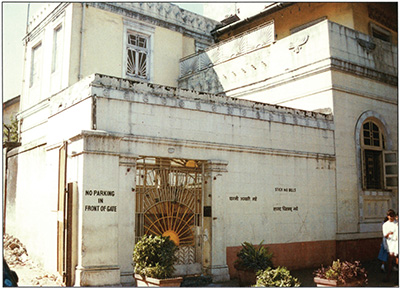
Behramji Cowasji Batliwalla Agiary at Tardeo in Bombay
Photo: Global Directory of Zoroastrian Fire Temples
The trustees stated that a public notice was not mandatory and that some disgruntled occupants would find it convenient to stop the proposal and start litigation. The learned judges mentioned, "There was misrepresentation made as to the actual transaction that was intended and had ultimately taken place in as much as it was stated in the application that no purpose would have been served by issuance of the public notice, as it was a joint development venture, however, the property was totally unencumbered and easily marketable in its present form. The Joint Charity Commissioner also omitted to take into account the actual nature of transaction of how such property has to be sold and conveniently overlooked the provisions of the Act and decisions of this Court” and "the order of the Joint Charity Commissioner is absolutely illegal.” Further "the application could not have been entertained at all, much less allowed by the Joint Charity Commissioner.”
The editorial reflected the trustees’ claim that their case was not adequately presented in Court in view of meager resources. The fact is that the builder and the trustees were very well represented in both courts by senior advocates such as Aspi Chinoy, Mukul Rohitgi, E. C. Agarwala, Rohinton Nariman and Arun Jaitley.
It has been implied that my objections to the actions of the trustees arose from a desire to settle scores. My legal challenge to the actions of the trustees was solely to ensure that the family Trust property would not be sold to builders/developers at throwaway prices. It would be naïve to believe that anyone would spend vast amounts of money and more than 12 years in courts only to settle scores with his own family. Motives are irrelevant. The case was examined and decided on facts, evidence, propriety, ethics and transparency.
The Supreme Court judges have clearly ruled, "The deal was not in public interest or for the benefit of the Trust and that the trustees were not up to the task of protecting the interest of the Trust while entering into such an agreement for development-cum sale” and also "The trustees acted in a clandestine manner and in collusion with the builder and the Charity Commissioner… The order passed by the Charity Commissioner as well as by the High Court is hereby set aside.”
I strongly believe that this landmark judgment would act as a deterrent to trustees who may try to find ways to subvert the law in future. The trustees responsible should have accepted moral responsibility and stepped down gracefully, especially when the Supreme Court came down so heavily upon them.
In November 2017, I met and requested the trustees to consider inducting a nominee of the Patel family to safeguard against repeating this and as our family was not represented on the board after my father Rustom J. Patel expired in 1994. I await their decision.
I am attaching the link for the benefit of your readers: http://supremecourtofindia.nic.in/supremecourt/2008/13509/13509_2008_Order_21-Sep-2017.pdf I now leave it to the Parsi community and right thinking individuals to make their own conclusions about what are the real lessons to be learned and by whom.
CYRUS RUSTOM PATEL
Gurugram, Haryana
patelcyrus@gmail.com
The editors reply
Our intention was not to impute motives to either the complainant or the trustees. We apologize if there was any inadvertent insinuation. We wanted to point out the pitfalls to be avoided when dealing with any trust property, and that however honorable or dishonorable the parties’ intentions may be when dealing with trust property, all parties must ensure due process is followed. No one can assume their actions will remain unchallenged at any time or at any forum.
◆ ◆ ◆
From the archive