
“Some home truths”
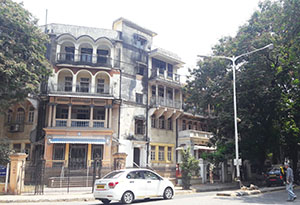
A building in Dadar Parsi Colony
Photo: Jasmine D. Driver
We have to bear not only the mental trauma but also the legal expenses. Where are all the Zoroastrian legal luminaries? Are they just going to be spectators in this saga with so much discrimination against the Parsi woman? And in the 21st century!
The editors reply
The legal luminaries are willing to take up cudgels on behalf of Parsi women. Sadly the women are not coming forth. Fortunately a Parsi woman from Calcutta has legally challenged the discrimination (see "This is not religion,” Editorial Viewpoint, pg 4)
• • •
On behalf of the Parsi Central Association (PCA) Co-operative Housing Society Limited, Dr B. S. Bhesania, consultant, Mulla and Mulla and Craigie Blunt and Caroe, replies
PCA is a 97-year-old registered organization formed for providing housing to Parsi Zoroastrians at reasonable rents and has been doing so even before most of the buildings in the Dadar Parsi Colony (DPC) came to be constructed.
Our clients would upfront like to clarify that the allegations made against our clients are made by individuals who have a selfish motive and do not appreciate the good work that our clients have been doing in protecting and enforcing the covenant which has turned out to be for the benefit of 20% of the Parsi population currently residing in Bombay.
The DPC is a part of Bombay which was envisaged as a Garden Colony by the Improvement Trust now Municipal Corporation of Greater Mumbai (MCGM) over 100 years ago. As far back as 1906 some farsighted Zoroastrian entrepreneurs got together and formed the Zoroastrian Building Society Limited (ZBS) and later, the PCA was founded in 1920 by Mancherji Edalji Joshi, the father and founder of the Parsi Colony. At the time when the Corporation was unable to lease the land developed in Wadala, the founders of the ZBS and later the PCA came forward to take on lease 113 plots with a stipulation that each of these plots would be subject to a covenant. The object of the covenant was that the lessee who constructs the building would see to it that the tenants residing in the said building would be members of the Parsi Zoroastrian community and a special covenant to that effect was introduced in all the leases affecting the 113 plots which are subject to such a restrictive covenant. In addition, all the 113 plot holders entered into a separate Deed of Covenant for mutual benefits. The rights under the Deed of Covenant were assigned under a Deed of Assignment to PCA by the ZBS. The Common Building Scheme proposed by the ZBS and the PCA was approved by the Board (Improvement Trust) now MCGM and is embodied in an agreement dated October 12, 1926 and registered with the Sub-Registrar of Assurances on February 3, 1929. The Board agreed to grant the leases for a term of 999 years of the land in the Reserved Area for the development thereof according to the Common Building Scheme of the Society subject to the covenant that the owners or lessees or occupiers of each such plot and building built thereon should be subject to certain restrictive covenants and be bound by the stipulations made therein for the benefit of the owners, lessees, or occupiers of all the said plots and for the purposes of carrying out the said object of the said Society to provide cheap and good residential accommodation for poor and middle class Parsi Zoroastrians only.
As a result of the Restrictive Covenant, the lessees of all the 113 plots undertook "that they the lessees will not suffer or permit any building or buildings now or hereafter standing on the said land or any part thereof to be occupied or used by any person who is not a member of the Parsi Zoroastrian community and that nothing will be done in breach, violation or infringement or contrary to the fair meaning of the said stipulation but so that the obligation of the present covenant shall be binding upon the lessees only during the time of their joint or sole possession of or title to the said land hereby demised provided nevertheless that this covenant shall not apply to any domestic servant, attendants, secretary, governess, nurse of any bona fide employee or temporary guest of a member of such buildings or any part thereof.”
As a consequence of this covenant where several plots that were sold to developers, the PCA had no alternative but to file suits against them to see that the building constructed by the developers were occupied only by a member of the Parsi Zoroastrian community and as a consequence of such restriction in the last 40 years, several buildings that were constructed have tenements which are tenanted to or owned by the members of the Parsi Zoroastrian community only.
The PCA directly and also as the successor of the Restrictive Covenant has considered it their solemn duty to enforce the covenant. It may be mentioned for your information that the covenant has been upheld by a judgment of the City Civil Court in 1981 and is effective till date. In fact based on one Supreme Court of India (2005) judgment in a similar case the Maharashtra Government (under directions from the Central Government) has directed MCGM and MHADA (Maharashtra Housing and Area Development Authority) to obtain prior written clearance from PCA for any redevelopment projects on the plots and restrictive covenants. Further the City Civil Court at Bombay in Short Cause Suit No. 271 of 1978: The Parsi Central Association Co-operative Housing Society Limited and Ors vs Ardeshir Vicaji Taraporewala has inter alia observed that "…the covenant cannot be said to be directed against any particular community. Rather, it is a protective covenant. A small community like the Parsis need this kind of protection for its very existence as a community and to maintain its identity. It cannot be said to be directed against any other community as preservation is its object and not hostile discrimination.” The defendants therein had inter alia argued that the restrictive covenant was unconstitutional. The Court had examined the relevant provisions of the Constitution of India and held that the restrictive covenant is not in violation thereof. The PCA has been guided by the definition of ‘who is a Parsi’ as laid down in the case of Sir Dinshaw Manockji Petit and Ors vs Sir Jamsetji Jeejeebhoy and Ors in the Bombay High Court, Suit no 689 of 1906.
In conclusion we would like to state that the PCA is rendering yeoman’s service to the Parsi community at their costs and time, and those Parsi ladies who are married outside the community should also endeavor to help PCA in upholding the covenant by not insisting upon their husband and children residing in any building which is on the covenanted plot. They should realize that in the larger interest of the community they themselves should respect the covenant and not challenge it.