
Privacy as per Nariman
In the Indian context, a fundamental right to privacy would cover at least three aspects, stated Supreme Court Justice Rohinton Nariman (pictured), while delivering his judgment, along with eight other judges, on whether the right to privacy is an integral part of right to life and personal liberty guaranteed in Article 21 of the Constitution. The nine-judge bench upheld privacy as a fundamental right.
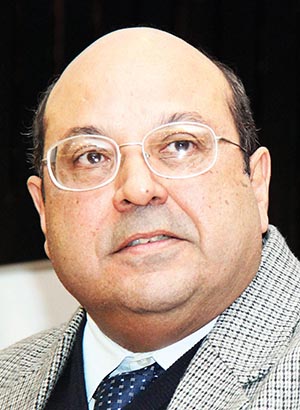 The facets Nariman referred to are: "Privacy that involves the person (for example, the right to move freely); informational privacy that deals with the person’s mind (control over dissemination of information that is personal to him); privacy of choice that protects an individual’s autonomy over personal choices.” The 120-page judgment stated that dignity of the individual encompasses his right to develop to the full extent of his potential, and "this development can only be if an individual has autonomy” and "control over dissemination over fundamental personal information which may be infringed” through unauthorized use. His judgment also stated that the right to privacy is not absolute, and is "subject to reasonable regulations made by the State to protect legitimate State interests or public interests.”
The nine-judge bench, including Chief Justice of India J. S. Khehar, J. Chelameswar, S. A, Bobde, R. K. Agrawal, A. M. Sapre, D. Y. Chandrachud, Sanjay K. Kaul and S. Abdul Nazeer, gave its ruling on August 24, 2017. The current ruling overturns two previous judgments of the Court in 1954 and 1962 that had ruled that the right to privacy was not a fundamental right.
Attorney general K. K. Venugopal, who represented the central government, had argued that "all aspects of privacy cannot be put under fundamental rights category.” After the ruling, he noted that "whatever the nine-judge bench says is the correct law,” quoted The Times of India on the same day as the ruling.
On August 23, Nariman was part of a five-judge bench of the Court that set aside the practice of instant triple talaq of divorce followed by Sunni Muslims under personal law as unconstitutional, arbitrary and unreasonable. Under instant talaq, a Muslim husband can divorce his wife by stating the word talaq (the Arabic word for divorce) three times in oral, written, or more recently, in electronic form. The other justices on the bench were Khehar, Kurian Joseph, Uday Lalit and Nazeer. The 395-page verdict was delivered by a majority of three against two.
News reports stated that while the majority judgment was written by Nariman for himself and Lalit, Joseph wrote a concurring judgment to set aside the practice. Khehar and Nazeer stated that triple talaq should be upheld as it has been practiced for 1,400 years, but wanted a stay on the operation of triple talaq for six months and directed Parliament to enact a law within the given time period. If law did not come in force in six months, then the Court’s injunction on triple talaq would continue, stated news reports. The Court has asked political parties to keep their differences aside and help the central government in bringing out a law on the practice, according to The Economic Times of August 22.
Divorce under Muslim law can take three forms: Talaq-e-Biddat, Talaq-e-Ahsan and Talaq-e-Hasan. Talaq-e-Biddat, which allows men to pronounce talaq thrice in one sitting, was the subject of the April 22 judgment. After the pronouncement, even if the man himself perceives his decision to have been hasty in hindsight, the divorce remains irrevocable. Under Talaq-e-Ahsan, once the husband pronounces talaq, there has to be a three-month iddat (waiting) period to factor in three menstrual cycles of the woman. This time is meant for reconciliation and arbitration. During this period, if cohabitation occurs, the divorce is considered to have been revoked. Under Talaq-e-Hasan, there is a provision for revocation too. The words of talaq are to be pronounced three times in the successive periods after menstrual cycles. The husband has to make a single declaration of talaq and then wait for another menstrual cycle to pronounce another declaration. The first and second pronouncements may be revoked by the husband and if he does so, either expressly or by resuming conjugal relations, the words become ineffective. Parsiana has culled this information on various types of divorce from news reports that followed the judgment.