
Observation
Gracious grandpa
Looking after elderly relatives can be a boon
The first eight months of my life were spent in New York, in 1993 after which my parents Naozad and Bhavna Tata handed me over to my grandparents, Jal and Nargis Tata, who then raised me in Bombay.
I stayed in Tata Blocks, in Bandra, for 12 years where my Bappi (grandmother) and Papa (grandfather) raised me in typical Parsi style: agiary, dhansak, torans; good thoughts, good words and good deeds. My grandfather had then retired from Air India, and my grandmother was an artist.
At age 12, my parents decided to move my sister and me back to the United States, and I spent the rest of my years in the country of my birth. I lived with my parents till I was 18, after which I moved out for college and was living, studying, and working on my own in Washington, DC.
In 2014, Bappi passed away suddenly, leaving behind the love of her life, and her offspring. Before her death, I was studying fine art and biology, and working on an ambulance as an emergency medical technician, with hopes of becoming a paramedic and eventually going to medical school. After my Bappi departed, I missed a lot of school, so eventually only managed to complete my BA in Fine Arts from The George Washington University, in Washington, D.C.
Life after my grandmother was very confusing and I was dragged into a gray area of uncertainty. After I graduated, I decided to come to India and spend some time with my grandfather, before I took up a job. Towards the end of my trip, Papa and I realized that this might be the last time we would be together, which broke my heart.
I stayed in Tata Blocks, in Bandra, for 12 years where my Bappi (grandmother) and Papa (grandfather) raised me in typical Parsi style: agiary, dhansak, torans; good thoughts, good words and good deeds. My grandfather had then retired from Air India, and my grandmother was an artist.
At age 12, my parents decided to move my sister and me back to the United States, and I spent the rest of my years in the country of my birth. I lived with my parents till I was 18, after which I moved out for college and was living, studying, and working on my own in Washington, DC.
In 2014, Bappi passed away suddenly, leaving behind the love of her life, and her offspring. Before her death, I was studying fine art and biology, and working on an ambulance as an emergency medical technician, with hopes of becoming a paramedic and eventually going to medical school. After my Bappi departed, I missed a lot of school, so eventually only managed to complete my BA in Fine Arts from The George Washington University, in Washington, D.C.
Life after my grandmother was very confusing and I was dragged into a gray area of uncertainty. After I graduated, I decided to come to India and spend some time with my grandfather, before I took up a job. Towards the end of my trip, Papa and I realized that this might be the last time we would be together, which broke my heart.
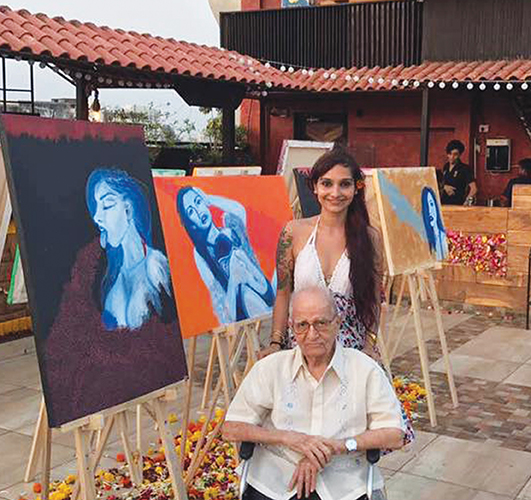
Octogenarian Jal Tata with granddaughter Shanaya and her paintings of her first solo show Women and Flowers
One hasty conversation with my father led to my return to the US for exactly 25 days with one purpose: to pack my stuff and seize the opportunity the universe had provided to return to grandpa. I moved to Bombay permanently in March 2016, with the sole purpose of taking care and being with my 86-year-old grandpa who was heartbroken after his wife’s death.
He and I have always shared a special relationship. He was working day and night when his own children were growing up, so I was the first child that he actually raised. Everyone in the family knows that for him, his whole life always revolved around Nargis and Shanaya. My grandma once told him, "There are two pieces to my heart. One in my body, and the other half in Shanaya.”
Leaving everything behind to take care of a loved one was one of the most difficult decisions of my life. But it has been extremely fruitful and useful. A month after I moved to Bombay, grandpa was hospitalized for 15 days. We had a good three months after the initial sickness, but in September, he was back in hospital for six months. Despite three heart attacks, fluid in the lungs, a nonfunctioning bladder, and degenerative spinal disease, grandpa somehow fought back and is now living the new life that was gifted to him.
Before the hospitalization, grandpa was semi-independent and could walk around and take care of himself. Now that he is no longer mobile, my help Neha, our ward boy Noor, our puppy Rumi, and I are a ‘power’ team prepared to do everything for him. It is an interesting journey as grandpa’s mind is powerful, but his body has aged. To metamorphose from a powerful human being handling a family and many people, to being completely dependent on others, is a transition that he has accomplished gracefully. I feel fortunate to be around such a person.
I worked at two different offices before grandpa’s decline, but had to quit when he got sick. For the six months that he was hospitalized, my schedule involved going to the hospital at 7.30 a.m. and leaving at 8.30 p.m. as I took charge of all his food intake and medical needs. (All that ambulance training did not go to waste!) Although it was a dark time, it has been one of the greatest lessons in responsibility and love.
With this new routine, I realized that I could no longer work in an office, my schedule now revolving around grandpa’s care. That’s when the artist in me manifested.
As a freelancer, I work part-time as creative head, with Rage Entertainment that organizes pop up events in the city. I am also a professional artist. My degree provided training in painting, drawing, photography, ceramics, sculpture, digital media, curating, exhibiting, etc which gives me an understanding of art as a profession. Although I have knowledge of various mediums, I currently identify myself as a painter.
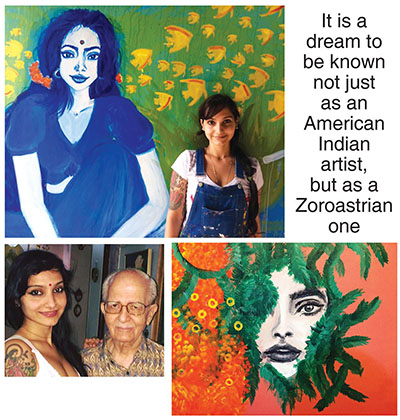
Shanaya Tata (top and above left) with her paintings Mural 1 (top) and Mask Off (right) and with granadfather Jal
I made my debut in India in May 2017, with a solo show called "Women and Flowers,” at Raasta Bombay in Khar. After a successful exhibition, I have sold many personal and commissioned paintings. Working on events has allowed me additional leadership opportunities. I was in charge of the entire art section: curation, production and live painting acts, at "Purple Rain,” Bombay’s first monsoon festival, that highlighted music, fashion and art. Furthermore, I got picked up by Dysco and Big Happy City (BHC) to do a mural on Carter Road, that is due to be inaugurated by the government. The piece was featured in Midday in August!
My identity as an artist has many faces. However, the aspect that is most important to me is that I am a Parsi. As part of my education, I have studied Eastern Art from the Persian perspective. Manuscripts passed down from Zoroastrianism to the Islamic tradition have been subjects that have directly influenced my work. Our garas, and their intricacies, lend themselves to my subjects and patterning. Most importantly, all my accomplishments in the art world are not just my dreams: I am fulfilling the dreams of my grandmother who was also a brilliant artist but never got the chance. It is a dream to be known not just as an American Indian artist, but as a Zoroastrian one.
When grandpa was fighting for his life, I prayed and promised myself that if he lived through this, I would make sure I do things to make him proud. It is my biggest goal at the moment to have the remainder of his life filled with excitement, as he now lives through me. Not every day is easy, but every day is worth it because my grandfather is truly one of a kind. We literally have no secrets. It’s not he who is lucky to have me, it’s I who am lucky to have him.
As a society, we are nothing without our elders. No matter how modern our lives become, we still need our traditions. As someone who was deprived of Parsi culture for 12 years, I now find it comforting to sit in an agiary embraced by the fragrance of sandalwood. I love being surrounded by bawas. A part of me screams "rebel” but my soul belongs to my childhood, to my grandfather, to my art… my Zoroastrian experience.
◆ ◆ ◆
From the archive