
Demography
A class apart
Jiyo Parsi’s second advertising campaign that prioritizes family over individual accomplishments has come under criticism
The second phase of the Jiyo Parsi advertising campaign was meant to be "serious and hard-hitting…to encourage young readers to think about their future and not just live in the present” but like its predecessor it has earned backlash from some young Parsi women who find it "regressive… classist… and distasteful.” The series of 12 black and white advertisements capture tender, affectionate moments experienced with the family or the misgivings entertained by young and senior singles.
One of the advertisements depicts a little girl lovingly kissing her sister with the catch line reading: "The most amazing gift you can ever give your child: A sibling”. The subsequent explanation that parents with only one child have undertaken "a job that’s half done” or the insinuation in other advertisements that unmarried individuals can only expect to lead a lack-luster life is criticized by the piqued ladies who have expressed their views in print and online media. They believe the Jiyo Parsi scheme that seeks to increase community numbers with the Rs 10 crore financial backing sanctioned by the Government of India in 2014 smacks of being racist and clannish.
One of the advertisements depicts a little girl lovingly kissing her sister with the catch line reading: "The most amazing gift you can ever give your child: A sibling”. The subsequent explanation that parents with only one child have undertaken "a job that’s half done” or the insinuation in other advertisements that unmarried individuals can only expect to lead a lack-luster life is criticized by the piqued ladies who have expressed their views in print and online media. They believe the Jiyo Parsi scheme that seeks to increase community numbers with the Rs 10 crore financial backing sanctioned by the Government of India in 2014 smacks of being racist and clannish.
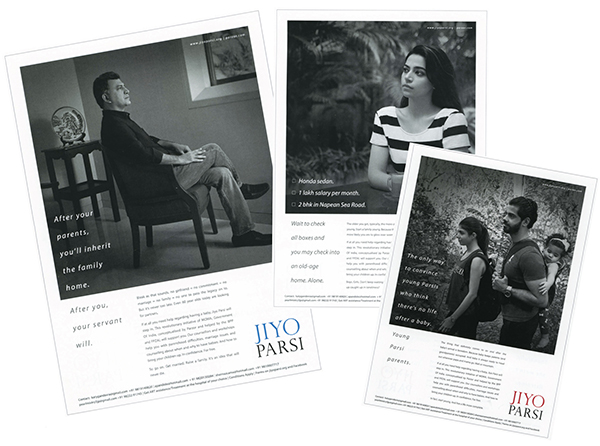
Some of the hard-hitting advertisements in the Jiyo Parsi campaign
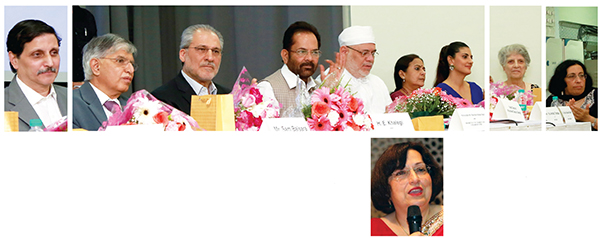
In support of the Jiyo Parsi endeavor at the launch of the second phase of the advertising campaign
(above, from left): Yazdi Desai, Sam Balsara, Masood Khaleghi, Mukhtar Abbas Naqvi, Dastur Khurshed Dastoor,
Niva Singh, Parizad Kolah Marshall, Armaity Tirandaz, Dr Niloufer Shroff; (alongside) Dr Shernaz Cama
"We genuinely believe that to live a fulfilling life, it is good to have a family and in later life a support system, which is missing today in many Parsi lives. Obviously the subject is delicate but needed to be tackled,” confirmed Sam Balsara, chairman and managing director of Madison Worldwide who worked pro bono on the campaign with his core team.
"These ads specifically target the Parsi community and encourage them to settle into married life at a younger age than the present average. These ads sometimes make for difficult viewing, but that is because they tell hard truths, when (and only when) viewed in their correct context within the Parsi community... Our request is to see all 12 ads in their correct perspective,” urged Dr Shernaz Cama, director of Parzor Foundation that is masterminding the Jiyo Parsi scheme.
In the new campaign launched on July 29, 2017, (see "The second awakening,” Parsiana, August 21, 2019) perhaps the advertisement that earned the maximum wrath showed a well coiffured gentleman sitting alone in an elegant home with the provocative caption: "After your parents, you’ll inherit the family home. After you, your servant will.” Those whose sensibilities were affronted by the message and the use of the word "servant” felt it reflected the class culture that characterizes many affluent Parsis.
Bombay born Anahita Mukherji who is now a journalist in the US wrote on wire.in, "Not once does the campaign talk of fluffy ideas such as romance and compatibility as reasons for marriage. Instead, the focus is on not letting your ‘servants’ grab your property, having companionship at the theater and producing children who will go on to look after you in your old age. There’s even one about how people who don’t get married will eventually have to check into an old age home alone. Now that’s the very best incentive for marriage that I’ve heard of so far!
"The Jiyo Parsi campaign aims at preserving an ethnic community, one that believes that it is a separate, blue-blooded race, whose racial purity will be lost if Parsis marry outside the community,” stated Mukherji. "Children born with medical help from the first Jiyo Parsi campaign over the last three years really aren’t going to save the community. At present, Parsis need to be rescued from themselves,” she declared.
"The campaign is symptomatic of the sick and sinful Jiyo Parsi scheme,” historian and blogger Simin Patel was quoted in The Hindu of August 11, 2017. At the launch of the first campaign in 2014 she had felt the community was being likened to endangered species like panda bears. This time, a young mother Sanaya Dalal who was offended by the insinuation that "the only joy single young Parsis can look forward to is marriage within the fold and children,” questioned rhetorically, "What are we? Sheep?”
Responding to some of the adverse comments, Balsara conveyed to Delshad Irani of The Economic Times that many "generous” Parsis have left their homes, from palatial flats in south Bombay to bungalows in beachside towns to people who have served them for decades. In an interview with Jyoti Shelar of The Hindu, Balsara commented that the critics are "people who want to use the Jiyo Parsi platform to further their own agenda about intermarriage, entry to religious places, etc. These are not issues for Jiyo Parsi to look at… When we launched phase one, there were similar objections raised by a handful of people. But I hope all Parsis are agreed on at least one objective: that the community must live and it’s a good thing to have a family.”
Asserted Cama, "The principal goal of the Jiyo Parsi scheme is to provide financial aid, when required, for infertility treatment and counseling for Parsi couples… We have recently crossed the 108 baby mark in three years of running the program which is significant, an around 18% rise per year, when considering, that on average, only about 200 babies are born annually in the Parsi community in India.”
In addition to the medical treatment which forms the bulk of the funding within the scheme, there is a social advocacy program through which they want to urge Parsis to "marry at an earlier age which will help boost the total fertility rate (TFR).” Citing the study by Harvard researchers Shroff and Castro that currently pegs the community TFR at an abysmally low 0.89 children per couple, she quoted from their paper, "Results show that, given current fertility, acceptance of children of intermarried women would have a negligible impact on stemming the population decline.”
The reason why Parsi women who have married outside the community are not covered by Jiyo Parsi is because it is a government of India scheme and therefore "bound to follow the legal definition of Parsi Zoroastrian” in the Indian context, stated Cama, adding, "The Parsis have maintained a patriarchal system of ethnicity for which there is now even genetic evidence (Chaubey et al, Genome Biology). The issue of intermarried women is a debate for the entire community to decide and act upon, it is beyond the remit of the Jiyo Parsi scheme or its team to change the definition.”
In the concluding paragraph of her press statement she wrote, "If community members who are critical of this approach have any better, constructive ideas, within our remit, to stem our decline, we encourage them to get in touch with Jiyo Parsi (www.jiyoparsi.org or on our Facebook Page) with their suggestions.”
Fortunately, the Jiyo Parsi team has its fans too. As confirmed community historian Marzban Giara, "I find the ads are depicting reality. There is nothing regressive.” Dinshaw Tamboly, managing trustee of WZO Trust Fund, was quoted by The Quint on August 16 as stating, "Being a very keen admirer and supporter of the all-ladies Jiyo Parsi team functioning with missionary zeal in cities, towns and villages, I can only applaud their efforts and pray their efforts be crowned with success.” He further added, "It is a universally acknowledged fact that positive thinkers are known to see the invisible, feel the intangible and achieve the impossible.”
◆ ◆ ◆
One reader wrote
"but like its predecessor it has earned backlash from some young Parsi women who find it "regressive… classist… and distasteful.” These ladies are a disgrace not caring for the community and the sufferings the community had to go through preserving the faith.
From the archive