
Where we are headed
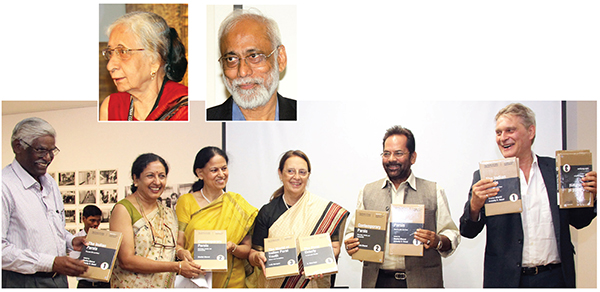
"Community ko aur aagé hona chahiye (the community should be further ahead),” Naqvi said, lauding the shandaar (glorious) history of the Parsis. Responding in Hindi, Dr Pheroza Godrej, chief guest of the evening said that "Parsi o ka dil bhi bada hai aur haath bhi bada hai (Parsis have large hearts and generous hands). We are Indians first… we should not ask for favors (from the government).” The art historian narrated that she had already procured the set of books, "not knowing she would be called upon” to release the tomes! "I hope to be able to contribute to telling India and the world the Parsi story,” she ended.
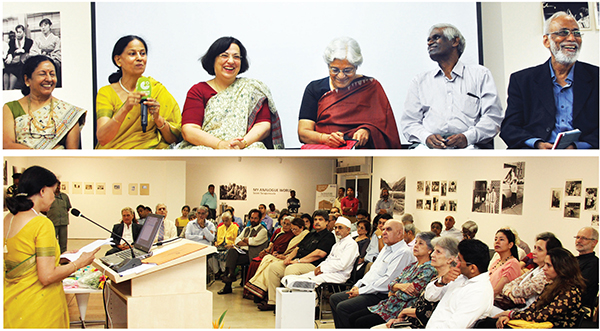
Earlier, Dr Martin Walde, director MMB, welcomed the audience. Congratulating the authors and TISS, the director said that he "saw daily the Parsi contribution to Bombay’s culture.” In his welcome address, Dr S. Parasuraman, director of TISS said he hoped the volumes would help the public to "understand the decline and how to arrest it.”
The volumes include articles and empirical findings based on multiple researches. The invitation to the event stated that "this is a major socio-psycho-anthropological work in over a decade” on the dwindling community numbers. The studies were carried out in collaboration with Parzor [The UNESCO (United Nations Educational, Scientific and Cultural Organization) Parsi Zoroastrian Project] with the support of the Bombay Parsi Punchayet and Sir Dorabjee Tata Trust.
The first volume co-edited by Desai and Bharat, The Indian Parsis: Themes Old and New covers the historical and contemporary concerns of the community and integrates the findings from the other three books; Volume 2 Contemporary Parsis: Marriage, Family and Community, authored by Bharat addresses questions of sociology; Gen Next is the subject of Volume 3, The World of Indian Parsi Youth: Status and Perceptions, authored by Prof Lata Narayan while the senior members of the community are covered by Volume 4, The Parsi Elderly: To Live with Dignity, authored by Prof S. Siva Raju. Both Narayan and Raju are faculty members at TISS.
Since Desai could not attend the program due to her ill-health, Bharat read out extracts from her eight-page address. She called the volumes "the first truly pan-Indian study of Parsis.” Desai’s speech stated that the results in the books would shatter many commonly held myths: that Parsi boys study less than girls; that Parsis hanker only after white collar jobs; that Parsis do not have entrepreneurial vision; that most youth want to live in baugs.
The researchers who covered Volume 2 covered 1,132 respondents for a quantitative analysis and 132 for qualitative views. Presenting a summary of the findings, Bharat stated that "late marriages were accepted as the norm within the community, and singlehood had community-wide acceptance.” There was "poor acceptance of incentivized schemes for fertility.” As many as 77% of the people who responded agreed that mixed marriages are unavoidable, whereas 60% supported mixed marriages over remaining single. Promotion of early marriages and early start to families was required, she said, but messaging to youth for this had to be "supportive and non-directive.”
Narayan’s team interviewed 761 individuals in 15 locations between the ages of 20 and 35 for the third volume on youth. The researcher detected gender discrimination: there was pressure on women to have more children (as against men), compounded by the restrictions imposed on those who are intermarried, she pointed out. The youth had a grouse as far as religious identity was concerned: there is no clarity regarding religious practices, seemed to be a common refrain. "Parsi youth are no different from Gen Next… ultimately the youth will negotiate and make informed choices,” she noted. Explaining that the youth were comfortable with "multiple identities” (Parsi, Indian, Bombaywalla…), the academician said that this should be taken as a positive sign. Most respondents asked for a greater role in community decision making, role modeling by leaders, more connections with rural Parsi youth…
The Parsi elderly account for 31% of its population, as against the national average of 8.5% revealed Raju. The surveys for the fourth volume drew 835 respondents. Home-based support seemed to be the overwhelming need, with training of medical and para medical staff a voiced priority. Raju made a plea for an apex organization to manage and coordinate efforts for the elderly. For institutionalized care, there was a need to have a more participatory style of governance within such bodies.
Forecast 40K
At the end of the coming three decades, the Parsi population in India will be between 40,000 and 42,000 (from 57,264 as per the 2011 census) according to demographer Prof Leela Visaria, honorary professor and former director at Gujarat Institute of Development Research. She was participating in a panel discussion with Dr Shernaz Cama, head of Parzor. "Even if from today, the community started accepting children of mixed marriages or other similar ‘drastic’ methods to ramp up numbers, the future scenario is not likely to change significantly.” Trends of decline such as exhibited by the community "have not been reversed anywhere in the world,” Visaria said. "Accept this fact and start planning for it,” was her message. "I don’t think that the Parsis will completely disappear” was her parting sop. (At one of the World Zoroastrian Congresses in Bombay, social scientist Ava Khullar had put the figure for stabilization at 25,000. Subsequent to that, the number would again fall, she had said — editors)
Cama related instances from her 15-day tour of Parsi rural settlements in Gujarat in the early years of the last decade: "Village after village with not a child in sight,” she recounted. This was perhaps the seed of the collaboration with TISS for the book, she said. There was a glimmer of hope: the Jiyo Parsi program would soon report its 100th baby in three years. Compare it to the annual average births of 200, and you will note that Jiyo Parsi is making a difference, she said.
Tea and refreshments followed.
FARROKH JIJINA