
Events & Personalities
Women’s entry to Dargah
The Haji Ali Dargah Trust (HADT) intends to move the Supreme Court challenging a Bombay High Court (BHC) ruling of August 26, 2016 recognizing the right of women to enter the inner sanctum of the dargah.
According to a news report in times- ofindia.indiatimes.com, the BHC "bench ruled on a public interest litigation which urged lifting restriction on women inside the inner sanctum which houses the mazaar or tomb of the saint. The ban was imposed somewhere between March and June 2012 by the HADT. The bench held that it is in contravention of Articles 14 (Right to Equality), 15 (Prohibition of discrimination) and 25 (Right to practice religion) of the Constitution of India. It directed the status quo ante to be restored and women be allowed entry on par with men. The state and the trust running the were directed to take steps for the safety of women.
According to a news report in times- ofindia.indiatimes.com, the BHC "bench ruled on a public interest litigation which urged lifting restriction on women inside the inner sanctum which houses the mazaar or tomb of the saint. The ban was imposed somewhere between March and June 2012 by the HADT. The bench held that it is in contravention of Articles 14 (Right to Equality), 15 (Prohibition of discrimination) and 25 (Right to practice religion) of the Constitution of India. It directed the status quo ante to be restored and women be allowed entry on par with men. The state and the trust running the were directed to take steps for the safety of women.
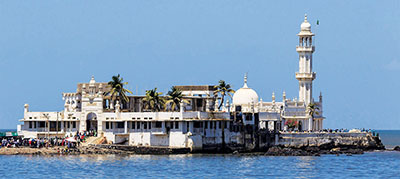
The Haji Ali Dargah at Worli
"The Trust defended the ban saying entry of women in close proximity to the tomb of a male saint is grievous sin in Islam. Its advocate Shoaib Memon argued that Article 26 of the Constitution of India confers upon the trust a fundamental right to manage its own affairs in matters of religion and as such interference is uncalled for by third agency.” Memon also informed that the existing arrangement provides for a secure place for women to offer prayer.
"Haji Rafat, Majlis-e-Ittahadul Muslimeen of the HADT, said the high court should not have interfered in the issue. The trust will now approach the Supreme Court,” he said.
"The Maharashtra government had batted for women saying that they cannot be banned inside the inner sanctum unless it is shown that banning them is integral to Islam. Advocate general Shreehari Aney argued that if the trust says it has a fundamental right to manage its religious affairs, then it has to be weighed against Articles 14 (Right to Equality) and 15 (Prohibition of discrimination on grounds of religion, race, caste, sex or place of birth) of the Constitution.
"The petitioner’s advocate Raju Moray also said documents show that the government while giving the land on 999 years’ lease has retained pervasive control including in the appointment of the trustees. He said their defence cannot be that it is a purely religious trust.”
Parsi women have still to challenge a 1908 BHC judgment barring the children of Parsi women married to non-Parsis from entering fire temples, having their bodies consigned to the Towers of Silence or deriving any other benefit available to Parsi Zoroastrians. Only the child of a Parsi father is considered a Parsi, according to that judgment.
◆ ◆ ◆
From the archive