
Welfare
Cooking for carers
Khushroo Poacha’s Seva Kitchen network of volunteers delivers home cooked meals to disadvantaged relatives who tend to patients in hospitals
The cafeteria at the Central India Institute of Medical Sciences (CIIMS) was shut and Khushroo Poacha had to step out for a cup of tea at a roadside thela (hand cart). There he saw an old woman roasting rotis on a tawa (griddle) propped up on two bricks, heated by a fire rustled up with twigs foraged from the area outside the hospital in Nagpur. The rotis roasted on the make-shift ‘stove’ were served with no accompaniments like vegetables or even pickles to her family members who were taking care of a relative in that hospital. This is what led to the Nagpur resident’s epiphany. Poacha does not recall who the lady was, but thanks to this sight that touched him two years earlier, he started Seva Kitchen (SK). The organization provides food to caregivers at various hospitals through volunteers in nine hospitals in seven cities in India – Nagpur, Ahmedabad, Bangalore, Hyderabad, New Delhi, New Bombay and Moradabad.
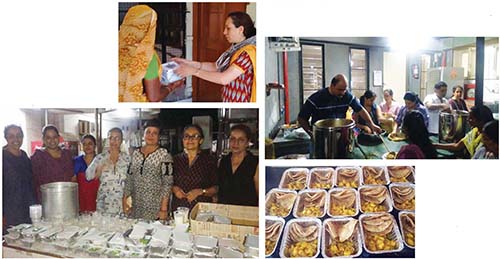
Clockwise from above: Fermin Poacha serving a carer at Tukdoji Maharaj Hospital;
seva at CIIMS; sample servings; volunteers at Arneja Hospital
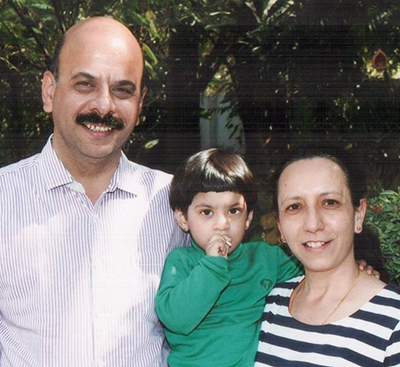
Khushroo, Tunisha and Fermin Poacha
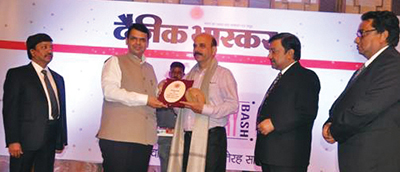
Khushroo Poacha felicitated by chief minister of Maharashtra, Devendra Fadnavis
for social entrepreneurship in December 2015
Poacha’ late mother Katie was undergoing brain surgery at that time, 48-year-old Poacha informs Parsiana in an interview on May 30, 2016. When he narrated the story of the old woman to Katie, she told him, "Why don’t you start feeding them? People will help you; they will give you the money to do so. Do something.”
"I felt the compelling need to do something about it, but I was going through a difficult time seeing my mother losing her battle with life,” states Poacha in a follow up mail to Parsiana. "Then, I remembered a friend of mine, Amit Badiyani, telling me that if there was any occasion where somebody needed help, I should let him know. I called him up and told him of the situation. He agreed whole-heartedly, and started the next Sunday to buy food from a restaurant for distribution to 25 people. We started the seva (service) on Sundays, as the hospital canteen would be closed” on that day, he states.
Katie was discharged from the hospital shortly thereafter, but lost her battle with life a few months later. "Grief-struck, I remembered her words, and wanted to initiate a seva of my own. One Sunday, I went to the hospital and witnessed the seva carried out by Amitji. As soon as it was announced in the hospital that the food had arrived, about 100-odd people would come running. And there was enough for only 25,” he recalls. This was when Poacha realized that if they cooked the food at home, the same amount of money would go a longer way in feeding more people. "I discussed it with Badiyani and my wife, Fermin, and we decided to cook the food at our homes and serve it at CIIMS on Sundays.”
Explaining how the movement grew, Poacha states "the first time we cooked food, we served 50 people. The numbers kept on growing every week as more and more people came to know about the seva in the hospital. We then hired a cook.” Friends and like-minded people offered money to help. "I did not want the money. I wanted them to cook food and take it to the locations where it was needed and serve it to the people,” explains Poacha. He wanted total involvement of the volunteers. Calling this a "people-sourced” initiative, he states that cooking was done alternate weeks in his household and in Badiyani’s. Soon, another friend wanted to start a service at another hospital "so we started a seva at Tukdoji Maharaj Cancer Hospital where we now serve five times a week.”
SK provides the meal service generally on Sundays at most locations. "Sunday is a holiday for everybody. People can take out time on that day at least (to cook and serve). As the idea spreads, people have started doing it on weekdays as well. Like in Hyderabad where the seva is done on a Thursday also,” says Poacha, whose network serves approximately 1,400 meals on any given Sunday. "Now volunteers in New Bombay want to spread the initiative to pavement dwellers and migrant construction workers,” he beams.
"We use the same idea everywhere across the country. When someone does a seva we ask the volunteers to take pictures of the food and post in on Facebook with a short description of Seva Kitchen and the location where they served the food. More people join in after seeing the post.” Prominently displayed on the SK website are rules for volunteers regarding the nature and quality of food and how it is to be served. The rules include this statement: "We must remember we have been given the opportunity to serve and (are) not doing anyone a favor …”
With over a 100 helpers in the seven cities (over 50 in Nagpur), "the volunteers cook the food and serve it immediately, in foil containers,” he elaborates. Aside from volunteers, social welfare minded restaurateurs chip in too. He mentions two in Nagpur: Khichdiwala and Goldy Caterers. He does not believe that "you need money or an NGO (nongovernmental organization) to do ‘good work.’” What you need is passion, he states quietly.
The commerce graduate from Hislop College in Nagpur who works in the commercial department of the Indian Railways, started www.indianblooddonors.com in the year 2000, which has "about 50,000 (registered) blood donors …and has served more than 1,00,000 requests for blood.” That initiative of Poacha received the silver Manthan award in the ‘e-health’ category for best e-content and creativity (see "Blood network,” Events and Personalities, Parsiana, August 21, 2005). His second initiative www.plateletdonors.org has about 1,000+ registered platelet donors and has fulfilled more than 4,000 requests for platelets. "Companies come up to us to give their services or infrastructure free of cost. They help sustain the (IT — information technology) systems,” he says. Poacha was recently part of a team put together by the Nagpur Parsi Gymkhana to help in the sending of 15,000 ltrs of water pouches to drought affected areas in Latur, Maharashtra. He was quoted in The Times of India of May 15, 2016 that "the idea is to do whatever we can to help those affected by natural calamities. At such times, everybody should contribute whatever little they can.”
Having lost his father Adi when he was 16, Poacha is appreciative of the how the Nagpur Zorastrians had then reached out to assist his family. "Helping comes naturally to Zoroastrians,” he says, adding that "I will always remember the support we got in those bleak days.” One Zoroastrian he holds in high esteem is gynecologist Dr Anahita Pandole who helped his wife Fermin (who he met at a Zoroastrian youth conference in the early 1990s, and who works in the office of J. N. Tata Girls School) and Khushroo experience parenthood after 19 years of marriage. In 2013 little Tunisha entered their lives. "A noble soul … next to god for both of us,” Poacha, exults about Pandole.
Poacha can be contacted on +91 95610 11264 or at poachas@gmail.com
◆ ◆ ◆
From the archive