
Zoroastrians Abroad
The restored road
After a remarkable transformation, the historical Eduljee Dinshaw Road stretching from the Karachi Port Trust (KPT) building to Customs House was opened to the public by Sindh governor Dr Isharat Ul Ebad Khan on December 13, 2015 at an elaborate ceremony attended by diplomats, senior government functionaries and politicians, as reported in The News International the following day. Considered a successful public-private partnership, "The project is a stepping stone to Karachi’s cultural revival,” Khan had remarked at the ground breaking ceremony the previous year, recalling how Karachi used to be a peaceful, pluralistic city and efforts were required to replicate that spirit, according to a news report in Dawn, November 12, 2014.
As reminded the customs preventive collector Tariq Huda, the thoroughfare houses the two most prestigious architectural landmarks of the metropolis, the KPT building and the Imperial Customs House. But the area had been substantially neglected, becoming infamous for the worst forms of traffic jams, being used as a garbage dumping site, shops being converted into warehouses and a favorite den for drug peddlers. "Over the years the Road began to reflect the same neglect as other contributions of the Parsi community that have faded into the city’s increasing chaos,” noted a write-up in The Express Tribune of December 15, 2015.
As reminded the customs preventive collector Tariq Huda, the thoroughfare houses the two most prestigious architectural landmarks of the metropolis, the KPT building and the Imperial Customs House. But the area had been substantially neglected, becoming infamous for the worst forms of traffic jams, being used as a garbage dumping site, shops being converted into warehouses and a favorite den for drug peddlers. "Over the years the Road began to reflect the same neglect as other contributions of the Parsi community that have faded into the city’s increasing chaos,” noted a write-up in The Express Tribune of December 15, 2015.
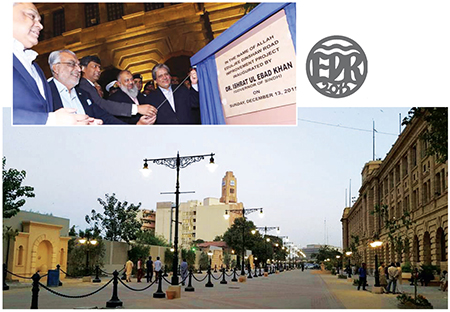
Dr Isharat Ul Ebad Khan inaugurating the renovated Eduljee Dinshaw Road
and the Project logo Photos: Project Facebook Page
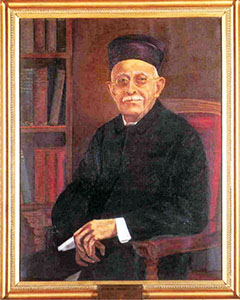
Portrait of Eduljee Dinshaw (top) Photo: dostpakistan.pk
The Customs House partnered with leading architect Shahid Abdulla and design consultant Danish Zuby to restore the Road’s former glory, stated Huda. According to Abdulla, all municipal stakeholders and agencies were taken on board to streamline the traffic, make space for pavements, adding benches and turning the street into a social hub for local residents. After 6.30 p.m. the Road turns into a pedestrians-only zone. "It feels like we’re roaming the streets of London,” commented one resident whilst another remarked, "I can’t believe this is our Karachi.” Academy Award winning filmmaker Sharmeen Obaid Chinoy’s production company — SOC Films — has documented the transformation process.
The Eduljee family is known to have contributed to the first phase of the project which cost Rs (PKR) 65 million (INR 41.6 million). The specially constituted Eduljee Dinshaw Road Trust and Facebook Page for the Eduljee Dinshaw Road Project will continue to give updates on the second phase of the Project which is expected to cost PKR 100 million.
At the ground breaking event, "no one mentioned the name, leave alone charitable work of one of the city’s benefactors, Eduljee Dinshaw, after whom the road is named,” regretted the news report in Dawn. According to Wikipedia, Dinshaw had made his initial fortune during the Second Afghan War (1878-1881) by being a contractor for the British Army. He subsequently invested his wealth buying land in Karachi and Bombay and ran a factory for pressing cotton and wool for export as also an ice factory. By the late 19th century he owned around half of the city of Karachi and the local government is believed to have placed an informal ban on his acquiring any more land. His charities extended to the Lady Dufferin Hospital, the Edulji Dinshaw Dispensary and the Nadirshaw Edulji Dinshaw Dispensary. He supported the Mama Parsi Girls’ School and the Sindh Art College in Karachi, and donated a marble bust of King Edward VII and a marble fountain to Frere Hall. A director of Land and Shipping Company and a delegate of the Parsi Matrimonial Court, he was a trustee of the KPT and a member of the Karachi Municipal Corporation. He was the first from Karachi to be made Companion of the Most Eminent Order of the Indian Empire (CIE).
◆ ◆ ◆
From the archive