
Events & Personalities
Boi ceremony in Japan
Clad in priestly vestments Ervad (Dr) Parvez Bajan demonstrated the boi ceremony reciting the Avestan prayers and explaining their meaning and significance at a three-day symposium and conference in Nara, Japan, organized by the Nara Prefecture Centre for Eurasian Studies, Nara Prefecture University where he had been invited as speaker. As per a write-up received from Bajan, he was the only Parsi Zoroastrian at the conference. He lit a fire in the open ground and performed the boi ritual before delegates who had come from Germany, Iran, Tajikistan, China and Japan. The Japanese authorities had an afarganyu especially made for him as per his specifications, along with a bell and long pieces of wood to represent the maachi during the boi ceremony.
Bajan also read a paper titled "Zoroastrianism – A Living Faith in a Living God” which highlighted the teachings and practice of the hoary faith propounded by Zarathushtra. He spoke of the ancient cultural heritage of the Iranian Zoroastrians and its influence on other cultures of the world.
Bajan also read a paper titled "Zoroastrianism – A Living Faith in a Living God” which highlighted the teachings and practice of the hoary faith propounded by Zarathushtra. He spoke of the ancient cultural heritage of the Iranian Zoroastrians and its influence on other cultures of the world.
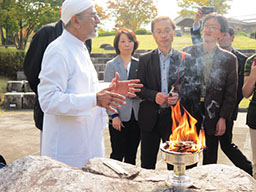
Ervad (Dr) Parvez Bajan explaining fire ritual
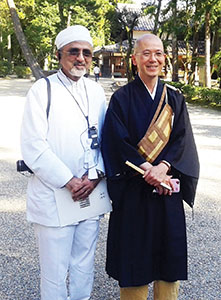
Ervad (Dr) Parvez Bajan with Taichi Ishida of Toshodaiji Temple
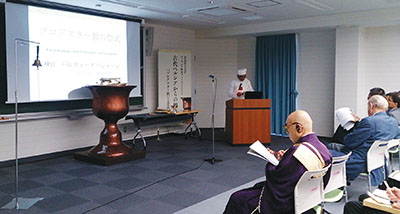
Bajan presenting his paper
The conference, from October 14 to 18, 2015, commenced with an excursion into the ancient city of Nara which served as Japan’s ancient capital from 593 to 784 CE. The participants were taken to the Asuka Historical Museum of the Nara National Research Institute for Cultural Properties and shown stones shaped like a tortoise, monkey and human heads, among others, at various sites.
The following day was devoted to a round table conference during which the Man’yo Shu culture of Japan was discussed with archeologist Prof (Dr) Fuminori Sugaya. The Man’yo Shu is Japan’s earliest extant collection of poems dating from the early 7th to the mid-8th century composed by emperors, members of the imperial family, courtiers, aristocrats, soldiers and common people. That afternoon the participants visited the famous Toshodaiji Temple and the Great Buddha Hall of the Todaiji Temple where they were acquainted with the history of the temple by chief priest Shoshu Hiraoka. A short film on the ceremony of taking care of the sacred water called Omizutori was screened, the write-up mentions.
After the closing ceremony, guest speakers and invitees exchanged views on the influence of Zoroastrian culture and the assimilation of cultures of the east at a dinner hosted by the University authorities where the governor of Nara and other dignitaries were in attendance.
◆ ◆ ◆
From the archive