
Events & Personalities
Ghandy’s hunger strike
Maoist sympathizer Kobad Ghandy has called off his three-day hunger strike after Tihar Jail authorities reportedly agreed to shift him back to his previous jail and not subject him to routine transfers.
Ghandy had gone on a hunger strike to protest against frequent transfers from one jail to another, which have been detrimental to his health. The 68-year-old has been imprisoned for the past six years, charged under the Unlawful Activities (Prevention) Act for being a member of a banned organization. His case is still being heard in the courts and there are several other similar cases pending in different parts of India.
Ghandy had gone on a hunger strike to protest against frequent transfers from one jail to another, which have been detrimental to his health. The 68-year-old has been imprisoned for the past six years, charged under the Unlawful Activities (Prevention) Act for being a member of a banned organization. His case is still being heard in the courts and there are several other similar cases pending in different parts of India.
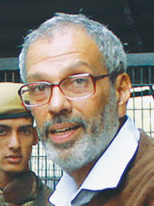
Kobad Ghandy: harassed in Tihar
Ghandy sent a petition to the superintendent of Jail 3 (from which he was transferred) declaring satyagraha, a letter to Jail 8/9 superintendent (jail to which he was transferred), and an appeal to the director general of prisons requesting his intervention, in which he has given details of the distressing methods adopted in regular jail transfers and the crippling impact on a senior citizen with serious health problems.
Outlining the main points, he wrote: "I have spent five-and-a-half years in Tihar with the Delhi case nearing conclusion. Though routine (three to five monthly) transfers of High Risk ward prisoners have been going on for four years I was subjected to this only from August 2014. This is the third time in nine months. Earlier, jail transfers were done only as a form of punishment.
"I suffer from a heart problem, high blood pressure, slipped disc, arthritis, spondylitis, kidney and numerous other health problems all of which have increased specifically after August 2014.
"While transferring we have to carry bags ourselves (some weighing 10-15 kg), go through two sets of detailed searches of all items, are made to hang around at the jail gates for four to five hours waiting for the transport, are packed like sardines with baggage into a single van and taken to the new jail gate.
"In the new jail two more detailed searches, again to carry all items ourselves to the ward, etc. One has to go through Mulaaza (medical check) done for a new entrant. Then a scramble for cells, with the later arrivals getting the worst. Then at least two to three days go in cleaning the filthy cell and arranging the baggage (no help given).
"In the new jail all medical treatment gets interrupted, medical diet and other permissions have to be applied for anew as also for the bed and western toilet. This can take from a few days to months. Also the Vodafone (cell phone) facility has to be started anew. Barely has one settled in and adjusted with the new lot of criminals (some of whom can be pretty nasty) when the next transfer comes and the whole process is repeated.
"The May 3 transfer (came) in the midst of my examination for a heart problem at the G. B. Pant Hospital.
"Since the 2012 High Court order to Tihar to take better care of senior citizens (above 65) I have been applying to be put in the (senior citizens’) ward — but to no avail. On the contrary, while earlier they had never transferred me, they have resorted to this since August 2014, obviously as a method of harassment and to destroy my health.
"As all the appeals, on both humanitarian and legal grounds, have been ignored, I, as a last resort, have had to go on an indefinite hunger strike since the last transfer on May 30.”
◆ ◆ ◆
From the archive