
Festival
Feasts for the faithful
Though gahanbars may have lost their religious connotation they are still part of the community’s cultural and social heritage
For many years gahanbars were a lost art in Bombay. But of late community partaking of meals is making a lavish comeback.
To celebrate the 150th year of Shapoorji Pallonji and Company Private Limited (SP) the Mistry family invited all Zoroastrians to a gahanbar at the Turf Club, Members’ Enclosure at Bombay’s Mahalaxmi Race Course on Mahraspand roz, Meher mah, March 14, 2015. Coupons for drinks and dinner were issued at predetermined venues a few days prior to the event which was attended by a record 6,500 persons. The entrance to the Turf Club, embellished with flowers, was welcoming. Security arrangements were tight and the small army of volunteers present controlled the surging crowds who had come in anticipation of a lavish feast. Long queues snaked outside the entry point trailing almost as far as the stables end of the Race Course.
Members of the Mistry family in the VIP enclosure received guests and graciously accepted greetings from well-wishers on attaining the 150-year milestone. Similar gahanbars, over two days, had been hosted by the Mistrys at their Infocity campus for the Zoroastrians of Poona earlier this year as well as in previous ones where attendees were ferried by special buses to the distant venue.
To celebrate the 150th year of Shapoorji Pallonji and Company Private Limited (SP) the Mistry family invited all Zoroastrians to a gahanbar at the Turf Club, Members’ Enclosure at Bombay’s Mahalaxmi Race Course on Mahraspand roz, Meher mah, March 14, 2015. Coupons for drinks and dinner were issued at predetermined venues a few days prior to the event which was attended by a record 6,500 persons. The entrance to the Turf Club, embellished with flowers, was welcoming. Security arrangements were tight and the small army of volunteers present controlled the surging crowds who had come in anticipation of a lavish feast. Long queues snaked outside the entry point trailing almost as far as the stables end of the Race Course.
Members of the Mistry family in the VIP enclosure received guests and graciously accepted greetings from well-wishers on attaining the 150-year milestone. Similar gahanbars, over two days, had been hosted by the Mistrys at their Infocity campus for the Zoroastrians of Poona earlier this year as well as in previous ones where attendees were ferried by special buses to the distant venue.
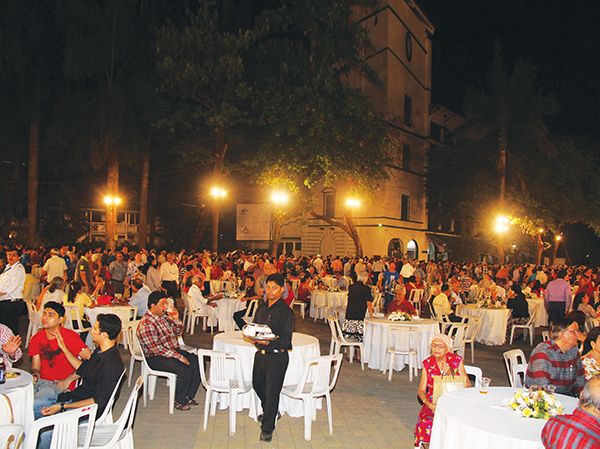
Gathering at the Race Course
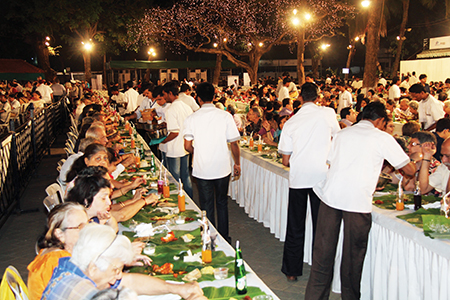
Gahanbar meal
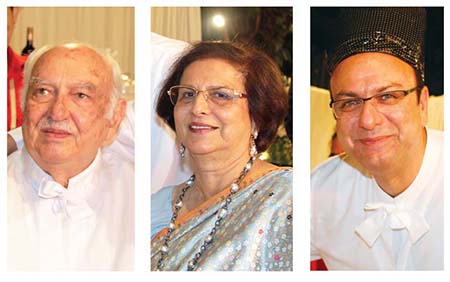
Pallonji, Patsy and Shapoor Mistry
Nor are the Mistrys alone in their largesse. On December 5, 6 and 7, 2011, Dr Cyrus Poonawalla, chairman of the Serum Institute of India, had hosted three days of gahanbars for the entire Parsi Irani Zoroastrian community of Poona in memory of wife Villoo, mother Gool and grandmother Bachubai.
Gahanbars are held to commemorate those who have passed on, or can be celebratory in nature as are those held in Udvada on the salgirah of the Iranshah or in Sanjan for Sanjan Day. There are also contributory gahanbars organized by some community organizations for which attendees pay a fixed amount for a dinner coupon. In earlier years attendees at gahanbars came togged out in traditional clothes with the men wearing daglis and phetas/pugrees/topis; the ladies wore kor ni saris in the Parsi manner with mathabanus, their heads decorously covered with the sor. In marked contrast, hardly anyone present at the SP gahanbar was dressed in traditional garb, though a few of the men wore topis. Most of the women present sported trousers or frocks with those in saris being so few in number that one could spot just the odd one or two!
The gahanbars of yore were mostly gatherings of men only or ladies only, though children under navjote age could attend all, irrespective of gender. The fare was simple: often thick masala dar to be eaten with rotlis, sali boti followed by dhansak or pullav dar, with or without mutton. Sometimes there would be bhaji daana or akuri. There was always plenty of cachumber as accompaniment. A soft drink was also provided but no repeats were available! Similar fare is served even today at gahanbars sponsored by families to commemorate their deceased members in Bombay, Poona and certain cities/town of Gujarat. What a contrast to the unending number of delicacies provided by the Mistrys, not to mention the premium spirits which were enjoyed by the attendees!
In The Religious Ceremonies and Customs of the Parsees, Jivanji Jamshedji Modi explains, "The gahanbars are generally accompanied with solemn feasts, wherein members of the family or residents of a street or town participate… If one can afford, he may pay his mite, in money or in kind.” Modi adds, "Universal brotherhood which we often hear spoken of, was one of the principal objects aimed at in the public gahanbars. The rich and the poor — rich and poor not only in wealth but in intellectual knowledge — of the town were expected to meet together and to learn from each other’s company what was best in it.”
But while retaining their social element, gahanbars, fixed as per the seasons, seem to have lost their religious connotation in the present times. Farrokh Vajifdar, London based independent researcher on Zoroastrianism elaborates: "All six gahanbars form an integral part and parcel of our ancient religion. Being originally an agro-pastoral society of settled communities, it was important that the work and rest periods were timely observed where the sun, the seasons, and the zodiacal stars ensured their correct times.
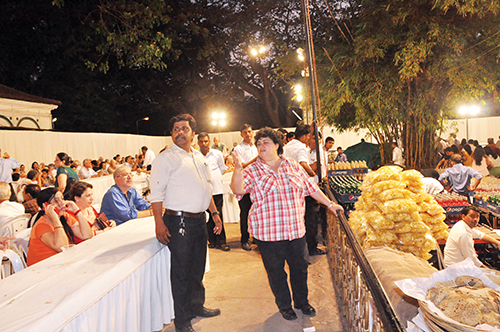
Tanaz Godiwala (in checked shirt) overseeing the service
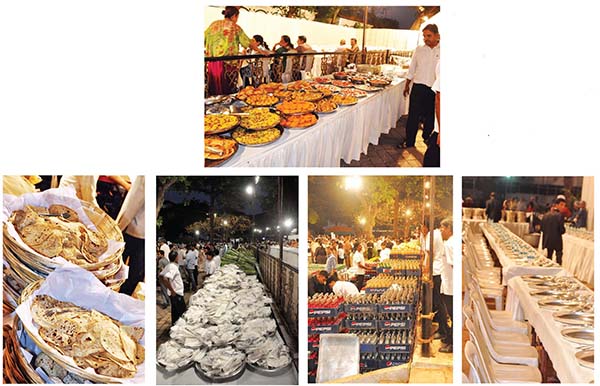
Behind the scenes activities at the Shapoorji Pallonji gahanbar
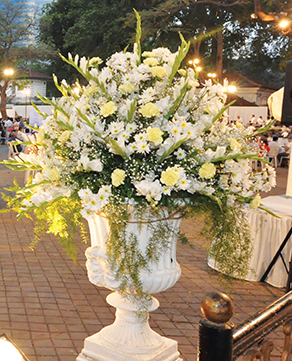
Floral decoration
"The learned priest-scholars who formulated our unified calendar explained these matters through popular devices as the six periods of creation followed by six sensibly placed five-day ‘rest’ periods. They were exactly named for precise seasonal intervals which had their fixed roz-mah indications. Gahanbars are named after their seasons and seasonal duties (as of old!). Thus, we have Maidyoizaremaya, mid-spring (April 30-May 4), Maidyoishema, mid-summer (June 29-July 3), Paitish-hahya, harvest (September 12-16), Ayathrima, cattle returned from high pastures (October 12-16), Maidyairya (December 31-January 4), Hamaspathmaidaya, mobilization of labor (March 16-20). Gahanbars must be held at these precise times. No longer can urbanized Zoroastrians observe these as five-day breaks; one-day observances now suffice. It is nevertheless crucial that these ancient festivals continue to be observed — it is our ancient Zoroastrian heritage. Ignorance and indifference must never be allowed to diminish its precious transmission.”
Vajifdar agrees that gahanbars do serve a purpose today at the social level and can be held for any good purpose. "If such a gahanbar were held to commemorate an anniversary, then it is all to the good.” He also stresses the need for people to be informed of the religious imperative of the gahanbar.
"Gahanbar means ‘the time for collecting/storing,’” wrote Noshir Dadrawala in the Jam-e-Jamshed Weekly of March 22, 2015. "Broadly speaking it is the time for collecting good deeds and nature’s blessings… In modern times, a number of philanthropic Parsi and Irani Zoroastrians sponsor gahanbars in the nayat or memory of their dear departed as an act of spiritual merit and to invoke blessings from and for the departed…”
Istvan Keul, Professor, Study of Religions, Department of Archeology, History, Cultural Studies and Religion, University of Bergen, writes that "throughout time and in every culture, human beings have eaten together. Commensality — eating and drinking at the same table — is a fundamental social activity, which creates and cements relationships. It also sets boundaries, including or excluding people according to a set of criteria defined by the society. Particular scholarly attention has been paid to banquets and feasts, often hosted for religious, ritualistic or political purposes, but few studies have considered everyday commensality.”
Keul recommends reading Commensality: From Everyday Food to Feast by Profs Susanne Kerner, Cynthia Chou and Morten Warmind of Copenhagen, Denmark which offers an insight into this social practice in all its forms, from the most basic and mundane meals to the grandest occasions. With insights from anthropologists, archeologists and historians, the volume offers a vast historical scope, ranging from the Late Neolithic period (6th millennium BC), through the Middle Ages, to the present day with case studies from across the world, including the USA, Bolivia, China, Southeast Asia, Iran, Turkey, Portugal, Denmark and the UK for an understanding of commensality’s role as a social and political tool, integral to the formation of personal and national identities.
An unfortunate aspect of the recent SP gahanbar was the scramble to obtain coupons, with videos of unseemly brawls between women making the rounds on WhatsApp and rumors that the generously dispensed coupons were sold by unscrupulous elements for Rs 200 each. "From what was once a solemn religious event, we have reduced it to a black comedy circus where tickets are sold in black, people scream and shout and push each other as if they have just returned from a famine stricken district,” wrote a disgusted Dadrawala in the Jamé.
When Parsiana spoke to eminent social scientist Prof Armaity Desai, former director of Tata Institute of Social Sciences (TISS) and former chairperson of the University Grants Commission about whether there was any truth behind the notion that Parsis go berserk at the mention of free food, she was clear that this was not a Parsi trait. "Parsis are generally dignified (but) everyone wants to have his or her share of the cake. When the pie is small, it may result in some negative behavior. This is a typical human response, not necessarily relating to Parsis.”
Desai is in favor of continuing to have gahanbars in smaller towns where there is a need to provide for food to the needy. "It was different in the old days,” she says. The community got together to mingle, to exchange views. "Now they come only to eat,” she observes. "The community needs continuing programs for individuals to engage with each other instead,” she states. "Perhaps the original purpose of having gahanbars is not served by holding them in urban communities,” she believes.
But with the number of Parsis declining and fewer navjotes and lagans being held, occasions for getting together for a meal as a community are fewer. Gahanbars, whatever their merits or demerits, bring the community together.
◆ ◆ ◆
From the archive