
Festival
Channeling “positive energy”
The annual Kala Ghoda Arts Festival animates Bombay’s art district and helps raise funds to preserve the precinct
Maneck Davar heaves a sigh of relief when asked how he feels at the end of the 16th instalment of the Kala Ghoda Arts Festival (KGAF) in Bombay. He feels "no different,” he says, than he did "at the end of the 15th or the 14th or the 13th episode.” The chairman of the Kala Ghoda Festival Association (KGFA) that runs this much loved and well attended Festival of the arts every year in Bombay says that the response that it generates year after year is what keeps him going. A publisher of several journals and a former journalist, Davar says he came to be intimately involved with the KGAF as "after all, someone has to do the job of providing that much needed dose of excitement and culture to our city.”
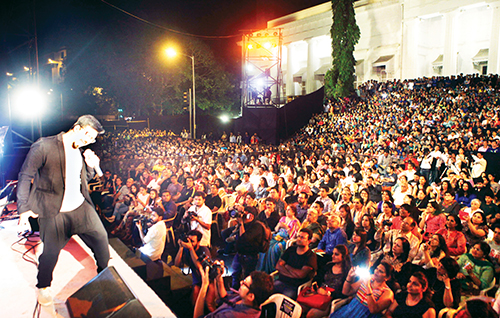
Bollywood composer Amit Trivedi performing on the last night of the KGAF
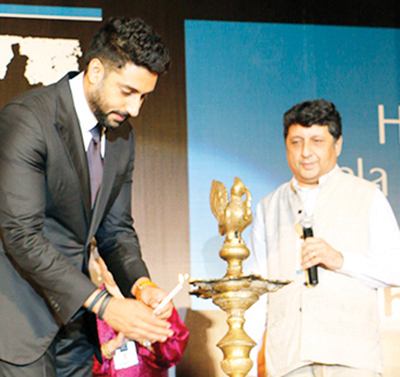
Chief guest Abhishek Bachchan lighting the inaugural lamp
while Maneck Davar looks on (Photos: Hindustan Times)
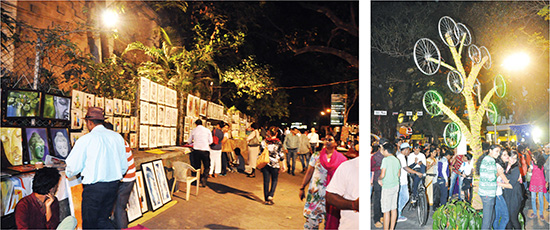
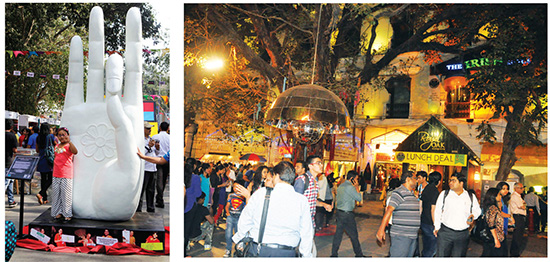
An art installation at Rampart Row;
Street views from the popular venues, (Photo: Hindustan Times)
The KGAF is an annual festival, nine days long, commencing always on the first Saturday of February, in the Kala Ghoda area of South Bombay. The Festival sections include visual arts, dance, music, theater, cinema, literature, heritage walks, urban design and architecture, food, a dedicated section for children and a vibrant street section including stalls selling eco-friendly, handmade arts and crafts. Entry to all events, simultaneously held at different venues in the vicinity, is free.
For someone who has been involved with the KGAF for a decade in various capacities, culminating in his appointment as chairman of the KGFA four years ago, he feels the defining moment of each year comes when, at the closing event, there is "an unbelievable amount of positive energy.” Hearing the satisfied roars of appreciation of the crowds at the closing venue, normally the Horniman Circle Gardens, gives him the satisfaction of steering the Festival through yet another successful year.
When asked what his long term vision for the KGAF is, the activist says with a shrug that he is "not a long term person.” He prefers to take each year as a step towards ensuring that this Festival binds people from diverse backgrounds into a "large family group” that can participate in diverse events and "just enjoy themselves.” The KGAF is "not only for a certain elite group; it is for everyone,” he avers. In support of this, Davar states that in 2015 about 500 events were held in 16 languages. He recalls two elderly Parsi ladies at a Hindi play. They apparently did not understand the language, but were there to soak in the ambience.
The chairman is particularly proud of the fact that over the years the KGFA has been able to successfully fulfil its objective of preservation of Bombay’s Art District. He quotes figures ranging from Rs 5,00,000 to Rs 50,00,000 donated out of the proceeds of the KGAF to various entities around the Kala Ghoda precinct, for their functioning, preservation and upkeep.
It is not smooth sailing every year for the KGFA, he observes. Though there is a prior resolution passed by the state government in support of the KGAF, there are, almost every year, last minute coordination glitches that result in "butterflies in the stomach.” Quoting the example of the 16th instalment, he reveals that all the relevant authorities had not provided their go ahead till 16 hours before the opening event. For example, for the main venue, the parking lot outside Jehangir Art Gallery, permissions are to be sought from three police stations each year. "There is no plan B,” he states simply. "We just have to do it.”
To underline the popularity of the KGAF, he cites the example of a retired public official who has offices in the Kala Ghoda area. The person was not happy at the ‘inconvenience’ he was put to each year and wanted to file a public interest litigation against the KGAF. The chairman met him personally to explain how the surplus generated by the festival was utilized to assist other laudable causes. The gentleman was satisfied with the explanation proffered and mentioned that anyway he had been told by his wife and daughter that if he did go ahead with his plans they would never talk to him again! The potential protester also added in an aside to Davar that his granddaughter was performing at some of the events!
For the 2015 instalment, the KGAF had to contend with a writ petition filed by an activist, Burgis Maloo, against the state government in late 2014, seeking a ban on the events. After various public hearings, the Bombay High Court in December 2014 opined that the Festival should not be barred, while at the same time ensuring that rules are not violated and people are not put to inconvenience, a decision that, Davar says, "was fully implemented.” They had to reduce the number of stalls at the main venue which fortuitously resulted in additional sales and more surpluses for the participating NGOs (nongovernmental organizations).
Late last year, the union tourism ministry had unveiled plans to develop Kala Ghoda as an open air cultural hub along the lines of the iconic Time Square in New York. It was subsequently reported that the plan has been dropped by the ministry. Explaining why a "Times Square plan” would not work for the Kala Ghoda precinct, Davar says that the areas are not comparable. The topography of each is different; the Kala Ghoda precinct is a designated ‘silent zone,’ and hoardings are not allowed in pursuance of a previous state government order. He, however, commends the state government’s intention to convert the precinct into a pedestrians only area during holidays and after office hours. He states that the KGFA would support "anything that will not inconvenience the businesses in the area” and is working closely with the authorities to prepare a plan.
Davar states that KGFA has been able to rope in another prestigious institution in the precinct — Jehangir Art Gallery — as a future venue for the KGAF. "We will continue to innovate and embellish as we go ahead,” he concludes.
◆ ◆ ◆
From the archive