
Cheering for the chancellor
Lord Karan Bilimoria values his appointment as chancellor of the University of Birmingham where his mother, uncle and grandfather had studied
As reiterated Bilimoria, UB is "not only based in UK’s second city, but is also in Britain’s manufacturing heartland.”
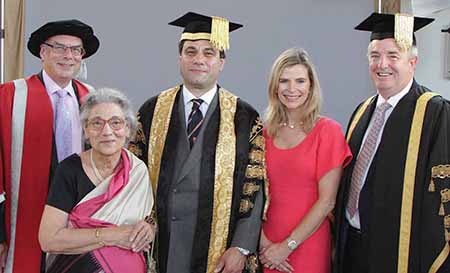
To the strains of Edward Elgar’s Imperial March Op. 32, played by the students of the University’s Department of Music, a long procession led by the marshals and ending with the pro-chancellor entered the 450-seater Elgar Concert Hall at the Bramall Music Building built in 2012 at a cost of £ 16 million. In his opening address the pro-chancellor Ed Smith mentioned, "It was with great enthusiasm that members of the University Council nominated Lord Bilimoria to be the University’s seventh chancellor. This enthusiasm was matched by members of the University Court, one of whom described the appointment as ‘an inspirational recommendation for Birmingham’ because of its excellent fit with the character and ethos of the University...I have known Karan for 25 years. I know how highly respected he is in the House of Lords as well as in the many other communities and areas of public life in which he plays an active and influential part. I also share his passion for higher education. For these reasons alone, I know he will make an excellent chancellor...”
Confident that like the chancellors before him, Bilimoria "will make a powerful and lasting contribution to the University,” Prof Sir David Eastwood, vice-chancellor and principal, noted, "He embodies the character, spirit and ethos of both the University (our motto is Per Ardua ad Alta – through great efforts to high achievements) and our home city – a great city built with innovative flair, determination and dedication. Karan takes up his role as chancellor at a particularly exciting time for the University...The transformation of our famous campus through our £ 225 million investment is under way and will provide new facilities...”
During the ceremony Bilimoria was robed in the chancellor’s gown crafted by ceremonial dressmakers Ede and Ravenscroft. As explained in the installation brochure, it is a Tudor-style robe similar in design to the State robes worn by the Lord Chancellor, the Lord Speaker, the Speaker of the House of Commons, the Master of the Rolls and the Lords Justices of Appeal. Made from a silk cotton black damask fabric, the gown is trimmed with two inches of best quality gold oak leaf lace. The shoulder wings of the robe are hand embroidered in gold wire with traditional oak leaf and acorn motifs.
"Birmingham is one of the most international universities in the UK, both in its student body and in its faculty members. I think that this is one of its greatest strengths and I look forward to helping Birmingham extend its international reach over the years to come,” declared the new chancellor who for over nine years has served on the advisory board of the UB Business School. Home to nearly 30,000 students, UB draws researchers, teachers and more than 4,000 international students from nearly 150 countries, according to its website. With more than 7,500 postgraduate students from across the world, Birmingham is one of the most popular universities for postgraduate study in the UK. The University plays an integral role in the economic, social and cultural growth of local and regional communities, working closely with businesses and research organizations, employing approximately 6,000 staff and from where 10,000 students graduate annually. As chancellor, Bilimoria will primarily play an important ambassadorial role, working with the vice-chancellor and the pro-chancellor to raise the University’s profile and advance its interests nationally and internationally.
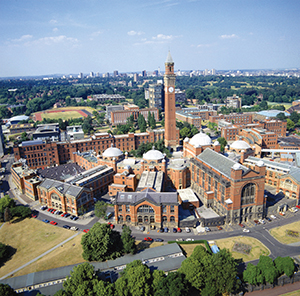
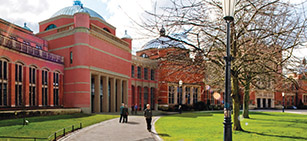
Aerial view of University campus
Whilst welcoming his successor, the sixth chancellor of the University Sir Dominic Cadbury introduced Bilimoria to four representatives of the University: the president of the Guild of Students, one of the University’s longest serving professors, the longest serving member of the professional services and the president of the Guild of Graduates and Alumni Association. The playing of the Indian and British national anthems at the conclusion of the installation ceremony made the occasion memorable for Karan as did the presence of his mother Yasmin Bilimoria (née Italia) who in 1958 had graduated with an honors degree in English language and literature from the same university. The procession exited the Hall to the strains of William Walton’s Crown Imperial.
The day following the installation Karan insisted his first meeting as chancellor would be with the students. Whilst he met with the outgoing student union office bearers as well as the incoming officers of the Guild of Students, his mother who was president of University House, the main hall of residence where she stayed for three years, was taken on a tour of the University and visited the places closest to her: the Barber Institute of Art on the UB campus, one of the top four University museums in Britain, and Winterbourne.
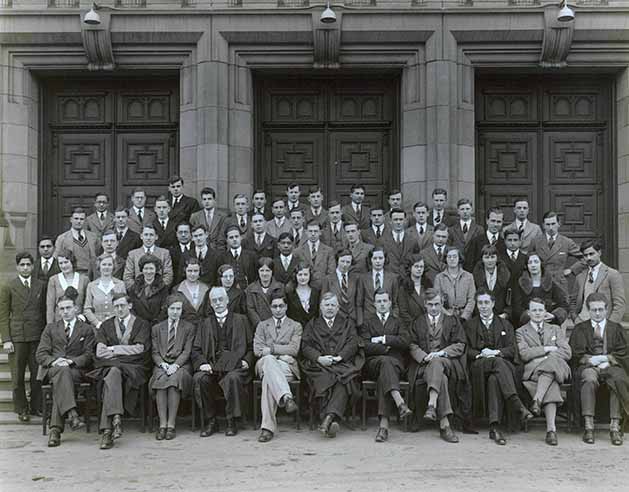
As a student of English at the University, Yasmin would regularly visit UB’s Shakespeare Institute at Stratford upon Avon and attend plays as part of her studies at the Royal Shakespeare Company. Daily attired in a sari during the three years she spent there, she recalls being taught by the famous Shakespearean professor Allardyce Nicoll. Her brother Dr Fareed earned his Bachelor’s, Master’s and PhD in engineering in the 1960s from UB too. Their father J. D. Italia had graduated from UB in 1931 and the family cherishes a photograph of his graduation ceremony.
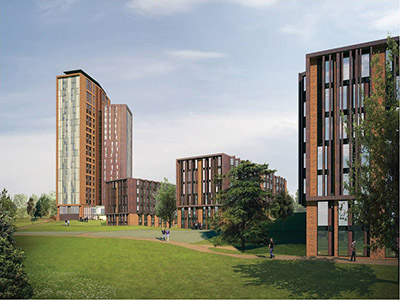
New student residences to be inaugurated in 2015;
Emphasis on education
Describing higher education as "a jewel in Britain’s crown,” Karan who graduated in executive education from three universities including the London Business School and the Harvard Business School, regularly speaks on this subject in Parliament. He has been very outspoken in Parliament and outside on the negative aspects of the current Coalition Government’s immigration policies which led to a nearly 25% decline in the number of Indian students coming to the UK last year. In 2007 he had initiated the foreign student two-year postgraduation work visa in Parliament which was discontinued by the present government.
He firmly believes that "India needs to allow foreign universities to operate and open campuses in the country. India desperately needs to increase capacity in higher education.” He commended the efforts in this direction of his former Hyderabad Public School contemporary Pallam Raju, former Human Resource Development cabinet minister, and hoped the "Narendra Modi government will follow through with this in an even bigger way because universities like Birmingham are waiting in the wings!”
A Commerce graduate from Osmania University in Hyderabad, India, Karan moved to London where he qualified as a chartered accountant from Ernst and Young. He then went on to read Law at Sidney Sussex College, University of Cambridge. He is the founder of Cobra Beer, chairman of the Cobra Beer Partnership Limited and of Molson Coors Cobra India, both joint ventures with the global brewing company, Molson Coors. He is also the founding chairman of the UK India Business Council and founder member of the Prime Minister of India’s Global Advisory Council. In 2004 he was designated Commander of the British Empire (CBE) for services to business and entrepreneurship, and in 2006 he was appointed an Independent Crossbench Peer in the House of Lords and was made Baron Bilimoria of Chelsea in the Royal Borough of Kensington and Chelsea, making him the first ever Zoroastrian to sit in the House of Lords. In Parliament, Lord Bilimoria is active in a wide range of matters including commerce, entrepreneurship, education, diplomacy, minorities’ contributions, and academia. From 2005-2010 he had served as chancellor of Thames Valley University (now the University of West London). He is also a senior independent director of the Booker Group Plc and a deputy lieutenant of Greater London. Married to Heather, they have four children.
With Bilimoria being a patron of the Zoroastrian Trust Funds of Europe, its president Malcolm Deboo wrote, "We know His Lordship will discharge his duty diligently and successfully. It will allow (him) to become involved in one of the UK’s most international universities, as well as to further links between the UK and India in terms of student rights, higher education and business cooperation.” Whilst Deboo could not attend the ceremony, his fellow ZTFE trustees Dorab Mistry and Rusi Dalal attended the installation.
Last year Bilimoria had established the Zoroastrian All-Party Parliamentary Group to provide an official forum for parliamentarians to increase their awareness of this ancient religion. In October-November this year, an event has been planned to commemorate the Zoroastrian contribution to the First World War.
Intellectual and welfare heritage
Among Karan’s priorities will be visiting the Queen Elizabeth Hospital, the largest hospital in Europe, attached to the UB. Renowned in the world for its expertise in trauma, the British Armed Forces Medical Services are housed here nationally. It is also where Malala Yousafzai (the inspirational young activist from Pakistan whose demand for equal educational opportunities for girls had earned a Taliban attack), whom Karan had met previously, was treated.
The University, as mentioned on their website, "is a legally independent, chartered organization, which is also an exempt charity. It is a private institution which receives significant public funding, principally from the Higher Education Funding Council for England (HEFCE).”
To build on the intellectual heritage of UB, there are many upcoming projects in the next couple of years. The Biomedical Innovation Hub, a fully serviced laboratory specifically designed to provide entrepreneurs and innovative start-ups with access to affordable laboratory facilities and equipment, will be completed in September 2014. The High Temperature Research Centre as a unique casting, design, simulation and advanced manufacturing research facility should be ready in March 2015. After the completion of the Student Services Hub in June 2015, September will see the opening of new student residences plus the launch of the Birmingham Dental Hospital and School of Dentistry as also a comprehensive, coeducational 11-16 school for children. Early 2016 should witness the opening of the Sports Centre and later in the year the new library. In addition to presiding over degree ceremonies and chairing the annual meet of the University Court, as sums up the installation brochure, "Our chancellor, Lord Bilimoria, will help to shape this future.”