
“Misconceived” and “ill-advised”
The wasteful expenditure on the so-called “renegade” priests case is to be condemned
Former BPP trustee Dinshaw Tamboly, busi-nessman and environmental activist Cyrus Guzder, son of former BPP chairman Jamshed Guzder, and partner of Mulla and Mulla Hormazdiyaar Vakil, son of former BPP trustee Shiavax Vakil, in individual letters to the trustees dated July 14, 2014 are critical of the "vast sums” expended on the case, both in the Bombay High Court (BHC) and the Supreme Court of India. The matter is pending for consideration before the apex court, all mediation efforts having failed. Parsiana publishes extracts from three letters. The text has been marginally edited for stylistic purposes.
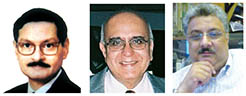
(L to R) Cyrus Guzdar, Dinshaw Tamboly and Hormazdiyaar Vakil
Dinshaw Tamboly
I have since some time now been following, what is uncouthly referred to in some community circles as "the renegade mobeds” case. I believe that the dignity of any human being is inviolable and it does no credit to those who use such insulting and offensive terms to describe others whose views and actions are not in sync with theirs.
From what I have understood so far, the trustees, ostensibly on the advice from some of the community high priests, passed a resolution banning two priests. This was done for the reason that these two priests were known to be performing navjote ceremonies for the children of mixed marriages. (The prime reason for instigating the ban was their performance of funerary prayers for those Parsi Zoroastrians opting for cremation. Other reasons were added later to bolster the trustees’ case — editors)
As a former trustee of the BPP (November 1996 to September 2008), I am familiar with the workings of the Trust, the pressures it faces from within as well as from outside, as also the ultimate goal of charity and philanthropy.
Although during my tenure as a trustee, there was nowhere near as much litigation by or against the Trust as there has been in recent times, I am not unfamiliar with the legal system. Being aware of the great costs involved in getting decent legal representation, I am sure that this ‘ban on priests’ case since its inception till date must have caused the Trust to spend a great sum of money. Whilst I can only surmise the amount on the basis of past experience, you as present trustees would be aware of the actual legal expenses incurred. (The figure for the legal charges are said to range between Rs 2.4 crores to three crores — editors)
However I am sure that whatever be the actual figure, had it been spent on the actual objects of the Trust, it would have been enough to feed, shelter, clothe, medicate and educate several financially challenged members of our community.
I have no doubts that where third parties illegally try to usurp the funds and properties of the Trust, the best possible legal action must be taken and followed to its logical conclusion. But, in a matter such as the ‘ban on priests,’ which in my opinion has been fuelled by the misplaced and misconceived religious beliefs and orthodox egos of some individuals, I find it a shame that vast sums of community funds have being expended, which should have been put to much better and fruitful use.
Ultimately, poor Parsi / Irani Zoroastrians are not going to be better equipped in life whether the two priests in question are allowed to, or disallowed from, performing ceremonies / offering prayers at BPP properties.
The trustees cannot justify their action by taking refuge that they acted as per direction of the high priests. The high priests are known not to speak in unison, they themselves express views that are not compatible with those of one another. In the not too distant past there has even been an instance where they had passed a ‘fatwa’ but then retracted when they realized it would not stand legal scrutiny.
It will not be out of place to mention that the views expressed and actions taken by earlier high priests have been at complete variance with the present day ones. Surely, religion, rites and rituals cannot keep on changing, depending on the views of individuals occupying the position.
On one of the issues for which the two priests have been banned, if one were to refer to History of The Bombay Parsi Punchayet (1860 to 1960) by Sapur F. Desai on page 13 it states that Dastur Kekhushroo Jamaspasa (grandfather of our present day Dastur (Dr) Kaikhusroo JamaspAsa) performed the navjote ceremonies on June 26, 1882 of nine children born of Parsi fathers and non Parsi mothers.
Further, if you were to refer to The Persian Rivayats of Hormazyar Framarz and others published by The K. R. Cama Oriental Institute, dealing with "peaceful and forcible conversion” it very clearly mentions "If they (a grave digger, a corpse burner and a darvand — one of a foreign faith) observe the rules of religion steadfastly and keep connection with the religion and if no harm comes on the behdins, it (i.e. conversion) is proper and allowable.” It is also mentioned that if a behdin turns darvand, he can be re-converted into our faith by performing certain ceremonies.
From the above two references, I do hope you will realize the futility of the BPP stand.
You will be aware that in a very recent judgment dated July 7, 2014, the Supreme Court of India has ruled that fatwas have no legal standing or force and cannot be enforced using coercive methods.
As a former trustee of BPP, I feel it my duty to counsel the present trustees that:
The practices followed by earlier high priests varied from those sought to be imposed on the community by some of our present high priests.
The ban on priests is ill-conceived, not supported by any legal authority. During the tenure of the earlier boards this would never have been resorted to. The present ruling of the Supreme Court is indicative of how our justices view fatwas.
It is not within the remit of the BPP to become self-appointed custodians of the faith. The main purpose of BPP is to look after the poor and needy and not waste precious funds on such matters.
The BPP trustees should try to be more inclusive and keep the community together, not divide it.
I sincerely hope you will see reason and take all necessary steps at the earliest to end this controversy once and for all. No benefit will accrue by continuing with this expensive litigation.
Cyrus Guzder
I have been reading with considerable concern reports in the Press regarding the ongoing litigation which has caused the BPP to incur a huge sum of money contesting a BHC judgment which set aside a BPP order banning two priests of our community from performing prayer ceremonies at Doongerwadi.
As a concerned member of the Parsi community, I thought I should write to you to convey my views on why I believe your actions in pursuing this costly litigation are ill-advised and, frankly, distasteful to many, our community having a reputation for being tolerant, educated and enlightened.
In the first instance, the March 11, 2011 judgment of the BHC is a reasoned one. It has not caused prejudice to anyone and has in no way affected the operation of the BPP these last three years.
Secondly, the recent Supreme Court judgment on ‘fatwas’ should serve as a cautionary warning: ‘fatwas’ according to the judgment are not enforceable and the BPP’s ‘ban’ on the priests certainly smacks of being in the nature of a ‘fatwa,’ an action which – to the best of my knowledge – is also unprecedented as far as trustees of the BPP are concerned. Surely the elected BPP trustees cannot impose their personal views or opinions upon us and, that too, at the cost of the community.
The BPP ‘ban’ is a ban not only on the two priests in question but, effectively, also on all those members of our community who would wish to have the freedom to choose a priest to say prayers for their family members at Doongerwadi. The ‘ban’ is therefore an unpleasant intrusion on our freedom of choice and, in my humble opinion, not one to which as BPP trustees you are entitled.
Further, Doongerwadi is a property of which we are all beneficiaries and while we respect the right of the BPP to be administratively responsible for the management of the property, the BPP trustees may wish to consider whether they are overstepping what they may believe to be within their authority, by curtailing our rights and freedom of choice in this manner. In fact, it is surely up to the members of our community to decide even whether they wish to follow the advice of our learned high priests or not.
A matter of equal concern to the community, however, must be the exorbitant sum of money that the BPP has expended so far in pursuing this litigation. Press reports indicate that over three crore rupees (US $ 500,000) have been spent on dealing with the fall-out of this ‘ban.’ The BPP exists to safeguard the community’s funds so that they are put to charitable purposes. This expense is by no stretch of imagination a charitable activity. It would not be surprising if the trustees were sought to be held accountable for what could be regarded as fiscally irresponsible actions that are diverting charitable funds for a non-charitable purpose.
I was personally witness to an impassioned presentation by the chairman of the BPP at the city’s heritage conservation committee where he dwelt at length on the pitiable financial condition of the priesthood and the burden of recurring costs of maintaining the heritage property of Doongerwadi.
On the one hand our cherished Trust property is in dire need of funds and, on the other, the trustees freely pay legal costs of three crores (with presumably more to come), to pursue a futile ban that has neither the unanimous support of the BPP trustees nor of the community at large. It would be a shame if this wasteful expenditure puts the BPP at risk of inviting public scorn if not ridicule.
I would therefore earnestly request your good selves to reconsider your decision to fund in addition to your own appeal, an appeal by the high priests and other interveners in the Supreme Court, and to bring to an end this wasteful and futile expenditure which is being incurred at the cost of all the worthwhile community projects and investments which the trustees of the BPP were elected to undertake.
Hormazdiyaar Vakil
I am appalled to read that you, the trustees of the BPP, have spent sums in excess of three crore rupees to pursue the issue of the so-called "renegade” priests. "Whose father’s Diwali,” translated Konna baap ni Diwali, is this? This is a criminal waste of charity funds and as a Donor member on the voter’s list I strongly condemn this illegal expenditure and lodge my protest.
I fail to understand what purpose will be served even if the BPP were to succeed. Who has authorized this unconscionable expenditure and the engagement of senior counsel in Delhi who charge these exorbitant fees and also to send junior counsel from Bombay to Delhi by Business Class and lodge them in five-star hotels? The BPP should expend their energies in administering the Trust funds for the purpose for which they are meant to be used.
I am also informed that the other side have proposed fair consent terms to put a close to the matter as they also have to expend legal fees and other expenses from their own pockets unlike the BPP trustees. I understand that two trustees are in favor of these consent terms to put an end to the appeal.
In my view, the appeal should be gracefully withdrawn by filing consent terms and the matter should be buried. You must be well aware of the recent Supreme Court’s views on ‘fatwas.’ If the egos of the trustees do not permit the withdrawal of the appeal then the trustees in favor of continuing this fruitless litigation should foot the entire expenditure from their own pockets.
I am ashamed at what is being done in the name of religion.
I expect at least a courtesy of a reply from the BPP trustees after they have read this. Otherwise I will have no option but to move the Charity Commissioner to put an end to this illegal use of charity funds for such litigation.