
Events & Personalities
Two visionaries
On May 31, 1893 two patriots and visionaries sailed together on a ship from Japan to the United States. They were Jamsetji Tata and Swami Vivekananda. "They were nationalists to the core and their dream and mission was to work for the progress of India,” both firm believers in their own religion, but respecting all faiths, denouncing narrow-mindedness and fanaticism, writes Dr Homi Dhalla. Though Tata was initiated into the priesthood at an early age, when plans for setting up a steel plant in Jamshedpur were on the drawing board, he wrote a letter to his son in 1902 stating: "Be sure there is plenty of space for lawns, playgrounds… and parks. Earmark areas for Hindu temples, Mohammedan mosques and Christian churches.”
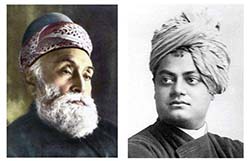
Jamsetji Tata (left) and Swami Vivekananda
At the Parliament of the World’s Religions in Chicago on September 11, 1893, Vivekananda addressed his "Sisters and Brothers of America” in a speech that gave him instant global prominence as the first luminary to lucidly expound the greatness of Indian philosophy to the western world. "The Christian is not to become a Hindu or a Buddhist, nor a Hindu or a Buddhist become a Christian. But each must assimilate the spirit of the others and yet preserve his individuality and grow according to his own law of growth… holiness, purity and charity are not the exclusive possessions of any church in the world… every system has produced men and women of the most exalted character… if anybody dreams of the exclusive survival of his own religion and the destruction of others, I pity him from the bottom of my heart,” Vivekananda thundered.
Tata was not merely the father of the industrial revolution in India; he contributed significantly to the field of education by establishing the J. N. Tata Endowment Scheme for higher education in 1892 to support bright Indian students of modest means to achieve their ambitions, mentions Dhalla. Tata also set up the Indian Institute of Science in Bangalore, pledging half of his personal wealth of Rs 30 lakhs to make this a reality. On November 23, 1898 he wrote to Vivekananda about this: "I trust you remember me as a fellow traveler on your voyage from Japan to Chicago. I very much recall at this moment your views on the growth of the ascetic spirit in India, and the duty, not of destroying, but diverting it into useful channels.
"I recall these ideas in connection with my scheme of a research institute of science in India, of which you have doubtless heard or read. It seems to me that no better use can be made of the ascetic spirit than the establishment of monasteries or residential halls for men dominated by this spirit, where they should live with ordinary decency, and devote their lives to the cultivation of sciences — natural and humanistic… Do you think you would care to apply yourself to the mission of galvanizing into life our ancient traditions in this respect? Perhaps, you had better begin with a fiery pamphlet rousing our people in this matter. I should cheerfully defray all the expenses of this publication.”
Dhalla quotes from Vivekananda’s response: "I am not aware if any project at once so opportune and so far reaching in its beneficent effects has ever been mooted in India… The scheme grasps the vital point of weakness in our national well-being with a clearness of vision and tightness of grip, the mastery of which is only equaled by the munificence of the gift that is being ushered to the public.”
◆ ◆ ◆
From the archive