
The good earth
Preserving Doongerwadi’s green cover has become a bone of contention between the Bombay Parsi Punchayet trustees
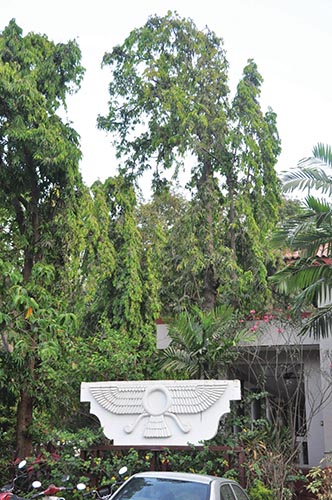
Farohar in front of Hodiwalla bungli at Doongerwadi
Dhalla and BPP chairman Dinshaw Mehta arranged for representatives of Mumbai Mirror (MM), The Times of India (TOI) and Parsiana to visit Doongerwadi and see for themselves the deposited soil and the newly planted saplings growing there that is proving fertile ground for fresh public dissension among the BPP trustees.
The gift of the valuable and expensive soil handed to the Bombay apex trust by a builder excavating a plot nearby, has resulted in some trustees alleging Mehta availed of the offer to "favor” the developer. They claim Mehta acted without informing or taking the consent of his colleagues on the board and without undertaking an examination of the soil to see if it was suitable (see "Majority report,” Parsiana, April 21, 2014 and "Saving Doongerwadi” Parsiana, May 21, 2014). The earth was transported to Doongerwadi at the builder’s expense who also provided heavy machinery without charge to level the dumped soil on Doongerwadi’s rocky terrain; pipes were also laid at his cost to carry water to the new saplings planted.
"The bottom line is this was done without the board’s approval,” TOI, (May 18, 2014) quotes BPP trustee Jimmy Mistry as stating. "Merely because the earth is getting washed off with the rains doesn’t mean you dump trucks of earth. We have to plan how to retain it and create a structural report before doing a project like this.” But allowing for the BPP’s track record in preparing and implementing reports, the builder would have found it more economical to deposit the earth at a landfill elsewhere.
What sparked the controversy afresh was a report in the MM of May 15, 2014 stating "300 truckloads of debris...have been allegedly dumped in the densely wooded area.” The report also cites an email from BPP trustee Yazdi Desai claiming "the matti piled up loosely poses a serious threat of landslide during monsoon, and endangering Godrej Baug precincts and also threatens to breach the (boundary) wall.”
Desai, Mistry and co-trustees Arnavaz Mistry and Khojeste Mistree further allege that the builder "has saved in excess of Rs 20 lakhs by being allowed to dump the excavated matti at Doongerwadi.” The four have also brought the incident to the notice of the Charity Commissioner (CC), states MM. The CC is presently hearing a petition by the four to suspend/remove Mehta from the trust.
"Under normal circumstances you would have to pay lakhs for such matti, but we got it free,” explains Dhalla who was responsible for the installation of solar panels at Doongerwadi. He cites a "test certificate” by Gadark Lab Private Limited dated April 18, 2014 which states, "the soil is deficient in NPK (nitrogen, phosphorus, potassium) and organic matter. The soil can be made fertile using NPK fertilizer and organic manure (and) is suitable for the growth of large trees, ornamental and flower(ing) plants after proper application of … manure.”
Dhalla claims that he has been writing to the trustees regarding the soil for three months but received no reply. "It was only after several truck loads were dumped and leveling had begun that some trustees objected,” MM noted. Dhalla alleged that the four trustees were trying to stall the work and "malign my name and that of Mehta.”
Afforestation efforts at Doongerwadi have been in existence over the past 50 years. In his History of the Bombay Parsi Punchayet 1860-1960 Sapur Desai noted "In the year 1960 the trustees undertook to afforest the barren lands and grew as many as about 6,000 trees in less than a decade — casuarina, eucalyptus, silver fen, alphonso mango, babul, coconut, cashew nut, etc. There are also brab (variety of palm) and other flowering trees like gulmohur, peltiforum, etc. In parts the land being sheer rock is not amenable to tree culture. But over a hundred years ago a number of fruit trees were growing…
"Doongerwadi once covered an area of over 3,25,000 square yards (67 acres). But roughly about 49,000 square yards were given over to municipality or improvement trust to make first what is known as Gibbs Road, and then later Hughes Road leaving about 2,76,000 square yards (57 acres).” In 2009, 15.97 square yards of land near the Doongerwadi main gate was surrendered to facilitate better traffic management at Kemp’s Corner.
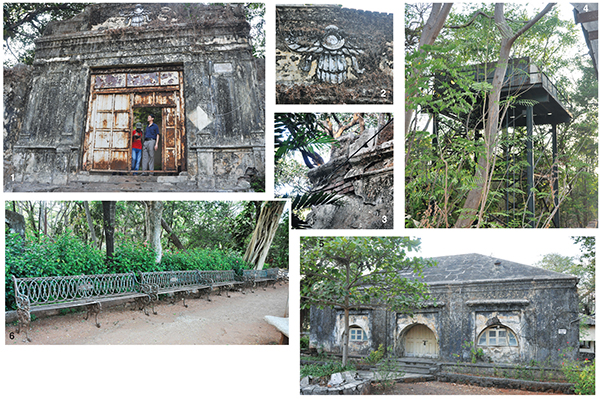
Aside from the greenery, even the physical structures at Doongerwadi need attention. An overhead tank that stores water for the plants is in need of a coat of paint and treatment for rust. Dhalla’s periodic reports to the trustees state: "Although I have been bringing this to your notice in six of my earlier reports, work has not started on repairing and painting the same. This corroded tank which is the main source of water supply has not been repaired and painted for many years. In case this corroded tank starts leaking, hundreds of trees will die.
"Before the outbreak of the monsoons, the plaster of the outer wall of the Bisney dakhma which has fallen off should be attended to.
"The metal door leading to Khareghat Colony is in a poor condition. The structure above the same may also collapse and injure someone.
"The old structure where utensils are stored near the ‘sagdi’ and used on Fravardin roz is also in a pathetic condition. (Doongerwadi staff member who tends to the greenery) Dara Elavia informs me that it is one of the oldest structures in the city.
"The antique benches in the garden in front of the ‘sagdi’ are in a shocking state — they at least need to be painted.”
Though the trustees state ad nauseam that their first duty lies in the preservation of Doongerwadi, the green estate has suffered neglect due to their internal squabbles.
A cursory reading of the history of the Bombay Parsi Punchayet (BPP) totally dispels the notion that the body was formed to primarily look after Doongerwadi. The founding fathers clearly had the larger interests of the community in mind. The Governor of Bombay State Gerald Aungier in the 1670s saw the benefits of punchayeti self-government for the various communities and "made this institution responsible for the good behavior of their respective communities.” So notes J. Douglas in A Book of Bombay, as quoted by the former BPP secretary Sapur Desai in his History of the Bombay Parsi Punchayet 1860-1960.
Desai places the BPP’s origins to 1673. "We do not know who its first members were but it is certain they had some sort of a constitution albeit unwritten which they called bundobusts (arrangements, fatwas or rules) and by which they guided the course of the community… In the beginning the Punchayet was a quasi-judicial-cum-social body dispensing justice, regulating conduct… in general the Punchayet enjoyed legislative, judicial (civil) and administrative functions. Penal justice was the prerogative of Government.” The first informal trustees to hold the funds of the Punchayet were appointed in 1823, states Desai.
The first BPP trust deed December 4, 1851 "held some 15 funds… In 1884 the then trustees had to declare another trust this time encompassing their immovable properties,” writes Desai.
The preamble to the 1884 trust deed states: "for many years the management of the social and religious affairs and the settlement of religious, matrimonial and other social disputes of, and between, Parsis in Bombay were entrusted by the community to a punchayet or committee selected from amongst the most influential or leading members of the said community…
"The said Punchayet also (italics ours) acted as, and were the recognized custodians and managers of the property so from time to time given for religious, benevolent and other purposes and objects by the members of the said community.”
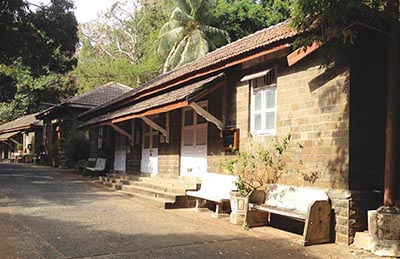
Although the Prayer Hall Trust (PHT)is now constructing a bungli at the municipal crematorium at Worli, there is no legal reason why the structures at Doongerwadi cannot be used for the funerary rites of those opting for an alternate means of disposal to dakhmenashini. Noted jurist Rafique Dada had given the legal clearance over 12 years ago when his opinion was sought by the Bombay Parsi Punchayet (BPP). With a survey conducted by the Hansa Research Group at Parsiana’s behest showing 80% of the Zoroastrian community in Bombay in favor of permitting prayers to all Zoroastrians at Doongerwadi irrespective of the mode of disposal, the trustees need to reconsider optimum utilization of Doongerwadi assets.
"It would be open to the querists to permit the followers of the DDD-AG to construct a separate prayer hall at Doongerwadi after taking such permissions from the statutory authorities as may be necessary, provided that such a prayer hall is used for religious rites and ceremonies in accordance with the Zoroastrian religion."
Explaining the reasoning for his opinion Dada notes in the second schedule to the General Trust Deed it is recorded "the land and the several towers, buildings and erections thereon standing" were to be used "by every member of the Parsi community professing the Zoroastrian religion as a place of exposure of the dead and for the performance of religious rites and ceremonies.
"There is no historical record as to whether the lands and building thereon were used only for the exposure of the dead and not for the performance of other religious rites and ceremonies. However, one must go by the recital in the Trust Deeds (which)... would indicate that the parties to the Trust Deed recorded the objects for which the Trust land could be used both as a place for the exposure of the dead and for the performance of religious rites and ceremonies."
"In my opinion, considering the various portions of the Trust Deed referred to above it is not permissible to restrict the phrase ‘for the purpose of religious rites and ceremonies’ as performance of religious rites and ceremonies connected with or relating to the exposure of the dead...
"This clearly indicates that this is a distinct object and cannot be read as religious rites or ceremonies relating only to the exposure of the dead by the system of dakhmenashini...
"It necessarily follows that no rite or ceremony can be performed on the land which is not in consonance with or antithetical to the Zoroastrian faith. A strong objection has been raised by the members of the Save Doongerwadi Committee that cremation or burial (where dakhmenashini is available) is not permissible in the Zoroastrian religion and that no religious rites or ceremonies can be performed with reference to a method of disposal of the dead by cremation or burial. The members of the DDD-AG have strongly contested this position. As counsel, I am primarily concerned with the interpretation of the various Trust Deeds given to me, which I have done. While I have given a reference to and considered the various material which has been provided to me, in my view, it is not for counsel to determine as to whether the Zoroastrian religion permits the system of cremation or burial (where dakhmenashini is available)."
In an article published in the Jam-e-Jamshed of February 29, 2004 well known lawyer and senior partner of Mulla and Mulla and Craigie Blunt and Caroe, Bucky S. Bhesania noted "the law permits an individual to decide how his mortal remains will be disposed of, though the final choice is of his legal heirs…
"There is no penalty in law but if by choosing cremation the individual breaks Ahura Mazda’s law then he alone is answerable to his or her God. No orthodox (person) or even a high priest has a right to force him to opt for dakhmenashini by issuing edicts that Zoroastrian prayers will not be performed for such individuals either in the bunglis or later in agiaries... I have perused (Dada’s) legal opinion obtained by the BPP and I make bold to say that the trustees have succumbed to the pressure of the orthodox in not allowing the geh sarna prayers in the bungli prior to cremation because in fact there is no legal impediment to the same."
The BPP banned two priests from praying at Doongerwadi because they performed funerary rites for those opting for cremation. The issue is now being contested in the Supreme Court.
Despite two lower bunglis at Doongerwadi lying locked for the past six years, the BPP trustees refuse to let the premises be used by those opting for alternate means of disposal. The A. H. Wadia Trust is bearing the cost of Rs 1.80 crores for the hall at the Worli crematorium being built by the PHT. Parsis will be given a preference for the use of the cosmopolitan Hall.
Though the trustees always claim they uphold the settlors’ wishes specified in the trust deeds, in the case of the Doongerwadi estate they have clearly violated one of the basic tenets which stipulates "to allow no person professing an alien creed to that of the Parsi permanently to occupy or have access to the said hereditaments and premises hereby conveyed." A large percentage of the khandhias married to non-Parsis reside on the Doongerwadi premises. Additionally, the Ambawadi portion of the Doongerwadi estate houses non-Parsis.