
Sports
Spur of the moment
With a dazzling Derby run Alaindair triumphs over fancied favorites in record time
His fluid acceleration in the final furlong saw him cross the winning post two-and-a-half lengths clear of his nearest rival, stopping the clock at 2 min 28.05 sec, the fastest time recorded by an Indian Derby winner. On February 2, 2014, Alaindair won The McDowell Signature Indian Derby (Grade 1) at the Mahalaxmi Race Course, decisively defeating the favorite Murioi and proving once again that calculations, combinations and permutations of punters and pundits can go for a toss over the grueling mile-and-a-half (2,400 meters) length of the race.
"He has matured well from a horse who was a great disappointment in his first start, where he jumped out of the gates slow and practically didn’t take part in the race,” says Dr Nevill Devlaliwalla who owns the horse with Ameeta Mehra and Gaurav Sethi. Bred at the Mehra Stud and Agricultural Farms in Gurgaon, Haryana, trained by Altamaash Ahmed and skillfully ridden by Y. S. Srinath, Alaindair was one in a field of 15 runners in the richest, most prestigious race in the country. With over 25,000 people thronging the lawns and a large air-conditioned tent, Derby day showcased not just high-stepping horses and thrills on the racetrack but provided families a merry mix of music and magic performances, girls in gowns walking the ramp in a fashion show, pulsating Bollywood beats and celebrities in short skirts and high hats!
"He has matured well from a horse who was a great disappointment in his first start, where he jumped out of the gates slow and practically didn’t take part in the race,” says Dr Nevill Devlaliwalla who owns the horse with Ameeta Mehra and Gaurav Sethi. Bred at the Mehra Stud and Agricultural Farms in Gurgaon, Haryana, trained by Altamaash Ahmed and skillfully ridden by Y. S. Srinath, Alaindair was one in a field of 15 runners in the richest, most prestigious race in the country. With over 25,000 people thronging the lawns and a large air-conditioned tent, Derby day showcased not just high-stepping horses and thrills on the racetrack but provided families a merry mix of music and magic performances, girls in gowns walking the ramp in a fashion show, pulsating Bollywood beats and celebrities in short skirts and high hats!
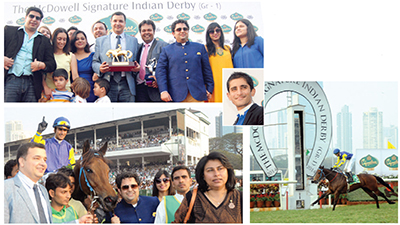
Dr Nevill Devlaliwalla (holding trophy) with Altamaash Ahmed and Gaurav Sethi to his left and respective families;
Y. S. Srinath (inset); (2nd row): Devlaliwalla, Sethi and Ameeta Mehra (ext right) lead in Alaindair, winning in style
With Alaindair having won three Grade 1 races, Devlaliwalla traces how the bay gelding has grown in stature: "We gave him a lot of time and campaigned him sparingly and the trainer did a lovely job with him. He is fast, has a high cruise speed and he stays as well. He is versatile in how he races, he can run up with the pace and come off the pace too.” Though training thoroughbreds can be difficult due to their high-strung ways and volatility, Alaindair in contrast has "a very good temperament.”
An ophthalmologist by profession who has his own clinic at Prabhadevi, Devlaliwalla describes the race on Derby day: "Jockey Srinath was selected for his big race temperament and experience. He’s a beautiful judge of pace and that really helped in the final result. He settled Alaindair well throughout and the moment he pulled him out coming into the straight I knew I was going to finish first or second and then when he started devouring ground I knew we were going to win it, even before he came alongside Murioi (the tote favorite who had defeated Alaindair in the Indian 2000 Guineas). Winning the Derby is a dream come true. Every owner races with the hope that they can win the big one someday. To put it in perspective, every year more than 1,500 horses come up for sale and only one horse gets to win it.”
Racing has been Devlaliwalla’s interest since 1997 but the starting gates opened as an owner in 2007. "I’ve been lucky and God has been kind. My first filly went to Class 1, my second filly won me my first classic (The Hyderabad Fillies Trial Stakes Grade 3) but not in my wildest dreams would I have thought of winning the Indian Derby, the Indian St Leger, the Bangalore Summer Derby, the Bangalore Colts Championship Stakes and six other group races so early, if at all, because I am a small owner and buy at best two or three horses a year.”
"It pleases me to know that I have given every small owner and every small yard hope that we too can win the big races, which is very important for the sport,” The Times of India (TOI) quoted Devlaliwalla in its February 3 edition in its extensive coverage of the event under the title "Alaindair the Great.” It was a good team effort, Mehra told the paper.
For the Usha Stud Farm it was a double delight as Starry Eyes, bred at their farm and trained by Cooji Katrak, stood second. Pesi Shroff-trained Circle of Life came third. Both fillies also bettered the existing record of 2 min 28.54 sec set by Shroff-trained Jacqueline in 2010. This was the 72nd running of the Indian Derby and the 30th successive run under the McDowell banner, probably the longest continuous sponsorship of any sporting event in India, mentioned Vivek Jain, chairman of the Royal Western India Turf Club, in TOI, January 31, 2014.
Two of Devlaliwalla’s horses had run the Derby earlier. "My first was Scionic. She was coming out of multiple setbacks but we ran her because we thought the world of her. Then I had An Acquired Taste last year who was the second favorite going into the race and was very unlucky to get knocked out at a very crucial juncture of the race and finished fifth. Racing is a high risk, high investment industry where you are dealing with thoroughbreds susceptible to injury and mortality. For every success story there are so many failures.”
In the bloodstock business pedigree is paramount. Devlaliwalla narrates how Alaindair (Multidimensional out of God’s Grace) came into his possession: "Alaindair had been selected by Ahmed for AAP Racing among seven yearlings from the Usha Stud Farm, but they (the buyers) had not made payments for any of their purchases. The untimely death of the owner of AAP Racing (Amitabh Parekh) meant that all their horses were put into the market by the respective breeders. Ahmed didn’t want to lose Alaindair (who had been kept at the Race Course stables) and asked me to buy him. Ameeta Mehra, who is the breeder, consented to keep a share in the horse as we then couldn’t buy the full horse from her.” Sethi, he adds, is also new to racing. Ahmed, who has trained under the renowned Rashid Byramji, has guided Devlaliwalla’s horses from the outset. "His getting a license and my becoming an owner were around the same time and I guess the trust and confidence grew as I bought more horses. He has given me some fantastic results.” His own extended family has been, he says, interested and non-interfering and has supported him in all his endeavors.
Indian racing, the eye surgeon believes, has a lot to do before it can even be spoken of in the same breath as international racing. Horses who have won multiple classics here have been found wanting in handicap company when raced abroad. "The breeding industry needs to be opened up. Right now we have an overflow of poorly bred horses. Just as the import of mares is permitted, so should the market for yearlings and racing horses. It will improve the Indian stock as also restrict the practice of breeding in numbers.” Japan did this a number of years ago and there was a period of transition where they struggled but today they are a force to reckon with internationally, he adds.
"We have a new race track coming up in Punjab. What we need are more such new tracks that are run professionally. There has also to be greater emphasis on tote and the turf clubs have to sit down and negotiate taxation with the government. The tote is the lifeline of any race track,” he says. Racing does provide an adrenalin rush. "I’ve grown up having numerous dogs and horses as pets. I love horses and being around them is a feel good factor,” says the doctor who believes in harnessing skills, intuition and hard work to steer steeds of style and substance.
◆ ◆ ◆
From the archive