
50TH ANNIVERSARY
Back to the future
A past, present and future scenario for the Parsi community
Parsiana asks me to write an article about palav-daar bawas in 2051. Every day I read my forecast in the papers and my fortune every week but not once has it come true so how, I wonder, can I say anything about 2051?
To write about 2051 I must first have some clue about the past and to do that I must visit the 19th and 20th century. In the good old days when Parsis used to wear a tie and daglas and phetas or pugrees, it was a man’s world and women were confined to producing children and doing household chores.
To write about 2051 I must first have some clue about the past and to do that I must visit the 19th and 20th century. In the good old days when Parsis used to wear a tie and daglas and phetas or pugrees, it was a man’s world and women were confined to producing children and doing household chores.
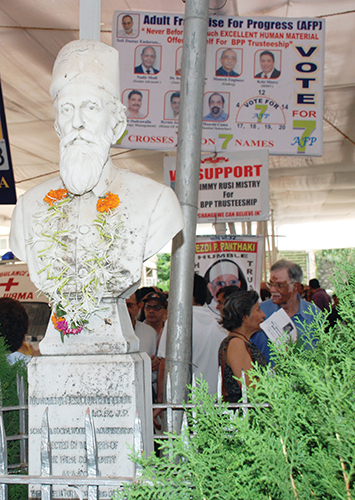
Muncherjee Khareghat statue at Khareghat Colony
Parsis came forward and started schools for girls. There was an uproar as to how this could be allowed. But the people prevailed. The teachers would dress in black daglas and wear Parsi caps; not ones which you can fold and keep in your pocket, but with quite stiff and high sides, and very visible. Some non-Parsis may have been employed to teach subjects like Hindi. The full fees were Rs 11 which most students couldn’t afford. Boys would get snacks in the short recess at 11 a.m. and lunch at 1 p.m.
Then things changed. Schools became cosmopolitan due to a shortage of Parsi students. Similarly in the banks where once the managers, assistant managers and cashiers were all bawas, all that changed. In the 21st century bawas suddenly woke up to find they were diminishing in numbers.
I kicked the bucket and quit this world and reached the Chinvat Bridge. My appraisal was done and I was assigned to Hell, in a cell called "wholesale block.”
I entered the place and there were people there who on seeing me started playing music and singing, "Let’s rock, everybody let’s rock, everybody in the ‘wholesale block’ dance to the jailhouse rock.” My identity was member No 420, as no one had any names.
One fine day some people came and took me away to the opposite side of Hell, and made me stand in a big hall like a darbar. After some time many others came there and sat down. I presumed they were all from heaven. Then someone came and everybody stood up as a mark of respect, so I presumed he may be some big gun. Later on I came to know that he was a prophet. Then God entered and sat on his throne. I was ushered into His presence. I was then told that I had been selected to go down to earth and find out about the Parsis and submit a report.
My soul descended and I first went to Khareghat Colony. I saw a board that stated: "Flats available on rent on tenancy basis. No leave and license, or statutory tenancy. Parsis will be given first preference.” Looking around I saw many of the older buildings were no longer there and in their place were tall towers touching the clouds. I asked a passerby where the statue of Muncherjee Khareghat had gone. He mumbled something in Marathi and went his way. I asked a lady, "There was an Alpaiwala Museum here, I don’t see it.” She gave me a dirty look.
Then a young man came up and asked "Yes, Uncle, what are you looking for? You want to see someone?”
I told him that I was looking for Parsis and this is a Parsi colony. He looked me up and down, and said, "Uncle my name is Romeo.” I said, "Sure you look like one.” He continued, "My dad’s name is Robert and my surname is Remedios. My mother’s name is Roshan, and sister’s Rati. I know about Parsis as my mother is one. Every day she unties a rope round her waist and mumbles ashame, ashame and so on. I too was once made to wear that rope. One chap had come and tied it round my waist, but I don’t know what it is all about.”
I proceeded to Doongerwadi. I was shocked to see a tall building there. When I asked a security guard what is all this and where are our towers of silence and the gheedhras (vultures) he thought I was mad and shooed me away. I visited a few agiaries and atash behrams but almost all were desolate, forlorn or closed.
I dropped the idea of going to Navsari, Surat, Udvada and so on, and returned to Hell. I was once again ushered in that same hall. God remarked, "We monitored your actions and we feel you have done quite well. So now you are transferred from the ‘wholesale block’ to another place.”
The prophet then stood up and volunteered to return to earth. "But this time in my sermons and discourse I shall be very precise and clear that the Zoroastrian religion is not meant for Parsis alone but for all mankind. That the priesthood is not the monopoly of any tola or family and anyone can become a priest, including a woman. That it will be a duty, and that too a religious one, to spread the word of the Good Lord and encourage people to embrace the Zoroastrian religion.”
I left the darbar and went into my new lodgings which were near to the "wholesale block” and could hear them singing "Everybody in the ‘wholesale block’ dance to the jailhouse rock.”
In response to our request for a brief bio data and photograph to carry with this article, Aga wrote: "I am 75, ready and packed to make my final journey on Chinvat Pul. Waiting for approval from my sons to donate my spare parts such as eyes, lungs, kidneys, and get cremated. No regrets; nothing lost and nothing gained.”
◆ ◆ ◆
From the archive