
Readers' Forum
“Concourse at the...”
"Concourse at the...”
In "Concourse at the Congress” (Parsiana, January 7, 2014) on the 10th World Zoroastrian Congress (10WZC) held in Bombay in late December 2013, it is reported that Khojeste Mistree claimed: "It is foolish for people to say Zoroastrianism is a universal religion.” Is he mistaking Parsiism for Zoroastrianism?
In "Concourse at the Congress” (Parsiana, January 7, 2014) on the 10th World Zoroastrian Congress (10WZC) held in Bombay in late December 2013, it is reported that Khojeste Mistree claimed: "It is foolish for people to say Zoroastrianism is a universal religion.” Is he mistaking Parsiism for Zoroastrianism?
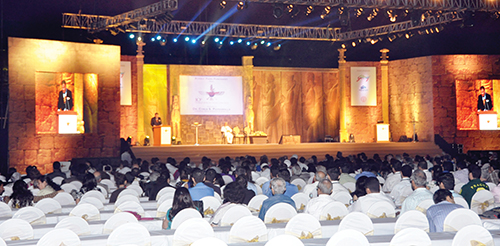
A session in progress at the 10th World Zoroastrian Congress
He contends: "The Zoroastrian religion is ethno focused: no non-Iranians were able to sustain the Zoroastrian message.” But the Armenians did till the Romans maneuvered for centuries to impose Christianity on them.
In an obvious riposte to Maharashtra advocate general Darius Khambata’s contention to the contrary at the 10WZC, Mistree pontificates: "Religion…cannot be left to legal luminaries.” Yet Mistree and his allies still desperately hang on to the judgment of Justices Dinshaw Davar and Frank Beaman to justify their spurious ethnic claim. Mistree asserts that religion should be the domain "of those who have studied our faith, those who have done enough research.” Few scholars have done this as well as Prof Philip Kreyenbroek, who is quoted in the same issue of Parsiana as declaring: "Zarathushtra was willing to accept believers wherever they came from provided they accepted the philosophy as proposed by Ahura Mazda.”
"Congress comments,” in the same issue, wonders: "For how much longer will we harp on exclusiveness?” Regrettably at the 10WZC "most issues were swept under Persian carpets” thus missing a golden opportunity to resolve the ethnic issue ominously hanging over us as a death threat. One hopes the next Congress will address such vital issues, discuss them threadbare and offer tangible solutions. Few open-minded scholars were invited at the 10WZC. When I was barred from reading a paper at the Fourth World Zoroastrian Congress in Bombay in 1985 because of my views, the late solicitor Shiavax R. Vakil thought it fit to note in his Foreword to my book on acceptance: "A day will dawn when posterity will not forgive this lapse on the part of self-appointed leaders of the community who wish to avoid discussions on controversial issues.” If any world Congress continues to do so, we will only end up ill-serving our progeny.
Few can claim to have come from a more traditional background than myself. Both my parents were traditional, and along with my solicitor brother Burjor they were greatly influenced by Dastur Khurshed Dabu. My biography of the revered Dastur, which has been published in FEZANA Journal, reveals that despite being very orthodox he was quite flexible about the need to change when required. And that moment has already arrived. It is not true that in North America we exempt ourselves "from preserving rituals, traditions and practices” as we have sought "greener pastures, better lives.” Rather, the present immigrants, being mainly from Parsi colonies and moffusil areas are more orthodox than the Bombay Parsis. They even aspire to have a traditional agiary here and are puzzled about why our ritual rules won’t permit it.
The 10WZC witnessed the presence of mostly the past and present office bearers of FEZANA (Federation of Zoroastrian Associations of North America), which has little relevance for our young generation. When the present generation is no more, there will be an unbridgeable divide between the Parsis in India and those in North America. The present Parsi immigrants will naturally be enamored of their ties with India but that would only result in neglecting the real need of our progeny here: how to remain true to our Prophet despite our sad inability to adhere to our Parsipanu.
This is not to suggest that we do away with Parsipanu. In fact, Parsipanu has kept our identity intact for centuries in India, though elsewhere it has not. Zoroastrians were spread from Egypt, Turkey, Armenia, etc to China but we could only survive in India, mainly because of its free acceptance of "others” and its caste system. Modernity and now globalization are, however, impediments to preserving Parsipanu even in India and it is but a matter of time before these forces will devour us. Even Mistree’s own family is no exception to the Zeitgeist (the general intellectual, moral and cultural climate of an era); no family is or will be. As a matter of fact, there is hardly a family left today that does not have someone who has married out.
Ethnicity indeed is so vital for the world’s most microscopic race to survive and every effort to reinforce and nurture it is also essential. But while the Zeitgeist is against us so strongly, the tenets of our Prophet are not. Rather, they are as universal today as when they were first promulgated in the pre-historic period. The planners of the 10WZC were able to sweep under the rug a disastrous time bomb awaiting our fate. Alas there will not be many young representatives from abroad attending the next WZC in Bombay as this Congress has done nothing to maintain ties with them. It could have tried to bring about a win-win situation by emphasizing and reinforcing ethnicity without compromising and negating the universal character of our great religion. This is a formidable challenge and is tantamount to change or perish.
Ethnicity is the main reason we survived so well in pre-modern India, but in the modern world following ethnicity is like blindly rushing to our destruction or decimation at best. There is not much time left to choose between our great Prophet’s universal tenets, ethnicity or a synthesis of the two, in view of our rapidly declining numbers for which no statistical analysis is needed.
ERVAD (Dr) KERSEY H. ANTIA
Chicago, Illinois
dilshadantia@yahoo.com
◆ ◆ ◆
From the archive