
Events & Personalities
Education, then and now
"He starts his day early when half the world is asleep and he has to work till late night... Our mobed has to be academically qualified and he has to attain perfection in his prayers which is learning by rote. He sacrifices his life for the laity, for his community and yet what does he achieve at the end of the day? The attitude of the laity towards the mobed is one of indifference so he is virtually apprehensive to take up this profession,” said Dastur Khurshed Dastoor of Udvada during his address at the salgirah function of the M. J. Wadia Agiary in Lalbaug on March 1, 2013, Meher mah, Meher roz. With the number of mobeds dwindling, "where does our community stand today?” Dastoor queried. In order to survive, the community must value our priests and work for the amelioration of their lot he emphasized, as per a write-up sent to Parsiana by religion teacher Roxane Desai.
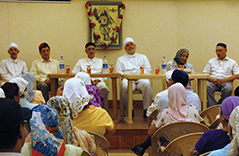
Decorative chalk designs and floral torans adorned the fire temple where a jashan led by Dastoor was performed on the occasion, followed by a program in the renovated M. J. Wadia Hall. An invocation by Dastoor was followed by a monajat sung by Marzban Mehta. The trustees presented flowers to Dastoor, Ervad (Dr) Ramiyar Karanjia, principal of the Dadar Athornan Institute and builder Zarir Bhathena.
Education being the evening’s theme, Kersi Limathwalla, chairman of the M. J. Wadia Agiary Trust noted that many times at the pinnacle of success in one’s chosen field there is a feeling of something lacking. The most successful are not the most happy. Our education system is structured in a manner that the subtler aspect is not given adequate importance. There is indifference to value education on the part of both parents and teachers which affects the outlook of students on society. This needs to change.
Karanjia spoke about education in ancient Iran. Prayers give us knowledge, he explained, which is far more important and useful than mere book learning. The Romans have testified that Zoroastrians in Iran gave utmost importance to education — rather than rote learning students were taught how to acquire wisdom which led to all-round personality development. In ancient Iran there was a specified age for education — from five years to 24 years. The time prescribed too was ideal — from 4 a.m. to 8 a.m. and 4 p.m. to 8 p.m.
A CD of monajats produced by Marzban Giara was launched by Dastoor (see "Songs of joy and peace”), followed by a play which conveyed the message that it is not just teachers who teach us; sometimes an innocent effort by a little child can change our lives forever. The play, by Desai and her team of little actors was much appreciated. The video of a play on Rustom and Sohrab directed by Mithoo Jessia transported the audience to ancient Iran.
It was announced that the Structured Course – VI, where religious knowledge is imparted under Karanjia’s guidance, will soon commence on the first Sunday of every month at the M. J. Wadia Agiary. To register for it, one should contact Desai on the telephone: 9819379345.
Decorative chalk designs and floral torans adorned the fire temple where a jashan led by Dastoor was performed on the occasion, followed by a program in the renovated M. J. Wadia Hall. An invocation by Dastoor was followed by a monajat sung by Marzban Mehta. The trustees presented flowers to Dastoor, Ervad (Dr) Ramiyar Karanjia, principal of the Dadar Athornan Institute and builder Zarir Bhathena.
Education being the evening’s theme, Kersi Limathwalla, chairman of the M. J. Wadia Agiary Trust noted that many times at the pinnacle of success in one’s chosen field there is a feeling of something lacking. The most successful are not the most happy. Our education system is structured in a manner that the subtler aspect is not given adequate importance. There is indifference to value education on the part of both parents and teachers which affects the outlook of students on society. This needs to change.
Karanjia spoke about education in ancient Iran. Prayers give us knowledge, he explained, which is far more important and useful than mere book learning. The Romans have testified that Zoroastrians in Iran gave utmost importance to education — rather than rote learning students were taught how to acquire wisdom which led to all-round personality development. In ancient Iran there was a specified age for education — from five years to 24 years. The time prescribed too was ideal — from 4 a.m. to 8 a.m. and 4 p.m. to 8 p.m.
A CD of monajats produced by Marzban Giara was launched by Dastoor (see "Songs of joy and peace”), followed by a play which conveyed the message that it is not just teachers who teach us; sometimes an innocent effort by a little child can change our lives forever. The play, by Desai and her team of little actors was much appreciated. The video of a play on Rustom and Sohrab directed by Mithoo Jessia transported the audience to ancient Iran.
It was announced that the Structured Course – VI, where religious knowledge is imparted under Karanjia’s guidance, will soon commence on the first Sunday of every month at the M. J. Wadia Agiary. To register for it, one should contact Desai on the telephone: 9819379345.
◆ ◆ ◆
From the archive