
Zoroastrians Abroad
Prized philosopher
"He’ll be fondly recalled by multitudes of grateful alumni as a source of cultural and intellectual enrichment and encouragement, not only for students of philosophy, but for all those who have had the privilege of interacting with him.” Prof Kaikhosrov Irani’s contribution to the Department of Philosophy was acknowledged on the website of the City College of New York (CCNY) that honored the nonagenarian with its Faculty Service Award on June 13, 2012. He was felicitated at the Alumni Association’s 160th annual meeting in The Great Hall on the CCNY campus by Dr Lisa Coico, president of the College. She appreciated that his interests are as diverse as their student body, with his expertise ranging from ancient civilizations and religious and physical issues to modern physics.
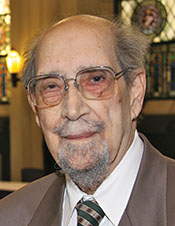 During his 61-year tenure with CCNY he chaired the philosophy department for nine years and directed the Academy of Humanities and Sciences for 12 years. In addition, he served as director of the History and Philosophy of Science Program and was responsible for the development of the Program and its execution and teaching. Known to influence generations of City College students, one of his admirers, an anonymous Scandinavian who became a successful chemical engineer, gave City College two million dollars in 1999 to establish a fellowship program named after Irani. Appointed Emeritus Professor of Philosophy after teaching at the CCNY for 41 years, he took his final class at City College last spring.
"Our Zoroastrian Association of Greater New York (ZAGNY) members were there to proudly celebrate this jubilant milestone with him,” noted a report from Dr Khursheed Navder, professor and director of Nutrition Program at the City University of New York. During 1993-95 he was ZAGNY president and over the years has worked with numerous boards and arranged seminars and conferences under its umbrella.
The philosopher-scholar is known to have arranged the first and second Gatha Conferences held in the UK and Los Angeles and the first Yasht Conference in New Rochelle, New York. From the time of the inception of the Zoroastrian temple in New York, Irani has conducted classes for adults on the subject of Zoroastrianism.
 Keen to pursue his interest in science, Bombay born Irani had studied chemistry, physical chemistry and physics before the war years, and law subsequently, briefly practising at his father Dinshah’s legal firm. It was there that he met another young lawyer, Piroja, whom he wed in 1953. (She expired in November 2012.) In 1947 he moved to the United States to continue his studies at Princeton University where he was taught by Albert Einstein. An authority on philosophical issues in modern physics, his work with Einstein earned him a letter of recommendation from the famous scientist.
Among his original philosophical contributions is the thesis on Domains of Belief according to which there are four intrinsic demands made by the human psyche: The demand for an explanation results in an enormous array of study called scientific knowledge; the demand for influence and control of the environment (both physical and social) leads to technology; the demand to justify one’s own actions and those of others contributes to ethics; and the demand to seek significance in our existence produces religion.
As enunciated by Irani on his website (www.kdirani.com), in the early history of humanity there was no clear understanding of the separation of these domains. However, as civilizations advanced, the various demands gained prominence and separated from the collective — forming their own distinctive domain of belief. Application of rules and methodologies of one domain to that of another is creating tremendous confusion and intellectual transgression. Conversely, the clear application of the methodologies of each domain to issues within the same domain will present clarity.
During his 61-year tenure with CCNY he chaired the philosophy department for nine years and directed the Academy of Humanities and Sciences for 12 years. In addition, he served as director of the History and Philosophy of Science Program and was responsible for the development of the Program and its execution and teaching. Known to influence generations of City College students, one of his admirers, an anonymous Scandinavian who became a successful chemical engineer, gave City College two million dollars in 1999 to establish a fellowship program named after Irani. Appointed Emeritus Professor of Philosophy after teaching at the CCNY for 41 years, he took his final class at City College last spring. "Our Zoroastrian Association of Greater New York (ZAGNY) members were there to proudly celebrate this jubilant milestone with him,” noted a report from Dr Khursheed Navder, professor and director of Nutrition Program at the City University of New York. During 1993-95 he was ZAGNY president and over the years has worked with numerous boards and arranged seminars and conferences under its umbrella.
The philosopher-scholar is known to have arranged the first and second Gatha Conferences held in the UK and Los Angeles and the first Yasht Conference in New Rochelle, New York. From the time of the inception of the Zoroastrian temple in New York, Irani has conducted classes for adults on the subject of Zoroastrianism.
Keen to pursue his interest in science, Bombay born Irani had studied chemistry, physical chemistry and physics before the war years, and law subsequently, briefly practising at his father Dinshah’s legal firm. It was there that he met another young lawyer, Piroja, whom he wed in 1953. (She expired in November 2012.) In 1947 he moved to the United States to continue his studies at Princeton University where he was taught by Albert Einstein. An authority on philosophical issues in modern physics, his work with Einstein earned him a letter of recommendation from the famous scientist. Among his original philosophical contributions is the thesis on Domains of Belief according to which there are four intrinsic demands made by the human psyche: The demand for an explanation results in an enormous array of study called scientific knowledge; the demand for influence and control of the environment (both physical and social) leads to technology; the demand to justify one’s own actions and those of others contributes to ethics; and the demand to seek significance in our existence produces religion.
As enunciated by Irani on his website (www.kdirani.com), in the early history of humanity there was no clear understanding of the separation of these domains. However, as civilizations advanced, the various demands gained prominence and separated from the collective — forming their own distinctive domain of belief. Application of rules and methodologies of one domain to that of another is creating tremendous confusion and intellectual transgression. Conversely, the clear application of the methodologies of each domain to issues within the same domain will present clarity.
◆ ◆ ◆
From the archive