
Readers' Forum
“Rituals, restoration...”
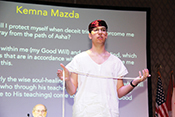
Our ancestors, we are told, fled Iran to preserve, protect, and promote our beloved religion. Today, one cosily assumes that our venerable heritage is being devotedly realized on all three counts. On reading the excellent report on the XVI NAZC ("Rituals, restoration and relief,” Parsiana, October 21, 2012) it is clear that none of the three aims are being met in North America where new traditions are blatantly usurping the good religion of Zarathushtra.
The three ancient languages in our liturgical texts were very carefully recorded for posterity in a specially devised fifth century CE script. In Iran it gave way to the unvocalized Persian for Farsi speaking Zardushtis; in India they were registered in Gujarati and Devanagari, both vocalized to render the old languages into readable form for Zarthoshti priests. In the wild and woolly West, whilst Farsi is maintained amongst the youth, Gujarati is not — it would be pointless except for sentimental reasons. The lingua franca is, in fact, English; perhaps Parglish (Parsi-English).
When, therefore, young Ervad Karl Khambata took to the podium with his makmal topied (velvet capped) and sudrehed presence to demonstrate the full nirang-i kushti bastan rite, not with intonation of the three ancient languages of which it consists, but in an English rendition (not translation!), which was nonsensical, if not quite scandalous! It does make a mockery of heritage transmission. Why does North America jettison the still lauded and tested procedure of a preamble given in either or all three modern languages, then prayed in the three liturgical ones and followed by a free rendition? This teaching method had been successfully utilized in both India and Iran until the 1950s and 1980s diasporas when pastures new beckoned.
To correct certain misapprehensions about the elements of the kushti nirang: The introductory Kemna mazda and Ka varathram.ja are in Gathic Avestan [GAv] from Yasnas 46.7 and 44.16 (both Zarathushtra’s own metrical compositions); || Pata.no in prose "Younger” Avestan [Av] is from the Vandidad, VIII.21, etc. This chapter in fact contains the complete Avestan prayers recited during the actual kushti-tying (marked here with ||.); Hormazd Khoday is a Pazand [Pz] section composed centuries later in India, since the oldest Iranian manuscripts neither know it nor show it. It is not from the "Spentomad” Gatha from which Ahriman is entirely absent: we are not dualists; the stray line Haithyavarashtam [GAv] is repeated from Yasnas 46.19 and 50.11; two Yatha ahu vairyos [GAv], from Ys.27.13 when fastening the front knots; a single Ashem vohu [GAv] from Ys.27.14 for the closing back double-knot. || The "Profession of the Faith,” Fravarane or Jasa.me [Av], (with its Mazdayasno zarathushtrish from Yasna XII.8,9) follows after the actual kushti bastan.
It is disturbingly evident that in North America matters of crucial theological importance are either misrepresented or willfully neglected. Navjotes indeed are prematurely performed not through adoption of pious duty but merely to forestall the onset of puberty! The ervads of the future must shape up and avail themselves of the vast resources for proper study existing there. Future generations and the future of Zoroastrianism itself are in real danger of parting company: it is religious quackery, ignorance, sloppiness and indifference of the Parsis that will ensure the disappearance of our long-cherished inheritance; the Iranians are quite secure with induction of women priests. For Parsis there can never be a second Sanjan.
The three ancient languages in our liturgical texts were very carefully recorded for posterity in a specially devised fifth century CE script. In Iran it gave way to the unvocalized Persian for Farsi speaking Zardushtis; in India they were registered in Gujarati and Devanagari, both vocalized to render the old languages into readable form for Zarthoshti priests. In the wild and woolly West, whilst Farsi is maintained amongst the youth, Gujarati is not — it would be pointless except for sentimental reasons. The lingua franca is, in fact, English; perhaps Parglish (Parsi-English).
When, therefore, young Ervad Karl Khambata took to the podium with his makmal topied (velvet capped) and sudrehed presence to demonstrate the full nirang-i kushti bastan rite, not with intonation of the three ancient languages of which it consists, but in an English rendition (not translation!), which was nonsensical, if not quite scandalous! It does make a mockery of heritage transmission. Why does North America jettison the still lauded and tested procedure of a preamble given in either or all three modern languages, then prayed in the three liturgical ones and followed by a free rendition? This teaching method had been successfully utilized in both India and Iran until the 1950s and 1980s diasporas when pastures new beckoned.
To correct certain misapprehensions about the elements of the kushti nirang: The introductory Kemna mazda and Ka varathram.ja are in Gathic Avestan [GAv] from Yasnas 46.7 and 44.16 (both Zarathushtra’s own metrical compositions); || Pata.no in prose "Younger” Avestan [Av] is from the Vandidad, VIII.21, etc. This chapter in fact contains the complete Avestan prayers recited during the actual kushti-tying (marked here with ||.); Hormazd Khoday is a Pazand [Pz] section composed centuries later in India, since the oldest Iranian manuscripts neither know it nor show it. It is not from the "Spentomad” Gatha from which Ahriman is entirely absent: we are not dualists; the stray line Haithyavarashtam [GAv] is repeated from Yasnas 46.19 and 50.11; two Yatha ahu vairyos [GAv], from Ys.27.13 when fastening the front knots; a single Ashem vohu [GAv] from Ys.27.14 for the closing back double-knot. || The "Profession of the Faith,” Fravarane or Jasa.me [Av], (with its Mazdayasno zarathushtrish from Yasna XII.8,9) follows after the actual kushti bastan.
It is disturbingly evident that in North America matters of crucial theological importance are either misrepresented or willfully neglected. Navjotes indeed are prematurely performed not through adoption of pious duty but merely to forestall the onset of puberty! The ervads of the future must shape up and avail themselves of the vast resources for proper study existing there. Future generations and the future of Zoroastrianism itself are in real danger of parting company: it is religious quackery, ignorance, sloppiness and indifference of the Parsis that will ensure the disappearance of our long-cherished inheritance; the Iranians are quite secure with induction of women priests. For Parsis there can never be a second Sanjan.
◆ ◆ ◆
From the archive