
Readers' Forum
“A major shock”
I was born in India but migrated to Toronto, Canada with my parents 14 years ago when I was five years old. Living there, I always had the perception that there was nothing like "poor or lower-middle class Parsis.”
This impression changed completely when I had the opportunity to visit the villages around Navsari with Dinshaw and Bachi Tamboly from the World Zoroastrian Organization (WZO) Trust Funds. I always thought that in Bombay and other places Zoroastrians are very well-to-do people, but in the villages there are many from our community who are still struggling to make ends meet.
I visited eight villages around Navsari with the WZO Trust Funds. In Gangaria I saw the hut in which a family had being living being replaced by a cottage. The cottage was nearly complete with only doors and windows remaining to be fitted. The family had a small field in which they were growing sugarcane.
In Bartad we met a man who looked after his buffalo farm during the day. He lived in a hut without any windows or doors. During the monsoon season, there was no protection from the rain. He would eat rice and dal every day, cooked on an open fire. The house afforded him no security.
In the village of Manpur the WZO Trust Funds has helped a family convert their hut into a cottage and now they have a proper roof over their heads. Another hut in which an elderly woman in her mid-90s lives alone lacked proper flooring. She is fortunate that the family living next door provides her with meals.
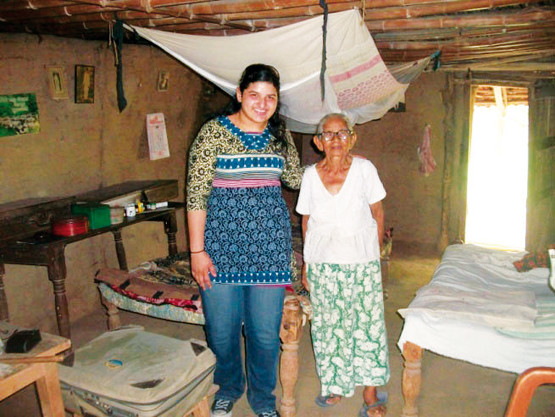
Tanya Bharda with Hillamai, 93, in Manpur village
The WZO Trust Funds has helped a family set up a poultry farm in the village of Choravni. They would get a batch of 500 chickens, feed them for about 40 days and then sell them. If the poultry market was good, they would earn a decent amount of money but if the market was not good at that point, they would have to survive on whatever they received.
The next village we visited was Vangan where a couple had to contend with many problems but still emerged strong. They keep rice, mangoes, onions, and garlic out to dry in the rooms of their house. In Vaghai we saw two Parsi chaiwallas (tea stalls). This came as a real shock to me. I had never ever imagined I would see Parsis running tea stalls for a living.
Finally, we went to Kevdi and Sadad Devi villages, the latter situated deep in the forest where I met Alice Tangri, who lives there with one son. Her husband Jamshed and other sons work as chasnivalas at different agiaries in Bombay. There is no electricity in this village. They produce their own power through solar energy. They do not have fans, or any other gadgets that work on electricity. It was a major shock for me to see how much labor it entails to get the basic necessities. There is a small primary school run by the local government with 27 children from very poor families who live in the forest. The WZO Trust Funds help the school financially from time to time.
This experience really opened my mind and I would recommend every young person to come and just see the reality of Parsis living in the villages and being helped by the WZO Trust Funds.
TANYA BHARDA
Toronto, Canada
tbharda@hotmail.com
◆ ◆ ◆
From the archive