
Cover Story
A royal reception
The Zoroastrian delegation with eight other religious denominations felicitated Queen Elizabeth II at a multifaith celebration hosted by the Archbishop of Canterbury Dr Rowan Williams
This gathering is a reminder of how much we owe the nine major religious traditions represented here. They are sources of a rich cultural heritage and have given rise to beautiful sacred objects and holy texts as we have seen today.” Her Majesty Queen Elizabeth II was addressing a multifaith reception at Lambeth Palace hosted by the Archbishop of Canterbury Dr Rowan Williams on February 15, 2012. This event being one of her first public engagements to celebrate the diamond jubilee of her accession to the throne, the Queen reaffirmed, "Our religions provide critical guidance for the way we live our lives, and for the way in which we treat each other. Many of the values and ideas we take for granted in this and other countries originate in the ancient wisdom of our traditions. Even the concept of a jubilee is rooted in the Bible.”
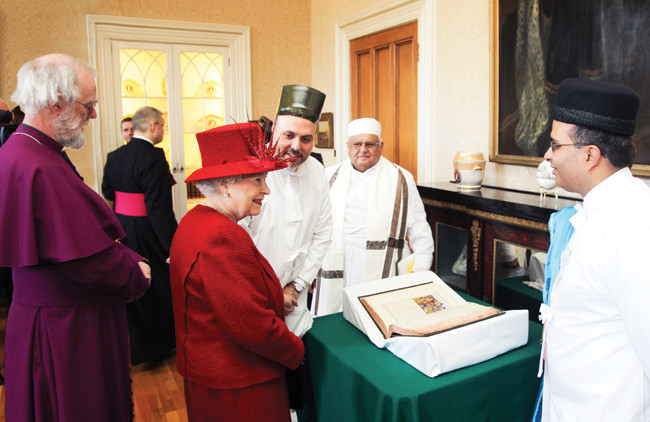
Her Majesty Queen Elizabeth II being shown the Shah Nameh manuscript by (from left) Malcolm Deboo, Ervad Rustom Bhedwar and Paurushasp Jila with Dr Rowan Williams (far left) Photo: Andrew Dunsmore
Representing the Zoroastrian faith at this reception were Malcolm Deboo, president of the Zoroastrian Trust Funds of Europe (ZTFE) (Incorporated), Paurushasp Jila, vice president, Ervad Rustom Bhedwar, trustee and Dr Rashna Writer, senior teaching fellow, Department of Religions at the School of Oriental and African Studies (SOAS). Each group of religious leaders was required to display a treasure of particular significance to the faith or practice of their community. The Zoroastrian quartet exhibited a 19th century illustrated Shah Nameh manuscript from the Qajar era. As per the minutes of the ZTFE meeting on January 25, 2012, the manuscript belongs to Navsari’s First Dastoor Meherjirana Library but was under conservation at the Royal Library in Copenhagen and hence Deboo was entrusted the task of bringing it to London a few days before the presentation.
The royal party seemed genuinely interested to learn of "the cultural and totemic significance of The Book of Kings in the Iranian world” and that in the late 19th century "a delegation of Parsi Zoroastrians led by then ZTFE president Dr Dadabhai Naoroji had petitioned the then Shah of Persia Nassurdin Shah Qajar, when he was a guest of Queen Victoria, to look kindly on his Zoroastrian subjects,” noted a report by Writer.
The Baha’i delegation had chosen to exhibit the Robe of Abdu’l-Baha, the Buddhists a silver stupa, the Hindus a floral representation of the Om, the Jews the Codex Valmadonna I, a Hebrew version of the Five Books of Moses that was flown in from New York, the Muslims a holy piece of Kiswah, the Sikhs a painting of Maharaja Ranjit Singh, the first maharaja of the Sikh empire, and the Jains the Kalpasutra (Book of Rituals). The last two sacred treasures were specially released for the occasion by the Victoria and Albert Museum.
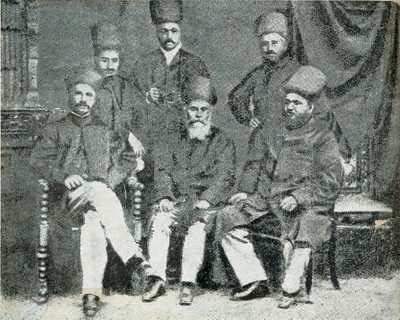
Parsi merchants of England in the 1860s (from left, sitting) Rustomjee Umrigar, Framjee Mowdawalla, Mancherji Cama; (standing) Dadabhoy Cama (left) and Sorabjee Captain (right) Photo: Parsi Lustre on Indian Soil
Acknowledging how the presence of "fellow distinguished religious leaders and the objects on display demonstrate how each of these traditions has contributed distinctively to the history and development of the UK,” the Queen added, "We should remind ourselves of the significant position of the Church of England in our nation’s life. The concept of our established Church is occasionally misunderstood and, I believe, commonly under-appreciated. Its role is not to defend Anglicanism to the exclusion of other religions. Instead the Church has a duty to protect the free practice of all faiths in this country. It certainly provides an identity and spiritual dimension for its own many adherents. But also, gently and assuredly, the Church of England has created an environment for other faith communities and indeed people of no faith to live freely…
"This occasion is thus an opportunity to reflect on the importance of faith in creating and sustaining communities all over the UK. Faith plays a key role in the identity of many millions of people, providing not only a system of belief but also a sense of belonging. It can act as a spur for social action. Indeed religious groups have a proud track record of helping those in the greatest need, including the sick, the elderly, the lonely and the disadvantaged. They remind us of the responsibilities we have beyond ourselves…”
The Archbishop commended the Queen for being "able to show so effectively that being religious is not eccentric or abnormal,” and pointed out, "If we take seriously the way our constitution works, the United Kingdom is a society where we might expect people to grasp the importance of symbols and traditions, not as a sign of mere conservatism or nostalgia but as a sign of what holds us together, what commits us to each other… It is for all of us an immense encouragement that the first major public occasion of this historic year should be an occasion celebrating the contribution of faith to our society…”
ZTFE’s close association with the Archbishop dates to 2010 when he endeared himself to the Zoroastrian community by becoming the first head of the Worldwide Anglican Communion to officially visit a Zoroastrian place of worship (see "Befriending the bishops,” Parsiana, December 7, 2010). The following year, as part of the 150th celebrations of the ZTFE, the head of the Roman Catholic Church of England and Wales, the Archbishop of Westminster Vincent Nichols joined in the gahanbar in memory of their benefactor the late Mobed Faridoon Zartoshty on November 18, 2011. Just as the prior month saw them play host to His Royal Highness, The Prince Philip, Duke of Edinburgh, who spent three hours with them (see "Sovereign sesquicentennial,” Parsiana, October 21, 2011), the Archbishop of Westminster was in their company for nearly five hours. During the time he spent at the Zoroastrian Centre he gained firsthand experience of the Zoroastrian community, their customs, traditions, religious practices and ceremonies, and even partook of their food.
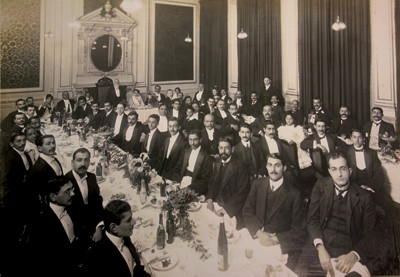
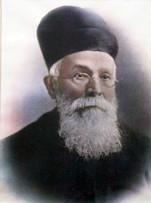
ZTFE Navroz banquet, 1906 with Dadabhai Naoroji in the chair (standing) and Bhikaiji Cama (on his left)
In his welcome address to the Archbishop, Deboo had referred to the Zoroastrian influence on Jewish/Christian theology, drew parallels in the concepts of heaven, hell and Judgment Day as understood by these religions, and dwelt on the significance of the visit made by the Zoroastrian magi to Bethlehem at the birth of Christ. Specially felicitated on this occasion was Bridget McCallig who had served as ZTFE’s housekeeper for over three decades at the Zoroastrian House and was almost a "mother and grandmother” to many in the community, as noted a report by ZTFE managing committee member Rohinton Munshi.
With 2012 being declared as "A Year of Service,” each of the nine faith communities, in turn, have been persuaded to host a day of volunteering in local communities and businesses across the UK inviting people of "all faiths and none” to join in. ZTFE will coordinate and organize groups of Zoroastrians to visit the elderly at their homes, senior citizens’ care centers, hospices. Whilst the traditional celebration of Jamshedi Navroz sees children gather around the Haft Sheen table, this year they will be encouraged to carry gifts for the aged.
"Maintaining the momentum”
"We firmly believe we should not be like ostriches,” declared Deboo when briefing the community media on the direction that the 150-year-old association has chosen to follow keeping in mind that they are "the oldest religious charity and voluntary organization of South Asian origin in the UK.” It is through their networking with members of other religious denominations that they have realized that they share "similar problems… fear of the community not growing or the children not continuing with our faith.”
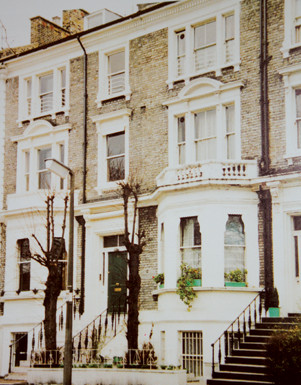
Zoroastrian House at Russell Road, used from 1929-1968
Currently it is estimated by ZTFE that there are around 6,000 Zoroastrians in Europe of whom at least 5,000 reside in and around London and the ‘home’ counties with additional pockets of 50-80 in cities like Manchester, Birmingham and Leicester and smaller numbers scattered throughout the UK. As explained in their sesquicentennial brochure, "The census of 2001 returned a figure of 3,738 Zoroastrians in England and Wales only. The census report confirmed that substantial majority of ‘other religions’ did not identify their religious affiliations…” This was because Zoroastrians being the smallest of minorities were "lumped” along with Jains and Baha’is in "other religions.” European cities like Paris, Frankfurt and Hamburg also have Zoroastrians residing there. Currently ZTFE’s European representatives are Fariborz Mawandad (brother of Paridokht Mehraban Zartoshty) based in Hamburg, Nariosang Poonawalla in Bonn and Kersi Porbunderwalla in Copenhagen.
The association, believing "the Directory is a vital and valuable link to all Zoroastrians across the European continent and indeed throughout the world,” brought out its seventh edition last year. Principal work in compiling the Directory is put in by current trustee and former ZTFE president Rusi Dalal, and Freny Jasavala who more or less maintain the data base of the community and bring out an updated version every three years. Freny and husband Yazdi try to help out "the community in any way they can,” whether it is in the printing, sorting or mailing of circulars. Their help being frequently sought at the nth hour, Yazdi says he fondly describes the community’s functioning as "lastminute. com”
Sharing scholarship
To announce the Zoroastrian presence in Europe, ZTFE regularly interacts with members of other communities, being a member of the Inter Faith Network for the United Kingdom, Faith Forums for London and several local interfaith organizations including the Harrow InterFaith Council. They even encourage their Young Zoroastrians (the YZ group was established in 1974) to represent the community at national interfaith events like at the Millennium celebrations in 2000 and the golden jubilee of the Queen and Tina Mistry, the current chair of YZ was invited to meet the Pope at the Vatican. In fact Deboo takes pride in mentioning that he started off as a member of the YZ team. ZTFE offers scholarships to students from the UK and overseas seeking to pursue postgraduate studies at SOAS. They have even introduced the eXtra Young Zoroastrians (XYZ) group where religious education is imparted through the Children’s Educational Fun Club.
When the ZTFE was established in 1861 one of its objectives was to advance the study and dissemination of information and knowledge of the Zoroastrian faith. Continuing to perpetuate this objective even 150 years later they organized a conference "150 years of Zoroastrian Studies” on October 22 and 23, 2011 as part of their sesquicentennial celebrations (see "Conference explores”). Events and programs like these continue to bring a closer understanding of the Zoroastrian religion, history and culture to the community and the general public, as pointed out Munshi.
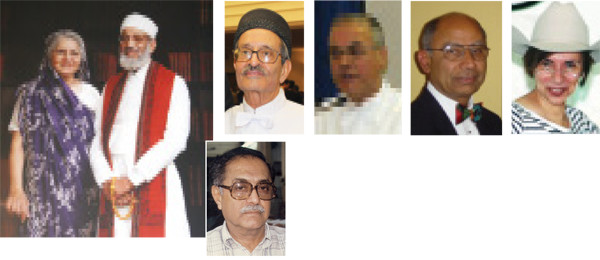
From left: Shirinbanoo and Dastur Sohrabji Kutar, Shahpur Captain (below), Rusi Dalal, Dorab Mistry, Jehangir Sarosh, Dr Rashna Writer
ZTFE has succeeded in forging links with academic institutions of repute like the Universities of Cambridge, Oxford, Manchester and London, The British Library, The British Museum, The Ancient India and Iran Trust, The Iran Heritage Foundation and SOAS. Yet another sesquicentennial celebration program was the introduction of a chair in Zoroastrian studies at SOAS thanks to the munificence of the Zartoshty Brothers and the late Prof Mary Boyce. The association, in fact, has a category of "Honoured Friend” of ZTFE, a title conferred on Profs Mary Boyce (posthumously), John Hinnells and David Bivar. This recognition acknowledges a non-Zoroastrian individual’s "meritorious service to the community in the UK in religious, social, economic or intellectual advancement of the community or where public services and achievements may have reflected exceptional credit on the community.”
The 150th year celebrations saw the inclusion of two new names to the 14-member ZTFE list of honorary members: Dasturs (Drs) Firoze Kotwal and Kaikhusroo JamaspAsa who "through the scholarship of their lectures and publications on Zoroastrian religion have rendered profound and meritorious services to the Zoroastrian community worldwide.”
The last Zoroastrian to be so honored by them was Jehangir Sarosh, president emeritus of Religions for Peace Europe whose services to interfaith relations was recently recognized with the OBE (officer of the Most Excellent Order of the British Empire) in the Queen’s New Year’s honors list. As acknowledged Deboo’s e-mail, "Jehangir has been working tirelessly to improve interfaith relations globally for over three decades and was instrumental in persuading the ZTFE to join the Inter Faith Network for the UK and was our first representative.”
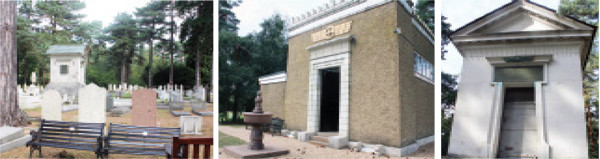
From left: overview of the graves, bungli and Wadia mausoleum at Brookwood cemetery
When March 2011 was designated as "Celebrating Religious Education (RE) Month” in England and Wales, ZTFE jointly with the Religious Education Council of England and Wales took the opportunity to invite students from schools in Harrow to the Zoroastrian Centre premises to witness the performance of the sacred fire litany, Atash Nyaish, and familiarize them with the religion and its key concepts through an interactive session where learning is taken outside the classroom.
One of the finest collections of books and literature pertaining to Zoroastrian religion and culture is housed in the reference library that was established 25 years ago at the Zoroastrian House. The library preserves the Association’s records from day one and includes the collection of books and documents of their third president Sir Mancherjee Bhownaggree since his Parliament days.
Names and places
During its 150-year history the name of the institution has been changed five times, it was reported in the sesquicentennial brochure. It started with Europena Zarthostionu Dharamnu Khatu (Religious Funds of the Zarathushtrians of Europe) under its first president Muncherji Hormusji Cama, in 1861. By 1889 when Dadabhai Naoroji was the president it was changed to Amalgamated: Charitable Fund of The Zoroastrians of Europe. A year after Bhownaggree, as the third president, had taken charge in 1908, the name was changed for the third time to The Incorporated Parsee Association of Europe. The fourth change to Zoroastrian Association of Europe (Incorporated) was made in 1971, within a few months of Dr Shirinbanoo Kutar taking over as the 16th president. It was in 1979, during the presidency of her successor Shahpur Captain that the organization got its present name, Zoroastrian Trust Funds of Europe (Incorporated).
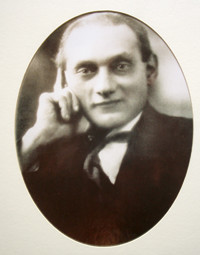
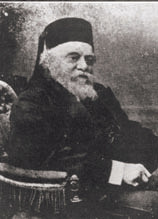
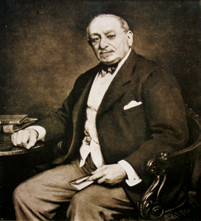
From left: Shapurji Saklatvala; Ardeshirji Wadia and Mancherjee Bhownaggree
ZTFE has needed to change its premises too four times to accommodate a growing community. Starting at a former boarding house for students at Cromwell Road, thanks to a donation from Edulji Jamshetji Khory, in 1929 they shifted to Russell Road with a generous donation from Sir Dhunjibhoy Bomanji Kt and Lady Frainy Bomanji. The next move was to Compayne Gardens in 1969 (the major donors being Khodad Rustom Mehrabi, Sir Cowasji and Lady Hirabai Cowasjee Jehangir, with the setayesh gah being donated by Dastur Sohrabji and Shirinbanoo Kutar, and the subsequent extension in 1983 made possible by generous donations from Arbab Rustam and Morvarid Guiv as also Mobeds Mehraban and Faridoon Zartoshty). They finally shifted to their present abode at Harrow in 2005 (the Zartoshty brothers once again serving as their most munificent donors). Zoroastrian Centre being designated as one of the heritage sites in London, on "open day” declared annually by the Open House London organization, free access is granted to the public. "Unfortunately, archiving history is not our strongest point,” regrets Deboo referring to some minutes books gathering dust in the attic at their former premises at Compayne Gardens until they were found by Dalal. As per the data culled by Deboo, ZTFE’s 26th president since 2009, the longest serving president of ZTFE was Naoroji who was in charge for 45 years from 1863 to 1908. In fact Naoroji was among the founder fathers of this organization and immediately supported the proposal mooted by Cama in 1861 that the nearly 50 Zoroastrians residing there could each give according to his means for religious and charitable purposes. "This would enable them not only to perform good deeds but also to live in harmony with one another in good and bad times,” noted Cama’s letter in Gujarati, the oldest document in the archives of ZTFE.
The first constitution of the association too was formulated in Gujarati with Cama, senior partner of Messrs Cama and Company, the first Indian mercantile firm in London, being elected chairman and Jehangirji Burjorji as secretary. Besides Naoroji who was elected trustee, yet another well-known trustee was Ardeshirji Khurshedji Wadia, the famous ship builder and engineer who 20 years earlier was the first Indian to be conferred the fellowship of the Royal Society. The third elected trustee Pirojshah Pestonji along with the two managing committee members Dr Burjorji Dorabji and Dhunjibhai Khurshedji Ratnagar were amongst the first seven-member elected team.
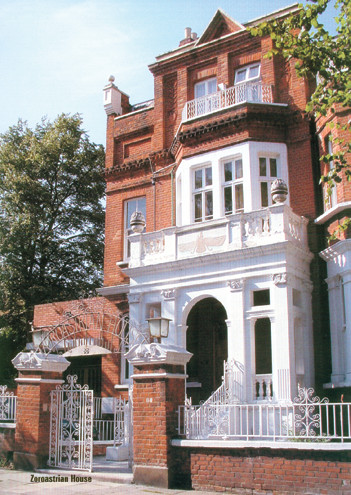
Zoroastrian House at Compayne Gardens, used from 1969-2004
The foresight of the pioneers was evinced in the purchase of an exclusive burial ground for Zoroastrians at Brookwood Cemetery in Surrey in 1863 that continues to be maintained by the association. Not only are the Wadia mausoleum and the Tata mausoleums located on this plot, there are about 400 graves with the oldest dating to 1864. Along the periphery are the older graves and there is one plot where those of East African origin have been interred. ZTFE spends £ 10,000 each year on the upkeep of the ground and burial plots. "This has been my domain for the last 25 years,” states Dalal who voluntarily shoulders the responsibility of overseeing this property. A blueprint with him shows the location of the different graves and the plaques for those cremated whose ashes have been interred. In terms of availability of space, "for another 30 years there is no cause for worry,” mentions a confident Dalal who is frequently referred to as "the walking encyclopedia on the community.”
Until World War II the community even had a cemetery in Germany but it was flattened thereafter. Among the six graves known to exist there was one of the wife of Arbab Kaikhusroo Shahrookh who was the righthand man of Reza Shah Pahlavi. When industrialist J. N. Tata died in Germany, his body was brought to London to be buried at the Brookwood cemetery.
The Tata family’s connection with ZTFE manifested in different ways. In 1909 R. D. Tata, approached the association in London after his French wife Suzanne was denied acceptance by the Bombay Parsi community. But there too she was denied membership. Shapurji Saklatvala, nephew of J. N. Tata, had his children’s navjotes performed although they were of a non-Zoroastrian mother.
After the independence of India, the group of leadership in charge of affairs at London had non-Zoroastrian wives but the spouses were never made members for the "leadership did not want to rock the boat,” states Deboo. Non-Parsi spouses however were permitted to be present for the muktad prayers in memory of the dead. In the 1960s-’70s a fresh wave of immigrants came from Zanzibar, Africa. The new orthodox leadership at the helm resolved in 1986 that non-Parsi spouses should be debarred from attending the Farvardian jashan prayers organized by the ZTFE at the bungli at Brookwood Cemetery. Erstwhile presidents like Captain and Shirinbanoo, known to be liberal, chose to distance themselves from the ZTFE’s workings and focused on promoting the World Zoroastrian Organisation.
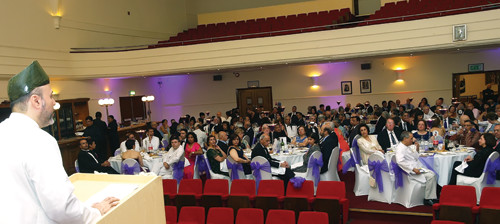
Malcolm Deboo addressing the assembly at the 150th anniversary banquet
In the early 1990s the new leaders who held office "took a conservative stand, rightly or wrongly. We are maintaining the momentum,” summed up Deboo. The conflicts between the traditionalists and the reformists "have calmed down following Dorab Mistry’s presidency (1997-2005). Fortunately the major donors are with us,” stated the president. Describing the position of the association as "financially sound,” Mistry who is currently a managing committee member mentioned that the book value of their assets is worth six million pounds.
Wary of "burning all boats (which) is a typical revolutionary approach that shows you do not have the confidence to succeed,” Deboo is convinced, "That, sadly, is not the right way to follow.” A better option he advocates is the advice of Dastur M. N. Dhalla who in 1939 recommended the liberals to go their own way like the Protestants did.
Unlike other communities who resort to honor killings or compel their children to go back to India in search of a spouse, Zoroastrians "are a totally elite group,” appreciated Dalal. Even when confronted with internal problems like interfaith marriages "life goes on.”
Conference explores
Delivering the inaugural lecture for the ZTFE organized sesquicentennial conference on October 20 at SOAS was Kotwal who spoke on "An Overview of the History and Development of the Parsi Priesthood in India up to the 19th century.” His paper referred to the difficulties in detailing the history, the scant resources available, the fragility of important manuscripts and the confusion over dates.
Believing that knowledge should be "shared,” this conference was aimed to draw members of all communities from the age of 15 and upwards. Speakers who proclaim that "conversion is okay, it’s in the Gathas,” were kept out, conveyed Deboo. The hosts were keen to focus on the historical overtones rather than the controversial religious issues.
The two-day conference saw presentations from four SOAS faculty members: Prof Almut Hintze dwelt "On the concept of creation in Zoroastrianism” and referred to the Zoroastrian religion where Ahura Mazda has been described as the creator of the mental or spiritual world as also the physical or material existence. Hinnells’ presentation on "Zoroastrian Trust Funds of Europe: A history of 150 years” traced the growth of this organization, and focused on the key moments and major figures who have shaped it. Dr Sarah Stewart’s paper titled "Negotiating Transition: From dakhmeh to aramgah” based on her research in Tehran showed that the change from exposure to burial involved members of the elite in negotiations within and outside the community. Writer’s topic: "The Role of Education: Keeping the Zoroastrian Heritage Alive” stressed that it is important that the parents and grandparents of the Zoroastrian youth are reeducated in the basics of their heritage to enable them to answer the searching questions posed by enquiring young minds.
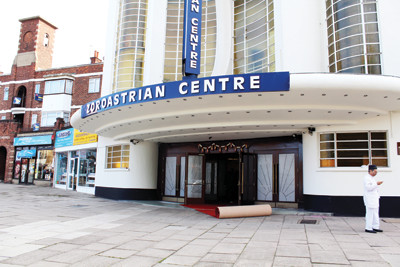
Zoroastrian Centre in the London borough of Harrow
Two other scholars from UK, Dr Vesta Curtis of the British Museum and Prof Alan Williams from the University of Manchester referred to travelers and the diaspora. Curtis’ presentation on "The Magic of ancient Persia: 19th century travelers and discoveries” summarized the views of some European explorers on Persia, its history and archeology. Williams’ talk on "Diaspora then and now in the mirror of the Qesse-ye Sanjan” related how the Qesse reaffirms the values of their past and speaks of the compromises and commitments that have had to be made, comforted by the central symbols that unite this community — the holy fire and the identification with Iran.
Professors from two American universities, Jamsheed Choksy from the University of Indiana and Dr Jenny Rose from Claremont Graduate University spoke on "The Zoroastrians of colonial Ceylon and independent Sri Lanka,” and "Agents of change: Dynamic encounters between Parsis and New Englanders in the late 18th and early 19th centuries” respectively. Choksy examined the community over four centuries in the "island of jewels,” particularly the challenges they face and the adaptations they have made to modernity and to minority status. Rose discussed the Parsi contributions to the changing cultures of America and Europe that occurred against a backdrop of political development that brought colonial expansion for some countries and revolution and redefinition for others.
There were two other overseas scholars speaking at the congress: French archeologist Franz Grenet’s paper on "Zoroastrian funerary art in Sogdiana and China” pointed out that although very few images of gods were known in Sasanian Iran, from the ancient Zoroastrian countries of Bactria and Sogdiana is emerging a rich repertoire as witnessed by new archeological finds. Co-founder of Zoroastrian Studies, The Athravan Educational Trust and the World Alliance of Parsi Irani Zarthoshtis, Khojeste Mistree’s paper titled "Select English and European Scholars and their Study of Zoroastrianism: A narrative and a Journey” covered a period of 300 years from the 17th to the 19th centuries and highlighted the early European travelers visiting India whose reports aroused the attention of orientalists.
◆ ◆ ◆
From the archive