
Cover Story
Befriending the bishops
The visit by the senior-most primate bishop of the worldwide Anglican community gave a fresh impetus to the Zoroastrians in UK
"To the best of my knowledge it is the first time in the history of Christianity and Zoroastrianism that an Archbishop of Canterbury has made an official visit to a Zoroastrian place of worship,” remarked Malcolm Deboo, president of the Zoroas- trian Trust Funds of Europe (ZTFE) when welcoming Dr Rowan Williams, the 104th Lord Archbishop of Canterbury. "In the light of this community I feel that I am touching some very great root of the religious inspiration of so many of the world religious faiths at this present point in time,” remarked the Archbishop adding that "for a small community in size your contri- bution is great… It’s important in this country to remember the smaller com- munities of faith; just as I have some- times said, there is no such thing as a small church, only small Christians. Heart and vision is what matters.”
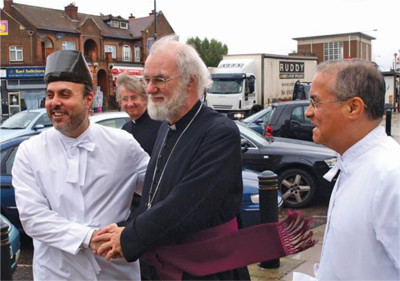
Malcolm Deboo (left) and Dorab Mistry (right) welcome the Arch- bishop of Canterbury Dr Rowan Williams
The landmark visit by the senior- most religious leader in the UK, second only to the Queen in terms of protocol, and the senior-most primate bishop of the worldwide Anglican communion on October 1, 2010 "took 15 months in the making,” notes a detailed report of the event from the ZTFE. Arriving at the doorstep of the Zartoshty Brothers Hall at 1.45 p.m. the Archbishop was given a traditional, Parsi and Iranian welcome. Parsi women decked in garas performed the aachhu michhu ceremony after which ZTFE joint social secretary Shernaz Sadri garlanded him. Iranian Zoroastrian women, Mahnaz Ostad and ZTFE joint secretary Mandana Moavenat, sprinkled rosewater, guided him to see a reflection of himself in the mirror and offered him dry fruits and Persian sweets. The Arch- bishop was accompanied by the Bishop of Willesden Pete Broadbent, Canon Guy Wilkinson, secretary for Inter Religious Affairs to the Archbishop of Canter- bury, and Christine Raben, the vicar of Roxbourne Church South Harrow.
The nearly eight-hour visit by the Archbishop was divided into two seg- ments with the afternoon session being set aside to acquaint him with the ZTFE leadership and invited guests as also a visit to the Setayash-Gah (prayer room); and the evening program giving the Zo- roastrian community an opportunity to celebrate Jashn-e Mehregan, interact and dine with him. Hence after the formal introductions to the priests, managing committee members and community stal- warts His Grace was taken around the gallery of photographs in the foyer and provided a brief narrative on past Zoro- astrian legends including philanthropist Sir Dhunjibhai Bomanji, senator Arbab and Morvarid Guiv, past presidents Jehangirji Moos, Dr Shirinbanoo Kutar (first woman ZTFE president), Dastur (Dr) Sorabji Kutar who had volunteered his medical services to the King and the country in World War II, and "honored friend of the ZTFE,” the late Prof Mary Boyce. Having known Boyce and aware of her immense contribution to Zoroas- trian studies, the Archbishop who had spent much of his earlier career as a lecturer in divinity at the Universities of Cambridge and Oxford was delighted to learn that she together with the Zoroastrian phi- lanthropists Mehraban and the late Faridoon Zartoshty had es- tablished the only Chair in Zoro- astrian studies in the world at the School of Oriental and African Studies (SOAS), University of London. Displayed in the Zartoshty Brothers Hall were the photographs of the Zartoshty brothers, former members of Par- liament and Lord Karan Bilimoria, the first Zoroastrian member of the House of Lords, the upper chamber of the UK Parliament.
In his address on the Zoroastrian con- tribution to the sovereignty and the coun- try, Bilimoria referred to the close links the community had forged with the Brit- ish Empire and gave an account of the first three non-British members of Par- liament who were all Zoroastrians, namely Dadabhai Naoroji (Liberal 1892), Sir Mancherjee Bhownaggree KCIE (Conservative 1895), and ‘Comrade’ Shapurji Saklatwalla (Labour 1922, Communist 1924) and joked that with him being an Independent, the Zoroas- trians had represented the full array of the political spectrum. Alluding to the role played by Zoroastrian owned global companies in the growth of the British economy, Bilimoria commended the House of Tatas for raising the required capital to ensure the continued manufac- ture of the two iconic names of the auto- mobile industry in the UK, the Jaguar and the Land Rover. The chairman of Cobra Beer commented on his own com- pany being driven by Zoroastrian prin- ciples, with their motto being "Industry and Integrity.” Entrepreneurship among Zoroastrians was also touched upon by Shernaz Engineer, founder of Ver- ity Group, a London based employment enterprise and chairperson of the World Zarathushti Chamber of Commerce — UK chapter.
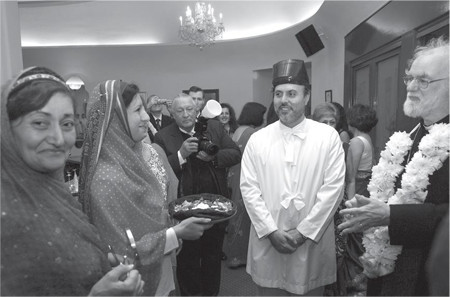
Mahnaz Ostad and Mandana Moavenat accord an Iranian welcome to the Archbishop
A short film, Zoroastrian footprints on the sands of time, premiered at the Ninth World Zoroastrian Congress in Dubai 2009 acquainted the Archbishop with the community’s contribution. Dr Rashna Writer, historian and lecturer in Zoroastrian studies at SOAS, gave an account of "Who are the Zoroastrians?” and concluded with the community’s contributions to UK life, with the first recorded arrival of a Zoroastrian, Rustom Maneck Sett in 1723. ZTFE past presi- dent and current vice president Paurushasp Jila gave a Power Point pre- sentation on the history of ZTFE, how the organization was formally established in 1861 with a Memorandum and Ar- ticles of Association, making it the old- est religious organization in UK of South Asian origin, and how it came to acquire its present abode in 2000.
Before the Archbishop was escorted to the Setayash-Gah he was informed of the community’s religious and interfaith activities. Counsel emeritus Noshir Avari mentioned that during all the 35 jashans (thanksgiving festivals) observed in the UK, the Zoroastrian priests pray for "the monarch, for it is under her rule, in her land that we must live.” Nazreen Avari, religious teacher of the Zoroastrian Edu- cation Fun Club, spoke on how Zoroas- trian values were being inculcated in the very young with the aim of advancing knowledge of Zoroastrian faith and culture.
Jehangir Sarosh, an eminent inter- faith representative and president emeri- tus of Religions for Peace Europe, re-
ferred to the Zoroastrian community’s active involvement in furthering inter- faith dialog in UK and Europe. Liberal politician and first Asian councilor Zerbanoo Gifford and her son Mark of- fered insights on Asha Centre in Gloucestershire built on Zoroastrian prin- ciples to serve as a place of "beauty and inspiration for all faiths and people.”
Prayer caps atop their heads, foot- wear removed, the guests were privy to the boi ceremony performed in the Setayash-Gah. As Ervad Rustom Bhed- war went through the regular paces,Deboo explained the significance of each reverential gesture. The impor- tance of the sacred fire, three grades of fire temples, sudreh-kusti, and other religious symbolisms were also enu- merated.
The second session commenced with the recitation of the Atash Nyaish by Ervads Rustom Bhedwar, Jal Karkaria, Marzban Dastoor, Zal Sethna, Zubin R. Bhedwar and Zubin Writer. Next fol- lowed a brief presentation on the obser- vance of Mehregan by Moavenat who wished everybody a Happy Mehregan in English and Persian and acknowl- edged that the regular celebration of this festival in the UK is thanks to the generosity of Goli and Late Mehraban Farhangi. She explained that the festi- val derives its name from the Persian word mehr meaning friendship and promise. In ancient Iran, Jashn-e Mehregan is an autumnal equinox festi- val and regarded as the second most important festival after Norooz or the spring equinox. The children, aged four to 14, of the Zoroastrian Education Fun Club then performed Sheer-é Shireen —The Sweetened Milk, a play scripted by Dr Ramiyar Ka-ranjia and Mithoo Jesia of the Mancherji Joshi Trust, Bombay. The perfor- mance enjoyed by the Archbishop was coor- dinated by the parents of the children of the Fun Club including Rozy Contractor Anahita F. Daruwala and Anahita Z. Daruwalla. Former president Dorab Mistry, master of ceremo- nies for the day, narrated the journey of the ZTFE and the acquisition of the property in Harrow thanks to the magnanimity of the Zartoshty brothers.
At the evening session the Archbishop observed, "Some religious communities seem to be destined by their history to be interpreters of different worlds. Very often these are communities that have been through deep trauma, that have been uprooted, displaced, that have a history of suffering and yet somehow through all that have been given the great gift of spreading reconciliation because they have had to inhabit so many different worlds and speak so many different lan- guages. They have a role in bringing strangers together; and this is one such community.” His tribute (see "Archbishop’s address,” pg 18) con- cluded with "So let me say thank you not only for (your) hospitality but for inspi- ration. Thank you for (letting me) wit- ness that fiery integrity which many cen- turies, many millennia of your history shows us. Thank you for that contribu- tion to the world of religious dialog which you represent and which you have inhab- ited in so many different places and in so many different languages, and in all of them shown the same honesty and wel- come. Thank you for the gifts you have given all of us, the gifts God has given through you; thank you once again for making me so much at home in this unforgettable environment and this un- forgettable community.”
On behalf of the Zoroastrian priests a woolen shawl was draped over the Archbishop’s shoulders and a silver ZTFE medal presented to him. This was followed by other presentations: the Gatha CD by trustee Bhedwar; a Zoroas- trian carpet from Iran on behalf of the Iranian Zoroastrian community; a copy of A Zoroastrian Tapestry: Art Religion and Culture by Deboo; a copy of Piloo Nana- vutty’s The Gathas of Zarathushtra: Hymns in Praise of Wisdom by Bilimoria. ZTFE silver medals were also pre- sented to Broadbent, and Wilkinson who was the principal liaison be- tween the ZTFE and Lambeth Palace over the last 15 months.
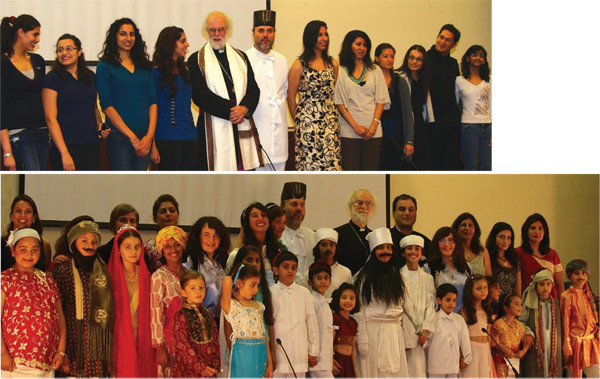
Dr Williams and Malcolm Deboo with young members of ZTFE (top) and participants and coordinators of Sheer- é Shireen (bottom)
The Zoroastrian volunteers of the ZTFE House Committee felt privileged to serve the dignitaries sagan-nu dhan dal, kolmi-no pâtio and lagan-nu custard prepared by Zoroastrian caterers Armin
and Yazdi Dastoor. The Archbishop got an opportunity to taste the Parsi meal just as he had earlier sampled the various Zoroastrian delicacies served during tea time including home-made yogurt, sev and ravo, dar-ni pori, Ira- nian baklava, naan khataai and bataasaas in the company of past ZTFE trustee Maneck Dalal OBE and eminent banker Zarir Cama.
Amongst the 400 plus audience were invited guests including Dr Sarah Stewart, Zartoshty Brothers lecturer at SOAS; Dr Natubhai Shah, chair, Coun- cil of Dharmic Faiths; Arjanbhai Vekaria, chair, Hindu Forum of Britain; Bharti Patel, secretary general, Hindu Forum of Britain; Sardar Rajinder Singh Bhasin, president, Khalsa Jatha (oldest gurudwara in UK); Jaffer Kapasi, trea- surer of the Dawoodi Bohra Jamat; Gareth Thomas, Labour MP for Harrow West; Navin Shah, Brent and Harrow councilor, Rekha Shah, Harrow coun- cilor; three local ward councilors Chris Noyce, Joyce Nickolay and John Nickolay; Krishna Suresh and Sasikala Suresh, Labour representatives.
In his vote of thanks past president
Rusi Dalal referred to the migration of Zoroastrians to the UK over the last two centuries and the warmth with which they have been received. At the start of the evening speeches, Deboo had commented that Zoroas- trians historically pre- ferred to live under the protection of the Brit- ish Crown during the colonial era as it en- sured freedom of wor- ship and recognized that Great Britain had also assisted the per- secuted Zoroastrian coreligionists in Iran during the 19th and early 20th century. He ended with a plea that this tradition of free- dom of worship for all religions may long continue in the UK.
The Archbishop’s address
(Edited excerpts from the speech delivered by the Archbishop) One of my dearest friends came from a Zoroastrian family — the late, much lamented and much loved Nadir Dinshaw, who although had grown up as a Christian, spoke to me time and again of how important in his life had been the heritage of the Zoroastrian community and Zoroastrian faith. Almost every time we met and that was quite frequently over many years, he would speak about his beloved grandmother and about how most of what he un- derstood about God had come from his grandmother…
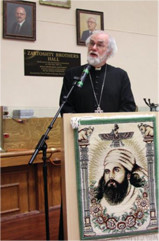
Dr Rowan Williams: "we need a sense of the living truth”
The experience of the Zoroastrians and the experience of the Jewish people comes so close together…
When I first began to study the Bible seri- ously and began look- ing at the footnotes (not always a good idea but sometimes it has to be done) again and again there would be references to "the influence of Iranian
ideas.” And most of those who have read the Jewish scriptures with care and at- tention will realize that, yet again, the experience of uprootedness and exile for the Jewish people, exiles in the Persian culture, meant that they too became car- riers and interpreters of new ideas. When they returned from exile they brought with them a new vision of angelic pro- tectors, of a battle between good and evil forces in the universe, a sense of the impending end of things when we would stand before our maker, even the hope of a savior.
Through that Jewish absorption of Iranian ideas, Christians themselves took on many of the most characteris- tic features of their faith. And when the Muslim faith begins centuries later there is once again a sense of the deep penetration of the imagery and thinking and poetry of that faith by some of these ancient tradi- tions and insights. When we speak of the three Abrahamic religions, Judaism, Christianity and Islam, we might speak of three religions deeply saturated with Ira- nian ideas and religious traditions also.
But that’s not all, because the Zoroas- trian community, displaced into the great Indian subcontinent, that astonishing, fertile, hospitable environment where so many religions have rubbed up against each other for so many centuries or even millennia, that transposition to India meant that the Zoroastrian community became yet again an interpreter, a me- diator between different worlds. It car- ried with it an understanding of the com- plex religious environment of India, the Hindu and Sikh traditions, Jainism and Buddhism, as if this community through its history and its geography was des- tined to be one carrying all these histo- ries, all these legacies, all these under- standings of God, befriending them all, threatening none of them. That is a very great gift of God, a very great gift to the rest of us through this community.
But there is a little more to say and Lord Bilimoria has once again given me the cue to say it: "Industry and integrity.” Integrity is something we all long to grow into in our own lives and is something that we long to see in our society. When there is a bit of a famine of integrity we all feel it — and we have all felt it at times, sadly, in this country in the last few years… Integrity, the word itself, comes from the Latin for "wholeness.” Integrity is the ability to hold your life together, not to let it be fragmented, broken up, with parts of it hidden and parts of it revealed, but rather to be able to stand in the light, in the truth without fear. That’s integrity, but for that to be real we need a sense of the living truth, of a living light to which we are answerable, which pours out strength and benefit upon us; a reality that we’re responsible to and yet a reality that is a caring environment for us, the reality ultimately of God.
We Christians read in our scriptures that "our God is a consuming fire.” We recognize that that image of painful purification fire suggests is one which tells us that integrity, that wholeness, is costly. It’s hard work letting go of our lives and our self protections and that is why the call to integrity is something which will never be simple, yet is al- ways attractive, because we want whole- ness.
So this faith, this religious tradition and this community, for which the con- cept of integrity standing before a puri- fying fire, is so central, is a tradition and a language which has a very great deal to say to all of us in this country and in our world at the moment. Integrity is vital for us, integrity is hard work — but it can be done when we believe that the light, strength and life in whose presence we stand, the God in whose presence we sit, is a God whose will is for our wholeness and our welfare…
◆ ◆ ◆
From the archive