
Events & Personalities
History of salt works
"Salt works or salt pans as they are popularly referred to are in the news for all the wrong reasons,” said K. R. Cama Oriental Institute (KRCOI) president Muncherji Cama on May 26, 2010 while introducing researcher Dr Kekobad Doongriwalla who spoke on "The History of Salt Works in Bombay and Salsette.”
Cama was referring to the builder-politician-underworld lobby that has been trying to use the salt pans for development and thereby personal enrichment. "There is very little published material” on the history of salt works, said Cama and one owed "a deep debt of gratitude to Doongriwalla” who had earned his doctorate in philosophy from the University of Bombay in November 2006 on the history of the salt pans in Bombay and Salsette from 1750 to 1950.
Recounting the historic importance of salt, Doongriwalla noted that Mahatma Gandhi started his civil disobedience by insisting that the British not tax the white crystalline compound. Gandhi organized the Dandi March to harvest salt from the sea without paying tax. When the British opposed his endeavors, Gandhi retaliated by demanding poorna swaraj (complete freedom) for India. Salt is also referred to in Homer’s Iliad. The Egyptians used it for mummification and preservation of corpses. There are four types of salt, said the scholar: rock, sea, estuary and earth salt.
As with any other crop, land belongs to the tiller, said Doongriwalla. He then referred to the various developments and legislation pertaining to the salt pans which at times declared the right of ownership vested with the tillers and other times said it was a lease from the government. This was now being questioned by the government of India and Maharashtra.
The British accepted the tillers as owners of the salt pans in Bombay around the 17th century. Again in 1858 the government noted "all who held land were deemed to be owners and proprietors.” And in 1935 once again it was reiterated that the land belonged to the owners of the pans.
Doongriwalla’s family has been in the salt manufacturing business for over 200 years. To this day he remains a hands-on owner, working the land himself. In 1958 the government recalled all licenses and issued new ones valid for 10 years and then five years. From 1963 the licences are issued annually.
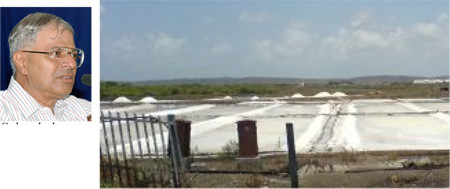
Salt scholar Ke-kobad Doongri-walla; a view of salt pans
Pilloo Bomanji whose family has leasehold salt pans was made a compromise offer by the government whereby one-third of the salt pans would go to MHADA (Maharashtra Housing and Area Development Authority), one-third to the government and one-third would be hers. Doongriwalla said the Bomanji family turned down the proposal.
To assert one’s claim on ownership of salt pans one must have the proper documents, said the researcher. To make it "a paying proposition,” owners should be working on the salt pans themselves. He noted that he and Alark Desai, whose family also has been in the salt manufacturing business, have assisted many people in establishing their ownership over salt works. "Desai and I helped all the people who were unaware of their rights.”
KRCOI honorary secretary Dr Nawaz Mody while thanking the speaker for his discourse requested those present to visit the Institute’s website: www.krcama orientalinstitute.org developed by Kersi Treasurywalla. "Go on the site and give us your reaction,” she said.
◆ ◆ ◆
From the archive