
Books
Pictorial projection
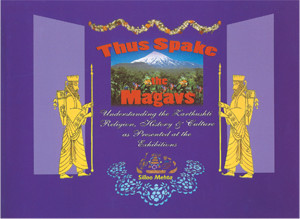
Thus Spake the Magavs by Silloo Mehta. Published in 2009 by The Mazdayasnie Connection, 79 Heritage, Irvine, California, USA. Pp: 116. Price: Rs 400.
Thus Spake the Magavs by Silloo Mehta is a book which, in a brief and innovative manner, explains the Zarthoshti religion, history and culture with the aid of pictures, animations, graphs and tables. The creator of the book has been successful to a great extent.
The genesis of the book lies in an exhibition put up at various locations in Bombay by Mehta herself over the past several years. Hence the book has a difficult purpose to serve — that of transmuting purely visual depiction to written word — with the aid of two dimensional visuals.
The book covers a wide range of religious subjects like creation, spiritual world, life of prophet Zarathushtra, rituals, sudreh-kusti and scriptures. It also covers history, festivals, culture and has a biography of Ustad Saheb Behramshah Shroff. There is a pictorial story, the "Dream,” allegorically bringing out the need for the finer aspects of religion and religious implements.
To the credit of the author and designer, the use of these visuals is admirably done. They are not only colorful and captivating, they also cover a wide gamut from charts and graphics to hand drawings and beautiful photographs. Simplification by graphics and elucidation by tables is very well done. Difficult concepts like time, atash and after-life are made easily understandable.
The brief history given in the book covers the entire range of the Mazdayasni Zarthoshti religion — starting from the pre-historic times in ancient Iran, then covering the historic dynasties and culminating with the downfall of the Sasanian empire. Thereafter the history of coming to India is briefly described as also the establishment of the Atash Behram in Sanjan, now revered as the Iranshah in Udvada.
Many chapters in this book, content and language wise, are based on the precepts of Ilm-e-Khshnoom. In fact, the last 10 pages of the book are devoted to an exposition of Ilm-e-Khshnoom. Readers not familiar with it may find these a bit difficult to understand although the author has given meanings of many difficult and technical words. However these meanings occur just at their first occurrence. I feel the author would have served a greater purpose if most of the technical and difficult words occurring in the text had been carried as a glossary at the end.
The layout and the design of the book could have made it a captivating religious book for children with its attractive visuals. However, its content just falls short of being within the grasp and understanding of children.
The section on Iranian culture and festivals — with beautiful pictures — is highly appealing, informative and novel. It’s more of a pictorial essay with a proper blending of pictures and text.
Ervad (Dr) Ramiyar Karanjia
◆ ◆ ◆
From the archive