
Zoroastrians Abroad
Move an asteroid
"We received submissions from all over the world and thank all the participants for developing creative Near Earth Object (NEO) mitigation strategies. The first and second place winners demonstrated an ability to think creatively about the problem and to explain it to the judges,” commen-ted A. C. Charania, administrator of the Move An Asteroid 2008 Competition. The winner of the first prize, Mary D’Souza’s plan to stop a 330 m diameter asteroid from hitting Earth in 2036 was first publicized in the autumn-winter ’09 edition of Rathaeshtar, the newsletter of the Zoroastrian Association of Victoria. Daughter of Siloo D’Souza, 26-year-old Mary is a PhD student at the department of mechanical engineering at the University of Queensland.
The Space Generation Advisory Council (SGAC), the world’s largest group representing youth perspectives on space exploration to the United Nations and national space programs, announced the winners of the competition from Vienna, Austria on June 30, 2008. The day coincided with the 100th anniversary of the last major impact of the Earth by an asteroid or comet, known as the Tunguska explosion. As part of her paper entitled "A Body Solar Sail Concept for the Deflection of 99942 Apophis,” D’Souza’s concept elaborated on wrapping an asteroid in a reflective film (referred to as a "body” solar sail). Such a coating could increase the asteroid’s reflectivity, enabling deflection by solar radiation pressure. In simpler terms, the aim of the competition was "to
encourage public awareness of NEO,” Mary explained to Parsiana.
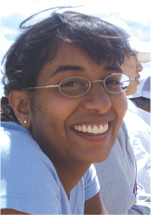
Mary D’Souza: space strategy
Directing us to an interesting website, www.spacegeneration.org/node/2024, we learnt that the competition called for individuals or teams under 33 years of age to write and submit a three-10 page original technical paper on their innovative concept to move an asteroid or comet that is at least 140 meters in diameter. The winners of the competition got to make a trip to present their papers at the Space Generation Congress (SGC) and International Astronautical Congress (IAC) which took place in Glasgow, Scotland from late September until early October 2008.
"It is great to see such an interest in this topic from young people all over the world. Hopefully with competitions like this, SGAC can further increase the involvement of youth in this important field of current space research,” said SGAC co-chairperson Alex Karl. "The SGAC is a non-government organization with observer status within UN-COPUOS (United Nations Committee on the Peaceful Uses of Outer Space) dedicated to representing the voice of today’s youth on tomorrow’s space issues. The SGAC was formed following the 1999 UNISPACE III conference in which five youth recommendations were included in the Vienna Declaration on Space and Human Development,” states the website.
Interested in space technology since the age of 13, Mary conveyed to Parsiana, "I read Apollo 13 and was inspired by the brilliance and courage of the engineers who were able to save the crew (and their nation’s pride) even though they had limited resources and time.”
◆ ◆ ◆
From the archive