
Zoroastrians Abroad
Acclaimed author
Author Thrity Umrigar was among the winners of the Cleveland Arts Prize conferred on June 25 this year at the Hanna Theatre in PlayhouseSquare. Recognizing individuals for significant contributions in design, music and dance, visual arts and literature, the Cleveland Arts Prize "identifies, selects and publicly honors those creative artists whose original work has made Northeast Ohio a more exciting place to live, and whose accomplishments have set a standard of excellence to which other artists can aspire,” according to its website.
"In many ways, I feel like I’m just beginning my career,” Umrigar said about receiving the Cleveland Arts Prize Mid Career Award that carries a cash reward of $ 2,500. Her advice to her students and novice writers: "Every writer has to discover his and her own voice. And voice is more than just the ‘tone’ of a story — it’s also why you decide to tell this particular story, what intrigues you, what you want to communicate with your audience, and the rationale for the work. You have to know what you’re passionate about before you can write.”
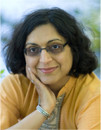
Thrity Umrigar: "my writing informs my teaching” Photo: Robert Muller
Umrigar’s latest novel, The Weight of Heaven, published in April is about an American couple who move to India as a way of dealing with the loss of their young child. "The novel deals with issues of how different people respond differently to grief and what happens when cultures with great economic disparity come into contact with each other,” she explained. It joins her other books, including If Today Be Sweet, The Space Between Us, First Darling of the Morning, and her first novel, Bombay Time, launched in 2001. For her vivid portrayal of the diverse relationships, cultures and lifestyles related to India, Umrigar has received critical acclaim. "I am simply a writer who is interested in examining issues of power and community,” she observes. "Whether it’s power arising from gender or class or caste or race differences, who has it and who doesn’t and how each responds, it’s just something that endlessly fascinates me.”
"There is something liberating about not being narrow-minded but open to the joys of other cultures,” wrote Umrigar in response to Parsiana’s queries. "What I’ve always loved about the Parsi community is its tolerance and respect for other religions...
"The legend of how the Parsis arrived in India — the one about the glass of milk and the sugar — is one that has been enormously influential in my own life. It certainly helped me as a young grad student in America because it gave me a blueprint as to how to behave in a new country. It made me realize that it is all our responsibility to ‘sweeten’ the lives of those around us, that this is the true meaning of community.”
Believing that writing and teaching are basically part of the same continuum — "I feel like my writing informs my teaching and the other way around” — she joined the ranks of academia in 2002. As associate professor of English at Case Western Reserve University she has taught courses in fiction and non-fiction, journalism, creative writing, and African-American and 20th century literature.
As a young child in Bombay, Umrigar first explored her urge to write by crafting ‘anonymous’ poems to her parents whenever she felt wronged by them, then secretly pinning them to their closet door. "I learned early on that writing was a good way to get rid of pent-up feelings,” she recalls. She continued to write poems, short stories and essays throughout her teen years. She didn’t really consider herself a writer, though, until that night in her living room when a poem called The Old Man just flowed through her hands, as if someone were dictating it to the 14-year-old student of Convent of Jesus and Mary. Today, in retrospection, she considers the piece sappy. Writing on issues concerning India, she developed an empathy for the poor and the downtrodden.
After graduating in commerce from Bombay’s H. R. College, Umrigar decided to move to the US. Her reasons to leave India were to discover her strengths and potentials, gain a clearer perspective, become independent. After earning her MA in journalism from The Ohio State University, Umrigar worked for 17 years as a reporter with newspapers like The Akron Beacon Journal. She earned her PhD in English at Kent State University and a few years later won the Nieman Fellowship to Harvard University where she wrote her first novel, Bombay Time. Over the years she has received numerous fellowships and awards, including a Kiriyama Prize Notable Book citation, being selected as a finalist for the PEN/Beyond Margins Award, and a citation for The Washington Post’s Best Fiction of 2006.
As for the next phase of her career, Umrigar hopes to continue writing and teaching. "I’m someone who doesn’t plan my life a lot. I’m a great believer in ‘life is what happens to you while you’re busy making other plans.’”
◆ ◆ ◆
From the archive