
Events & Personalities
BPA honors Adenwalla
On the 152nd birth anniversary of Sir Hormusji Cowasjee Dinshaw (Adenwalla), which fell on April 4, 2009, Vispi S. Dastur, president of The Bombay Parsee Association (BPA) and others garlanded the eminent businessman’s statue at Veer Nariman Road next to the Bhikha Behram Well. Dastur, who sent the write-up to Parsiana, spoke of Sir Hormusji’s achievements and highlighted events from his life. Hormusji’s great grandson, Saroosh Cowasjee Dinshaw, detailed how the family had established the business and had even helped Mahatma Gandhi. Community historian Marzban Giara and Adi Mehta, president of Federation of Zoroastrian Associations for Welfare and Culture also spoke.
Dastur writes that Hormusji, who was born in Bombay in 1857, the year of India’s First War of Independence, was the eldest son of Seth Cowasjee Dinshaw and Jerbai. The family had humble beginnings, with Cowasjee earning three rupees a month as a printer’s help. Its rise from poverty to affluence should serve as an inspiration for the youth of today, Dastur feels. Cowasjee went to Aden to work and later started his own business there.
After completing his matriculation in Bombay with Latin as his second language, Hormusji went to King’s College, London. He had married his cousin Manekbai before sailing for England. After graduation Hormusji worked in London and Paris where he mastered the French language. Returning to Aden at the age of 22, he joined his father’s firm as an ordinary employee, becoming a partner 14 years later. Cowasjee Dinshaw and Brothers was well known as a firm of merchants, importers and exporters, bankers, shipping and mill agents and ship owners having branches in most important cities of the world. Agents for several British, Italian, Dutch and Norwegian shipping companies, the firm owned six ships and it was on one of these that Mahatma Gandhi escaped from South Africa.
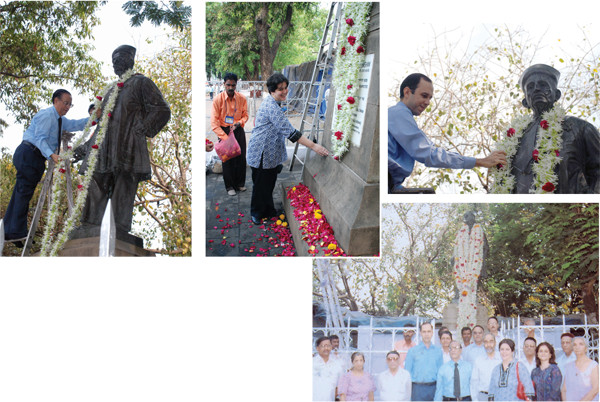
Clockwise from top left: Vispy Dastur, Sir Hormusji’s great grand children Freny Jehangir and Saroosh Dinshaw paying floral tribute. Well-wishers at function
Photo: C.C. Gandevia
Hormusji received many honors, titles, medals and sanads from the British, Portuguese, Spanish, Austrian and Abyssinian governments. In 1922 he was knighted by the British. Founder patron of the BPA, founder president of the Iran League, president of the Bombay Jashan Committee and a regular supporter of the Athornan Mandal and Dadar Athornan Boarding Madressa, Hormusji had the unique distinction of being trustee of three Parsi punchayets, those of Bombay, Aden and Lonavla, and president of the last two.
He was a great friend of Iran, a country he went to at the age of 70, visiting several historical and religious places there. He supported a number of orphanages in Yazd, Kerman, etc, and came to be known as "the Hatem-e-Tai of Parsees” and "the maker of modern Aden.” When he died in Bombay at the age of 82 a grateful public erected his statue at Veer Nariman Road not just to honor him but also to serve as a beacon to succeeding generations of Indians to "Go forth thou and do likewise.” The statue was sculpted by Sheru Dinshaw Daruvala (Sidhwa), it is reported.
Additional floral tributes were offered on behalf of the Iran League, Cowasjee Dinshaw Trust, Navsari Parsee Association, Municipal Corporation of Greater Bombay and Bombay Parsi Punchayet trustee Yazdi Desai. Amongst those gathered there that morning were Freny Adi Jehangir, Aloo Shroff, Tehmina Peer, Rusi Bhumgara, Soli Mistry, Gev Bhumgara and Coover Gundevia, the write-up mentions.
◆ ◆ ◆
From the archive