
Zoroastrians Abroad
Jamshedi Navroze 2009
"The real Nou Rouz — the New Day as the term denotes — is when the equinox coincides with the sunrise. That is, the New Year and the New Day start at the same time. Like it happened and was celebrated in 487 BCE at Takht E Jamshid,” notes Fariborz Rahnamoon, editor of Iran Zamin, in an e-mail to Parsiana.
Noting that on March 20, 2009 this event will unfold in North America — at Chattanooga, Tennessee and Fort Wayne, Indiana when the equinox time (7.44 a.m. ) will coincide with the sunrise (7.44 a.m.) local time — Rahnamoon urges all Zoroastrians, "Let’s travel to these locations and witness this natural phenomenon. Let’s get together and celebrate this unique event on a large scale and show the world our ancestors’ knowledge of and contribution to science over 2,000 years before Galileo.”
According to the world clock, the spring equinox this year is scheduled at 11.44 a.m. (Universal Coordinated Time/GMT) which will mean 5.14 p.m. according to Indian Standard Time on March 20, 2009.
"Nou Rouz, the Persian New Year is the only scientific New Year celebrated in the world today. It is celebrated exactly at the moment in time when the vernal equinox takes place. Nou Rouz has crossed all religious and national boundaries and is celebrated by all the people that once formed the great Persian Empire. Prophets and leaders of religions that originated in Iran like the Baha’i religion and the Ismaili Muslims have incorporated Nou Rouz into their religion. The Bible shares the wisdom preserved through the Nou Rouz table,” writes Rahnamoon on http://www.ancientiran.com
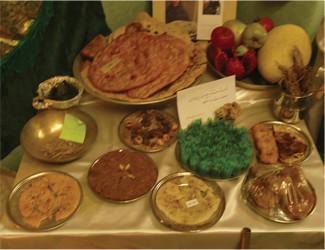
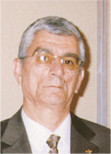
A haft-sheen table and (top) Fariborz Rahnamoon
"Nou Rouz is made up of two Persian words: nou meaning new and rouz meaning day. The question that should arise is: why is the New Year called New Day? However, nobody raises that question because the Iranian people have lost their science and history and Nou Rouz has gradually taken the form of a proper noun. After the Arabs invaded Iran they imposed Islam upon the Persians, burnt all their books and replaced libraries with mosques. Thus ancient Persian science was lost to the world. Centuries later, Galileo revealed just a tip of that ancient knowledge and was forced to recant on pain of death.
"According to the ancient Avesta writings the Persians led by king Jamshid celebrated the first New Year (Sal e Nou) on the first day of spring after the great Ice Age some 10,000 years ago. Then in 1725 BCE that is 3,733 years ago Zarathushtra, the sage of ancient Iran, coined the word Nou Rouz to record the phenomenon that occurred in Sistan (62 degrees longitude) where he had a planetarium. Zarathushtra had calculated that the vernal equinox of 1725 BCE would coincide with the sun rising at Sistan. Thereby the New Year and the New Day would start together at the same moment at Sistan, and he called that year Nou Rouz.
"Thereafter the Persians celebrated this phenomenon whenever it occurred in their kingdom. According to recorded history on the spring equinox of 487 BCE Nou Rouz was celebrated when the first rays of the rising sun coinciding with the equinox, lighted the square stone set in the central hall of the Apadana palace at Takht E Jamshid (Persepolis). This celebration was preplanned, the Persian scholars and astronomers had pre calculated this event and Darius the Great had designed the Apadana palace for this event. The bas-relief at Persepolis is a record of that celebration,” notes Rahnamoon.
◆ ◆ ◆
From the archive