
Events & Personalities
Great track record
When Viraf Dalal stepped off the local train at Chhatrapati Shivaji Terminus (formerly Victoria Terminus) on the last day of June 2008, the curtains seemed to come down on a century old tradition in the Indian Railways. Dalal was the last Parsi motorman, a career which he cut short by three years, opting for voluntary retirement at the age of 57 because of the enormous pressures the work involved, he informed Parsiana over the telephone.
Dalal, who was a train driver for 34 years, has an enviable accident-free record in a city which experiences several railway accidents a day, reported the Afternoon Despatch and Courier (ADC) of July 1, 2008. However, he was not spared public ire on March 12, 1992 when "a violent mob stopped trains over some petty issue. They bashed me up, hurled abuses at me. Even then, in that state of mind, I rode the train (from Mumbra) till Kalyan and then I was relieved at the station. This is the only odd incident in my professional career,” Dalal informed ADC.
Coming to Bombay from Nagpur in 1972 after passing the Senior Cambridge examination, Dalal dreamt of becoming "a purser and was selected by Air India. However, being the only son of a widow, my mother was reluctant to let me take up that job. Later, in May 1974 I joined the Railways as an assistant goods driver and passed out in 1986 as goods driver. Then I became a passenger train driver and passed out as motorman in 1990,” Dalal told ADC.
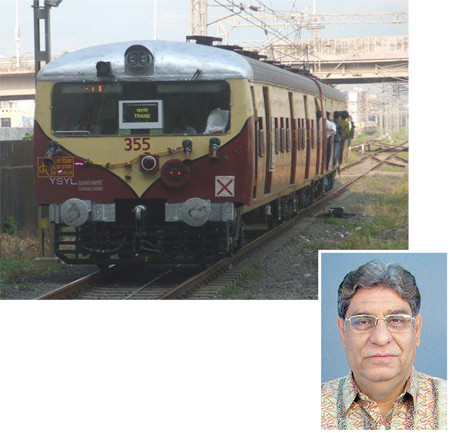
Viraf Dalal (right) and a local train which he drove
During the remaining years of his tenure he was a motorman on local trains on the Central Railway, a very taxing assignment as thousands of lives depend on the driver. "It’s all about watching the signals and the track constantly with not even the slightest room for error. Misread one signal and it’s disaster,” Dalal was quoted as saying in The Times of India (TOI) of July 5, 2008. "The toughest times are during heavy rains or the dense fog of winter mornings when visibility is really low,” he explained.
The British preferred Parsis as they were considered to be disciplined and hardworking, TOI states, so not only local trains but most long distance trains in the country were driven by either Parsi or Anglo-Indian motormen. "My great-grandfather was a driver with the Great Indian Peninsular railway and retired in 1948,” Dalal’s wife Dilnavaz informed TOI. "Though his own surname was Dorabjee we came to be known as Driver after his profession,” she added, explaining the origin of the surnames Driver and Guard.
Despite his tough work regimen, Dalal considered himself luckier than his century-old predecessors who "actually had to shovel coal and sweat it out in a steam engine.” Handling an electric train was relatively easy and, in fact, when the first electric train plied in India in 1928 it had at its helm a Parsi named Framjee, Dalal revealed. Describing himself as the "last bawa motorman,” Dalal recalled that one C. J. Eduljee retired a month before he did. When queried by Parsiana about why Parsis do not take up this career, Dalal explained: "Our boys prefer white collar jobs. Being a train driver is a tough job, very tough. It is very stressful, both mentally and physically. Since the Railways come under the essential services category, there is no leave, no days off.” Dalal mentioned that another Parsi who had joined after he did, Rohinton Kotwal, opted to become an instructor.
When ADC asked about family support, Dalal gave "full credit to my wife, Dilnavaz, who supported me wholeheartedly throughout my career. A motorman doesn’t have a weekly off and so it is sometimes very difficult to enjoy social and family life. Even though we have casual and paid leave, we work almost 365 days a year. However, my wife and daughter have always been my backbone during my tenure.” When asked by Parsiana about his post-retirement plans, Dalal confessed he is in no hurry to take up another assignment, though he eventually intends to do something. Right now, he is busy making up for lost time, enjoying being with his family.
◆ ◆ ◆
From the archive