
Cover Story
Ripon’s realms
Faced with a declining membership and rising costs the Ripon Club debates hiving off half its premises
The dishes may remain the same size, but the premises may shrink. The managing committee of the Ripon Club is proposing handing over the fourth floor of its two-floored Club premises to the reputed law firm of Wadia Ghandy and Company.
An item for voting on the agenda for the 121st annual general meeting (AGM) of the Club states: "Subject to the consent and approval of the members of the Ripon Club and subject to the approval of N. M. Wadia Charities, being the landlords of N. M. Wadia Buildings, situate at 123, M. G. Road, Fort, Bombay 400001; the offer set out in the Letter of Offer… received by the Ripon Club from M/s Wadia Ghandy and Company, Advocates and Solicitors, for acquiring monthly tenancy rights in respect of a part of the premises of the Ripon Club comprising of covered area admeasuring approximately 2,340.32 sq ft (built up area) and adjoining terrace admeasuring approximately 3,145.66 sq ft be and is hereby accepted… at or for the aggregate consideration of Rs 6,75,00,000 based on the valuation report dated of October 2007 obtained by the Ripon Club from Knight Frank (India) Private Limited… 50 percent thereof shall be paid by M/s Wadia Ghandy and Company directly to the landlords, N. M. Wadia Charities and the balance 50 percent i.e. Rs 3,37,50,000 shall be received by the Ripon Club as its share.”
Citing "financial difficulties for the past several years arising as a result of inflation, high maintenance costs, higher taxes, increased water charges, salaries and wages of the staff, losses in the commissariat section… substantial heavy repairs... to be carried out” and demands for increased rent, the managing committee "has put up a detailed proposal” foregoing one of the two floors occupied by it. The Club "incurred a deficit of Rs 75,823… against the surplus of Rs 75,152 during the previous year,” notes the annual report. The Club’s auditors are F. K. Mody and Company.
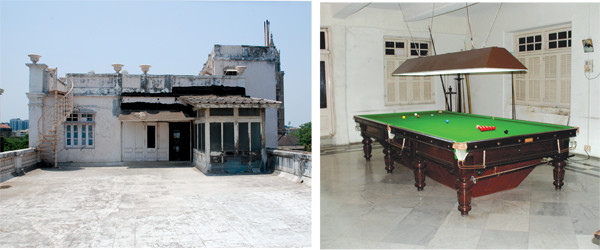
Terrace and adjoining premises on fourth floor. Billiard table on the same floor
The third floor of the Club comprises the dining room, hall cum reading room and the library and a television room which formerly was the bar area of the Club. When the Maharashtra government raised the license fee for serving alcohol, the Club didn’t renew the permit as the amount due was more than the total annual liquor revenues of the Club!
The fourth floor which is being offered consists of a billiard table, card tables (which are seldom utilized) and a terrace which can be used for functions but is rarely booked.
The Bombay Rent Act provisions allegedly do not extend to social clubs hence the landlord has the option to raise the rent if it so desires or ask the tenant to vacate, state the committee members.
"The members may please note that at present the Club is paying a total sum of Rs 4,412 as rent which is inclusive of all municipal taxes and service tax in respect of the third and fourth floor… An additional amount of Rs 2,500 per month is charged by the landlords as service charges in addition to the rent. Further, the landlords have time and again indicated that the Club should consider an increase in the rent since the prevailing market rent in this prime location was phenomenally higher than what is being paid by the Club... Therefore, in case if any such demand to increase the rent is received, the Club will not be able to bear and pay such higher rent and certainly not the prevailing market rent in which event disputes with the landlord may arise. At present the Club is enjoying a good rapport with the landlords and it is in the best interest of the members of the Club to continue to have a good relationship with the landlords at all times.”
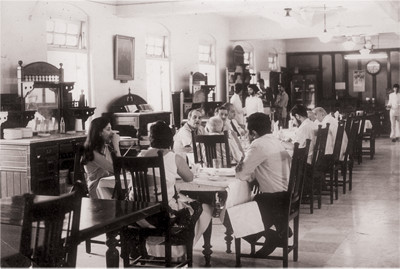
Dining room on third floor Photo : Ayesha Soni
The Club report notes that "two trustees out of four trustees, viz. Rusi N. Sethna and Mehli R. Cama have consistently opposed this proposal, whereas the remaining two trustees, Sorab D. Davar and Rohinton B. Dhalla, have consistently supported the managing committee on this proposal.”
Asked by Parsiana why he opposed the proposal, Sethna, also the president of the Club, commented, "I don’t believe in selling the family silver for short-term gains.” As regards the Rent Act, Sethna, a leading solicitor, believes a Supreme Court judgment in a case pertaining to a club was "sketchy.” He said he consulted noted Rent Act lawyer Dadi Patel who felt the Club may have a case.”
But Sethna doubts the landlords, a Parsi founded cosmopolitan trust, would attempt to evict a Parsi Club. "Parsi public opinion will be against them,” he says.
Another option would be to amend the Club’s constitution to add education as an objective. The Club could hold lectures, workshops, etc but the managing committee "doesn’t want to do that,” rues Sethna. He felt they had "a single-minded obsession ké èmaj karvu joié.”
With Davar as the chairman, Mehernoz C. Dangore as the honorary secretary and Phiroze E. Lashkari as honorary treasurer, the others on the managing committee include Jamshed B. Lentin, Dhalla, Rohinton K. Dhunjibhoy, Dr Soli D. Adrianwala, Adil H. Screwvalla and Bapoo M. Malcolm. Sir Dinshaw Manockjee Petit, fifth baronet, is the vice president of the Club.
In a section titled "Future,” Davar as the managing committee chairman states, "with more younger members joining the Club, the managing committee feels that our Club will maintain a steady growth and hopes that our members will patronize the Club and use its facilities to the maximum.”
But the facts belie that expectation. The report notes that 17 members joined the Club between April 2007 and March 2008 while seven resigned and 13 died, an overall decline of three. The previous year the drop was by 17 (eight new, 10 resigned and 15 expired). The Club has around 600 members.
And therein lies the Club’s nemesis. While nearly all the other clubs in Bombay are thriving and some have mile long waiting lists with entrance fees ranging from 10 to 20 lakh rupees, the Ripon Club which is open only to Parsi/Irani Zoroastrians at a nominal charge of Rs 16,000 for ordinary membership and Rs 33,000 for life, has few takers. The community members continue to shrink and many Parsis/Iranis have shifted either their residences or offices to the suburbs.
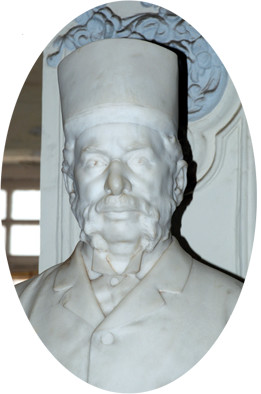
Bust of Sir Pherozeshah Mehta on the Club premises
As regards admitting a percentage of non-Parsi members at a higher fee, Sethna said, "I’ve nothing against it if you’re going to be selective.” He noted his co-trustee Cama favored the admission of non-Parsis. The Parsi Gymkhana at Marine Drive along with the Hindu, Islam and Catholic Gymkhanas opened their doors to all due to pressure from the municipality whose lands they lease.
For the Ripon Club the compulsion to open their doors is survival. Most mornings and evenings the Club premises are empty, the monthly catering billing is less than a lakh of rupees.
The Ripon Club was founded in 1884 by Sir Pherozeshah M. Mehta "to celebrate the advent just about then of local self government amongst us, during the Governor-Generalship of the Earl of Ripon,” wrote Cursetjee M. Cursetjee, one of the Club’s earliest members.
On April 21 the Club members will have to decide whether that legacy and celebration is to continue or diminish.
"The N. M. Wadia trustees were… building a big house on the Esplanade Road facing the University Gardens and the Rajabai Clock Tower. They agreed to rent to the Club the two upper floors, fitting up the same according to the Club’s requirements and so in due time the Club moved into its present quarters, admirably and conveniently situated and there it stands this day.
So arose in Bombay the first Parsi Club, as something new and novel, and distinct from all that had gone before and on the well-established modern western lines, and Sir Pherozeshah Mehta fitly named it after the Marquess of Ripon, to whom India owes the introduction and establishment of the great liberal measure of local self government — that is to say — government by the people, for the people in the shape of city and district municipalities. As the Ripon came into being, the earlier impalpable clublets "hid their diminished heads…”
In due course the next thing or matter that drew my attention was that the Ripon being exclusively for Parsis, we were apt to become unsatisfactorily communal, so that some move to help to counteract this isolation as it were, was both necessary and desirable. It was clear that in effect membership of the Ripon was confined to Parsis and may be properly so, but there was no rule nor restriction against the introduction of some desirable foreign element in the way of members inviting as guests non-Parsis. So after sounding Pherozeshah and others who thought it a good move, I boldly took the plunge. I was expecting some opposition of course, though nothing to what did take place. To me it was quite clear that a fair intermingling amongst us with members of the other communities of good standing and respectability — of Europeans especially — was bound to improve the tone and amenity of our Club life and be beneficial to the Club generally I thus took the eventful initiative by one evening, inviting as my guests at our common dinner Thomas Bennett (then of The Times of India and later Sir Thomas M. P.) and Skipsey (of Macfarlane and Skipsey, Solicitors). Pherozeshah, D. E. Wacha, Sorabji Patel and many others, I had sounded, gave them a cordial and courteous welcome. I noticed a few eyes cocked up crosswise here and there, with whispering and murmuring. The dinner however, passed off agreeably and pleasantly as was to be expected, with such excellent and desirable company as were my guests, the first non-Parsis at the Parsi Ripon Club table. Facta est acta. No time was lost, the whispers rose to a growl and ended in a protest to the committee against what was considered my unconstitutional action, lodged by the self-constituted constitutional lawyers, Rustom Patel and Hormusji Pleader of the Small Causes Court, arcades ambo. For reasons which need not be entered into here, I had not been a persona grata with these worthies. The managing committee did not consider me in the wrong.
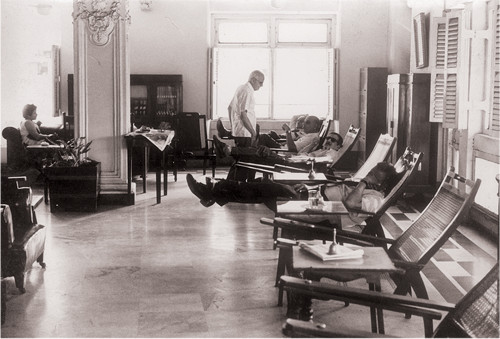
Members relaxing on reclining chairs
Photo : Ayesha Soni
The next step against me, was a requisition for a special general meeting to consider and decide the matter. As indeed the ancient custom prevailed that where there are two or 20 Parsis met together there was bound to be divergence of opinion, a split and contention. Our Ripon Club was no exception. However good the ointment there is sure to be a fly in it. Lo! and behold me arraigned before a club tribunal of the special general meeting, which duly convened, came off in due course. The matter or point for disposal had excited considerable stir and interest. The members mustered strong and in force. It was indeed a field day for the Ripon. It escapes me who was in the chair.
Sorabji Patel, if I remember right, took the chair. A proposition was moved to prevent such an infringement as was assumed of the Club constitution, it be ruled that no non-Parsi be invited as a guest. A large majority voted against this resolution. I carried the day, and it came to pass that the members were able to invite from time to time men like Badruddin Tyabji, Amiruddin Tyabji, C. H. Setalvad, Signor Pedroza, Dr Kirtikar, Bal Mugesh Wagle, N. G. Chandawarkar, W. A. Chambers and other such highly desirable non-Parsis ordinarily as guests at our weekly Thursday dinners and this innovation I introduced was found to be all round most agreeable and satisfactory in the best interest of the Club. The moving requisitionists gradually were out of it, and were in no way missed.
One queer result of this movement set in motion by me for more cordial social relations with our sister communities, came about some years later, which deserves some passing notice, just to show how perverse some people can be. A certain number of plutocrat Parsis, never reckoned nor recognized as particularly orthodox, started a new club as a rival to the Ripon, calling it The Asian, skied up in the heights of Green’s. It is a club for Parsis only, though the name given it is a clear misnomer, and its special rule is not to admit any non-Parsi even as a guest in it…
"After we had moved into our present quarters on Esplanade Road (now Mahatma Gandhi Road), I obtained through the kind offices of Sir T. Bennett, a fine engraved portrait of the Marquess of Ripon with his autograph. It is suitably hung up to the right-handed of the main entrance. It is a very excellent likeness and it is most fitting to have it on our Club wall, as a constant reminder of one of our most important Governors General.” (The portrait does not appear to be on display at the Club presently.)
Extracts from an article by Cursetjee Manockjee Cursetjee, the first Indian to be admitted to Oxford University. The article appeared in the Club’s centenary souvenir.
◆ ◆ ◆
From the archive